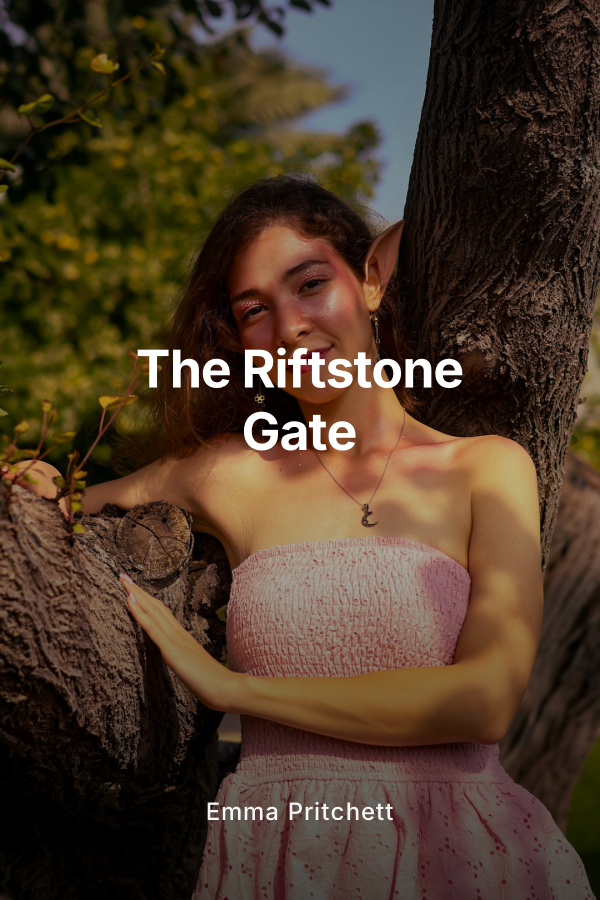
In the crumbling ruins of a forgotten kingdom, a colossal stone circle waits in the dust. Locals call it the Riftstone Gate, a relic from a time of vanished kings and half‑remembered wars. Legends insist it was built to seal something away, something that should never return. To most, the story is little more than a ghost tale. To Elian, a curious young scholar hungry for truth, it is an invitation.
During a research expedition into the dead kingdom, Elian finds the gate and the strange symbols etched across its weathered surface. As he studies the markings, he notices a dark, viscous substance seeping from the base of the stone. It is not tar, not shadow, not anything he can name. The gate pulses once, and something inside the world shifts. From that moment forward, Elian’s days are punctured by flashes of a place he has never seen, jagged landscapes, monstrous silhouettes, and whispers in a language that curls around his thoughts like smoke. The visions feel less like dreams and more like memories he never lived.
Terrified yet compelled, Elian searches for anyone who might understand what the gate has awakened. He finds Kaia, a teenage former guardian of the Riftstone who abandoned her post after a previous breach nearly broke her. Once part of a secret order sworn to protect the gate, she carries guilt like armor and wants nothing more than to forget. Where Elian is driven by wonder and questions, Kaia is driven by regret and the need to stay away from whatever lives beyond the stone.
Their reluctant alliance forms the heart of the story. Both are teenagers, close in age, with a fragile thread of romantic tension that grows slowly and quietly. They clash at first, Elian with his belief that knowledge can save them, Kaia with her hard‑won certainty that some knowledge only destroys. Yet as the gate’s influence spreads and the dark substance seeps further into the ruins, both realize they cannot face what is coming alone. The world around the gate becomes stretched and brittle, as if reality itself has begun to fray. The more Elian remembers through his visions, the more unstable the world grows, hinting that memory is not only fragile but also dangerously powerful.
Through investigations in nearby settlements and remnants of the old guardian archives, Elian and Kaia uncover a truth that overturns everything the legends claimed. The Riftstone was never a prison. It was a door, a deliberate passage between their world and another realm shaped by thought, memory, and fear. Someone on the other side has been working to open it fully, using the leaking substance, distilled memory, to weaken the boundary between realms. The gate feeds on human emotion. Joy, grief, terror, and longing all leave echoes that the gate drinks in, storing them like fuel. As Elian’s bond with the gate deepens, each remembered pain or buried hope tugs the stone circle closer to awakening.
The rising tension plays out on two intertwined fronts. Outwardly, cracks in the sky, people losing time, and entire streets flickering between present and half‑forgotten versions of themselves signal that the gate is nearly open. Inwardly, Elian and Kaia are each forced to confront the wounds they would rather avoid. Elian’s fear of failing the people he loves and his desperation to prove his worth are laid bare by the visions. Kaia’s shame over abandoning her duty and her terror of forming new attachments resurface whenever she steps too close to the stone. Their struggle is not only to stop an otherworldly incursion, but also to face the truths about themselves that the gate is intent on dragging into the light.
When the gate finally opens, what emerges is not a monster of claw and flame, but a being shaped like a living echo of Elian’s own fears and regrets. It is a creature of possibility, built from the worst version of his choices, offering to rewrite the world in a way that erases pain and failure. It does not want to destroy reality. It wants to correct it, to overwrite what hurts with something easier. The cost, however, would be the erasure of true memory, and with it, genuine identity and growth.
To stop it, Elian and Kaia step through the Riftstone together. They enter a realm constructed from broken memories, corrupted timelines, and the scattered remnants of every failed guardian who went before them. Landscapes shift with thought. Past and present overlap until it is almost impossible to tell what truly happened and what was reimagined. Here, their greatest temptations and deepest fears take shape around them. This other realm presses both of them to consider whether remembering is worth the suffering it carries.
Inside this shifting reality, physical force means little. The creature cannot be defeated by simple violence, because it is woven from what Elian and Kaia refuse to admit. The true climax unfolds as an emotional and psychological confrontation, where the two teens must name their failures, acknowledge the harm caused by trying to avoid pain, and accept that their scars are part of who they are. By facing the truth rather than attempting to rewrite it, they are able to renegotiate the ancient pact that shaped the gate in the first place. They assert a new balance between the two realms, one that protects their world without denying the existence of fear, grief, or regret. The gate is bound again, but this time under terms that honor memory instead of imprisoning it.
In the falling action, the Riftstone Gate closes. Its surface still bears the record of what happened, but it falls silent, no longer pouring unstable memory into the world. It does not vanish from history. It waits, a quiet sentinel that now stands not as a symbol of dread, but as a testament to resilience. Elian chooses to remain with the gate, taking on the role of guardian that Kaia once abandoned. His decision is not a punishment, but a form of peace, a way to live in honest relationship with the fears and hopes that once nearly broke him. Kaia, freed from the weight of her past failure yet still committed to the work, leaves to search for others who can remember what most people prefer to forget, those with the courage to join a new generation of guardians.
The ending is shaped to leave a distinct note of hope rather than despair. Years later, long after Elian and Kaia’s struggle has slipped into the hazy edges of rumor, a child from a nearby settlement stumbles across the old ruins. Drawn to the ancient stone circle, the child reaches out. The Riftstone pulses once, gently, like a heartbeat rather than a warning. From within the ring, Elian steps forward, no longer a bookish scholar overshadowed by his doubts, but a legend made real, a living bridge between what once was and what still might be. The gate, with all its dangerous power, has become a symbol not of terror, but of vigilant protection and the difficult, beautiful choice to remember.
The novel as envisioned is a cinematic, tense, and emotionally grounded YA fantasy, aimed at teen readers who enjoy character‑driven stories where intimate stakes intersect with world‑altering magic. Its central themes revolve around the cost and necessity of memory, the way fear can both protect and imprison, and the courage required to face one’s own past without letting it define the future. The relationship between Elian and Kaia remains delicate and understated, a thread of possible romance woven through a deeper bond of shared trauma, trust, and hard‑won partnership. Across roughly ten thousand words in five chapters, the book will follow their journey from reluctant allies to co‑architects of a new order of guardians, and leave readers with a sense of hard‑earned hope, the feeling that even the darkest gates can become doorways toward healing when faced with honesty and compassion.