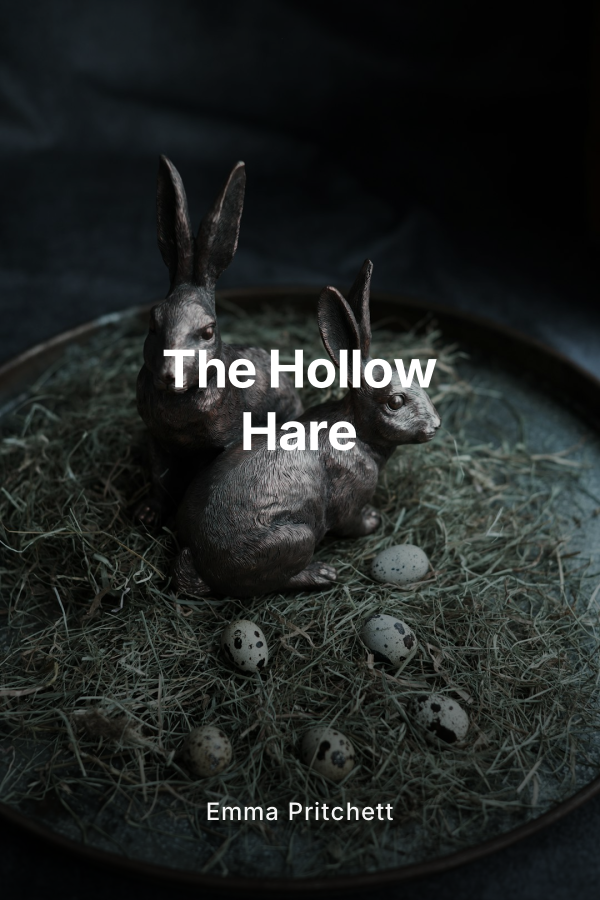
This YA horror with a hopeful heart follows Sylvie Thornin, a young antique shop owner who lives surrounded by other people’s memories yet quietly fears that her own life will never matter enough to be remembered. Her world tilts the night she opens a dusty box labeled “LOST & FOUND – Property of The Menagerie” and finds a cracked bunny mask that still smells faintly of smoke. The mask once belonged to Patch, the mascot of a beloved traveling puppet show that vanished after a mysterious fire. Local rumor calls it cursed, and the first time Sylvie touches it, the lights around her flicker as if the past itself is trying to wake.
The mask clings to warmth like skin, as if it breathes. When Sylvie tries it on in front of her mirror, silence crashes over the room and a girl appears beside her reflection, wearing the same stitched porcelain face and glowing purple eyes. The girl tilts her head with Patch’s unnerving, puppetlike motion, then disappears, leaving Sylvie shaken and inexorably hooked. That night, Sylvie dreams of a burning stage, children screaming, and a warped lullaby playing under the roar of flames. She wakes with soot on her hands and the television hissing static on its own, Patch’s hollow smile flickering across the screen.
The mask is not content to sit quietly on a shelf. It whispers names when Sylvie holds it close. Eli. Mara. Jasper. Each name tugs at her, like a thread caught on her heart. Searching the box, she finds an old Menagerie flyer and a grainy photo of Patch standing center stage, ringed by laughing children. Most people her age only know the show as a local ghost story, but Sylvie digs deeper in libraries and online archives until she uncovers the official history no one likes to talk about. The Menagerie vanished during a live taping when a sudden fire devoured the set. No bodies were ever found. Only the animatronics survived to be quietly locked away.
A chance meeting with an aging former employee turns warning into obsession. He tells Sylvie that the mask remembers. It does not forget and it does not forgive those who try to erase what happened. It feeds on memory and blurs identity. If she wears it too long, it will not give everything back. Yet the same man admits that the animatronics were never monsters. They were vessels, built to delight children, then pressed into a darker role when someone decided the show, and the kids who loved it, had to disappear. The mask became a desperate archive, a last attempt to preserve the children it could not physically save.
Drawn by dreams and whispers, Sylvie follows the pull to the edge of town, where the old factory that once built the Menagerie’s animatronics looms behind rusted chains. The building has slept for years, its windows opaque with dust, its legend used to scare kids away. With the mask beating like a second heart in her bag, Sylvie steps through the loosened gate and into the silence. A buried music box begins to play a crooked version of the Menagerie theme, welcoming her to a place that was never truly abandoned.
Inside, Act II of the story unfolds as a slow, creeping mystery that gradually softens into empathy. Sylvie wanders through shadowed halls lined with sun-faded posters of Patch and the children who once shared his stage. On one poster, she finds her own name scrawled in childish handwriting next to the cast list, even though the paper is older than she is. Deeper in, she discovers Patch’s animatronic body slumped in a storage room, faceless and still. When she turns away and looks back, Patch is standing upright, watching her with an empty neck where the mask should be. In reflective glass nearby, his head tilts in that same puppetlike motion, but in the room itself he never moves at all.
The others wait for her too. A broken bear with missing limbs, a bird with shattered wings, a doll with no face. Each animatronic bears a nameplate that matches the whispers from the mask. Eli. Mara. Jasper. As Sylvie edges closer, the mask heats against her palm, and sudden flashes of memory slice through her mind. Children rehearsing, laughing, sharing secrets. The stutter of a camera starting a live taping. The first lick of flame. Screams. In a dusty control room, she finds a VHS tape labeled “Final Show – DO NOT VIEW” and presses play. The footage begins harmlessly with grinning kids and Patch in the center, then warps into a distorted horror where the children blink out of existence and the animatronics convulse in frantic, unnatural spasms before the recording cuts to black.
As the mask digs deeper into her, Sylvie’s grip on her own life loosens. She loses chunks of time, waking in different rooms of the factory without remembering how she got there. Old photographs on the walls sometimes show her face in the background, even though they are dated decades before her birth. Snatches of songs and rhymes fall from her mouth in unfamiliar voices. This “memory bleed” terrifies her, but it also proves that the mask is more than a haunted artifact. It is a conduit that lets the children’s echoes slip into the present through her.
A retired technician who never quite left the building becomes her living guide. He explains that when the Menagerie died, no official memorial followed. The animatronics were warehoused here and forgotten, their software corrupted but their core routines still intact. The mask fought that oblivion by capturing the children’s emotional imprints at the moment of catastrophe. The result looks like a curse from the outside, yet it was built from a desperate wish to keep the kids from vanishing without a trace. He hands Sylvie a journal detailing each animatronic, each child’s personality, favorite song, and last known performance. The entries are clinical and heartbreaking, a catalogue of lives that the world shrugged off as an urban legend.
Sylvie decides the only way forward is repair. Guided by the journal and the memories the mask reveals, she cleans and rewires the bird animatronic, Mara, and plays her designated lullaby. Mara twitches, then sings in a voice warped by metal and time while a projection of her final day unfurls in Sylvie’s mind. Mara was shy, bird obsessed, thrilled simply to be on stage. The memory ends with Patch standing motionless in the wings as smoke thickens around her. The mask responds to Mara’s restoration with a warm, grateful glow. For the first time, Sylvie feels that this object is not hunting her. It is asking her for help.
Her work continues in Act III, which shifts the tone from fear to compassion. In a hidden Echo Room, Sylvie finds boxes of recordings, drawings, and voice clips, each tied to a specific child and their animatronic counterpart. Opening a file sends a pulse through the mask that echoes through her chest. She meets Eli, whose bear form thrashes violently until she uncovers his memory of loneliness and anger at relentless bullying. By playing his favorite song and speaking to him as a person rather than a threat, she calms his rage and allows him to settle. Jasper, the faceless doll, turns each corridor into a game of hide and seek that ends in laughter once Sylvie reconstructs his painted smile from old photos.
Among these files lies an absence more haunting than any ghost. A half-finished animatronic is tucked away, unnamed, lacking a performance routine, devoid of any official record. When Sylvie approaches with the mask, an overwhelming surge of static memories nearly drives her to her knees. Slowly, she understands that this child was never properly recorded at all. No programs, no paperwork, no favorite songs saved in the archive. This is the forgotten one, erased so thoroughly that only the mask remembers they ever existed.
Patch’s own past finally unlocks, and the story’s central mystery comes into focus. Once the star mascot, Patch was meant to keep the children happy and safe, the friendly face on posters, the anchor of their routines. Yet in the mask’s reconstructed memories, Sylvie sees that the fire was no accident. Someone wanted the Menagerie erased, and the easiest way to delete a show is to erase its audience. At the moment everything burned, the children’s memories flooded into the animatronics Patch had spent months performing beside. Helpless, he became the guardian of an improvised graveyard of minds.
The mirror girl returns now, clearer and more present. She is no longer a distant specter, but a child on the edge of tears. She is the forgotten one, the kid who never received a proper character sheet or marketing blurb, the one whose presence the official record refuses to admit. Looking out at Sylvie through the glass, she asks the only question that matters to her. Will you remember me? Sylvie, an antique dealer who has clung her whole life to the tangible residues of other people’s stories, finally understands what the mask has been asking from the moment she opened that box. She promises, aloud and without hesitation, that she will remember every one of them.
Act IV transforms the factory into a sacred theater of farewell. Lights that have not worked in years flicker on over the main stage as the animatronics shuffle into position. Behind the curtain, Sylvie finds Patch’s body broken and faceless where someone stored him like junk. With careful hands, she cleans the faded jumpsuit, reattaches limbs, and finally lifts the Hollow Hare mask toward his empty head. When the porcelain face clicks into place, Patch rises in stiff, jerky movements, eyes glowing not with menace but with sorrow and relief. The mask that once seemed cursed now looks like an identity returned.
Before the performance begins, Sylvie receives the full, unedited memory of the fire from the mirror girl. In this truth, she sees the deliberate sabotage that turned a final show into a disaster and watches as children vanish from the physical world while their inner lives are pulled into metal shells. Patch reaches for them and fails. The guilt that has echoed through the factory ever since belongs as much to him as to any human conspirator. By viewing and accepting this memory, Sylvie acknowledges both the horror and the intent to protect that followed it.
The last show then unfolds not as a spectacle for ratings, but as a ritual of remembrance. Sylvie activates the stage equipment and the original Menagerie theme swells, gentle now instead of jagged. One by one, Mara, Eli, Jasper, and the others perform their final routines. The sequences are imperfect and sometimes glitchy, but to Sylvie they are beautiful because they are honest. Patch takes his closing bow with the mirror girl at his side, the forgotten child finally visible. As the music fades, the animatronics settle, each powering down not in violence but in peace. The mask brightens one last time, then its glow and whispers fall quiet.
In the denouement of Act V, the factory releases its hold on the living. Sylvie steps out into the rising sun, the building behind her now still and ordinary. She carries the mask, which has reverted to simple porcelain and cloth, its haunting power spent. On the wind, she hears a faint child’s laugh that feels more like gratitude than lingering unrest. Back in town, she does what she has always done best, but with new purpose. She writes down everything she has seen and felt, cataloging not objects but people: names, favorite songs, final performances, tiny quirks and private hopes that only the mask could have shown her. Then she opens a small exhibit in her shop, a corner transformed into The Menagerie Memorial.
The book’s themes crystallize here. Memory becomes salvation rather than torment. The animatronics that once played as horror set pieces are revealed as children’s echoes who needed to be honored, not exorcised. Patch’s restoration is more than mechanical repair. It is the act of giving a guardian his face back and telling him his failure does not have to define him. The mirror girl, once the embodiment of nameless dread, finally steps into a remembered identity. The mask, feared as a curse, is reimagined as a sacred vessel for stories that almost slipped into nothing.
Across its five chapters, The Hollow Hare uses an eerie factory, haunted animatronics, and a cursed bunny mask to explore how remembering can be an act of love, especially when the world would rather forget. For teen readers, it offers chills that never tip into cruelty, emotional stakes rooted in empathy, and an ending that leans toward hopeful warmth. Sylvie begins as a young woman who hides in the comfort of other people’s relics, afraid that her own life will never leave a mark. She ends as a guardian of lost stories, someone who knows that to remember another person fully, including their fear and their joy, is one of the bravest ways to keep the dark from swallowing them whole.