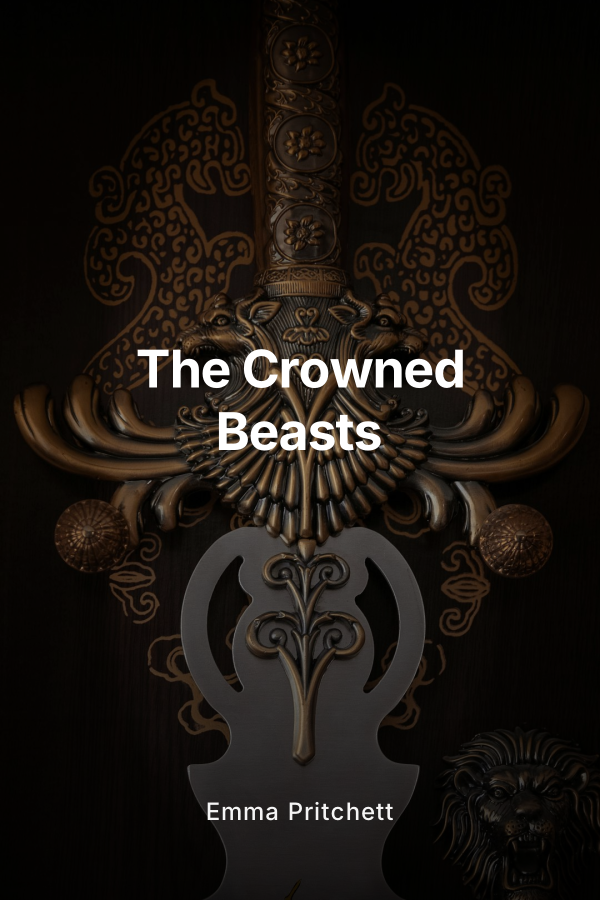
The Crowned Beasts is a harrowing young adult fantasy about inheritance, trauma, and the choice to build a gentler world after unimaginable ruin. Set in the silent wreckage of a once great kingdom, it follows two of the last known humans and the five elemental beasts who destroyed the crown that enslaved them and then claimed its power for themselves. In a landscape where every scar has a story and every legend is written in claw marks and ash, the question is not who will rule next, but whether anyone should rule at all.
At its heart, the story belongs to Brock and Skye. Brock is a reluctant heir born into a royal bloodline, sent into the wild lands to catalogue the ruins of the fallen kings and return with knowledge, not glory. He arrives expecting dust and silence and instead finds something far more dangerous: a living myth that still breathes, hunts, and remembers. Brock is no warrior. He is a listener shaped by guilt, the boy who was told all his life that he must become something great and secretly fears that greatness only ever means violence.
Skye is the opposite of the careful prince. A survivor of the king’s court, she escaped when the beasts rose against their masters and has been hiding for years in the deep forest, surviving on instinct, lore, and sheer refusal to die. She knows the old magic, the old lies, and the price of trust. Scarred by the fall of the court and haunted by what she did and failed to do, Skye has built her life on one lesson: closeness kills. Her world is a map of escape routes and hidden shelters, never of homes.
Their story begins when Brock, newly arrived in the wild lands, stumbles into a forest that feels more like a held breath than a place. Ruins smothered in ivy, broken roads swallowed by roots, and in the distance the low rumble of something vast. A single misstep draws the attention of a hunting presence, and Skye emerges from the trees like a second shadow, yanking him into hiding and into the shattered house that has been her refuge. Here Brock sees the remnants of a world that once believed it could bind the primal forces of nature: maps of lost cities, scrolls of forbidden rituals, and symbols of a crown that no longer sits on any human brow.
Their fragile safety lasts only minutes. A striped shape prowls outside the house, each padded footstep a question. Flame, the tiger who carries the echo of fire, has come hunting. The air thickens with heat and ash while Brock and Skye wait in breathless stillness. Flame sniffs at the walls, tests the wards, and for a heartbeat lingers, as if recalling another time when humans still mattered. Then he turns away, leaving only scorched pawprints in the earth and a message written in fear on Brock’s racing pulse.
In the aftermath, Skye tells him the truth that no royal library ever dared record. The kings once sought to bind the wild, to place crowns upon the heads of five beasts infused with elemental power. Cheetah, lynx, tiger, snow leopard, panther. Speed, stone, flame, frost, shadow. Each was meant to serve, to be a weapon in the hands of human rulers. Instead, betrayed and twisted by human greed, they turned on the crown and shattered the world that had tried to own them. The kingdoms fell. The cities burned or froze or simply vanished under creeping forest. And the beasts, once guardians, became the only sovereigns left.
Brock and Skye believe they may be the last of their kind. That loneliness draws them together even as their secrets keep them apart. Exploration becomes their shared language. They walk through forests stitched with claw marks and scorched clearings where embers never die, reading the history written on bark and stone. Beneath a moss‑coated tablet they uncover a prophecy that promises neither victory nor comfort: five shall walk where thorns still bleed. It hints that humans and beasts are not finished with one another and that the land itself still waits for a different kind of crown.
Curiosity and buried duty drive Brock toward the beasts; fear and memory drive Skye away. Their conflict sharpens when Flame confronts them again, this time not as a nameless terror at the door but as a presence with a voice. Whether that voice is spoken aloud or inside their minds, it cuts just as sharply. Flame offers no mercy, only a cryptic warning that survival will require more than hiding. Fire remembers the first chains more clearly than any human remembers the last coronation, and Flame is not certain whether humans deserve another chance to touch power at all.
Skye wants to run. Brock wants to speak. That clash defines the end of their old lives. He cannot ignore the possibility that the beasts are more than monsters. She cannot forget the screams that proved they were capable of monstrous things. Still, he convinces her to seek the others, to stand before all five Crowned Beasts and ask for something no one has dared ask them since the world fell: a shared future.
Their search begins in the open plains under a sky that always looks ready to swallow the horizon. There they meet Zipper, a cheetah whose body is built from speed and tension and whose element is the clean, cutting edge of wind. Zipper does not negotiate. He runs. Brock and Skye must keep up or be left as prey for something slower but far more cruel. The trial is not a test of raw strength but a race against their own hesitation, their willingness to move before they are ready, to trust their feet more than their fear. It is here that Brock first surprises a beast, reaching beyond exhaustion to match Zipper’s pace long enough to earn the cheetah’s curiosity, if not his trust.
From the plains they climb into the mountains, where the air thins and the world grows narrower with each step. In this realm of ice crust and jagged rock dwells Stone, the lynx crowned in the patient power of earth. Stone is colder than Frost in some ways, for the mountains have taught him the cost of every fall. He looks at humans and sees only fault lines, only the fracture that led to the first rebellion. Skye, who once walked polished palace floors, must find language in this harsh place that is not begging or bargaining. Through grief shared in halting words, she reveals her past in the court and the pain of surviving the fall when so many did not. It is this unshielded sorrow that persuades Stone to summon the others rather than crush the last humans beneath an avalanche.
The council of beasts convenes like a storm. Zipper arrives in a gust of dust, Stone with the rumble of dislodged boulders, Flame carrying heat that makes the air ripple, Frost cloaked in a cold that burns, and Shadow slipping from darkness so complete it seems to swallow sound itself. Each bears the marks of the betrayal that turned them from guardians into executioners. Scars mar fur once sleek and noble, eyes glow with lingering power that was sharpened by pain. They do not gather out of goodwill; they gather because the world itself seems to insist that the last humans must either be judged or used.
Brock stands before them and makes the only offer he has. Not dominance, not worship, but partnership. He speaks of a kingdom that might be built without a throne at its center, of a crown that might exist only as a story. The beasts listen, each for their own reasons. Flame listens for the smell of lies. Frost listens for the tremor of fear. Shadow listens for secrets unspoken. Zipper listens for the rhythm of a heart that truly intends to run alongside rather than ahead. Stone listens for the weight of resolve. In the end they agree to a bargain that satisfies none of them fully: Brock and Skye may live, but only if they can pass five trials shaped by beast and element and the very memories that broke the world.
The Trials of the Beasts form the brutal core of the story. Each chapter of this middle act strips away one layer of armor from the humans and one layer of curse from the beasts. This is not a gentle transformation. Magic in this world obeys hard rules; power has cost, and overuse leaves scars that never quite fade. Elemental force takes from flesh and memory alike, shortening lifespans and hollowing out those who try to wield more than they understand. The crown that once focused this energy did not simply amplify it; it devoured the will of any creature who reached for control rather than connection, corrupting humans and beasts who tried to bend the world instead of listening to it.
Frost, the snow leopard who carries winter’s weight, is the first to press them inward instead of outward. In Frost’s domain Brock is forced to walk through the corridors of his own memory, reliving a childhood of gilded expectations and quiet dread. Each step uses magic that drains the warmth from his body and the certainty from his mind. He sees again the ceremony where he was told that his bloodline existed to command, the lessons that taught him to view the world as a chessboard, the subtle cruelties he once ignored. Frost watches, searching not for perfection but for honesty. When Brock admits his shame and grief without excuse, Frost yields a fragment of trust, and the frost that had petrified his heart thaws by a fraction.
Flame’s trial is more explosive. Fire has always been Skye’s terror and hidden temptation. When Flame subjects her to a gauntlet of rage, she must face every moment when anger kept her alive and every moment when it nearly turned her into the same kind of destroyer that obliterated the court. The trial pushes her toward the brink of losing control, whispering that fury is safer than vulnerability, that a burning heart cannot be broken because it incinerates all who approach. Brock’s presence anchors her, his steady refusal to step back even as her power lashes dangerously close. Surviving Flame’s test softens the tiger’s own fury. He begins to see in Skye not a remnant of the court that betrayed him but a person who chose to walk out of that fire rather than rule beside it.
Shadow’s domain is darkness and truth. The panther does not tear flesh; he opens secrets. In his presence illusions disintegrate, including the ones they have built about each other. Here Skye’s deepest secret emerges: before the fall she did not merely serve in the court; she was entangled in the very machinery that forged the first chains, a minor voice in a hall that planned the beasts’ binding. She turned away too late and ran too soon. Brock, who built his fragile trust on the belief that she was only a victim, reels from this revelation. Their bond fractures. The argument that follows is raw and cutting, threatening to undo all they have built. Shadow considers this necessary. Only bonds that survive being broken can be trusted to hold under pressure.
Zipper’s trial forces them to run not from beasts or memories but from what they might become if they give in to despair. Illusions of alternate futures chase them: Brock crowned in blood, Skye alone in the forest, beasts once again shackled. Each vision hisses that giving up would be simpler. To succeed they must keep moving together, learning the rhythm of each other’s stride, choosing again and again to reach forward instead of looking back. By the end of the chase, their breaths are ragged, their legs shaking, but they cross the final stretch side by side. For Zipper this is proof of something he had nearly forgotten: that humans are capable of keeping pace with the world instead of lagging behind it or sprinting ahead to conquer it.
Stone’s judgment is the most terrifying because it looks like choice. He places before them an ultimatum built from earth and oaths. One can go free, given safety and a chance to live a quiet life among the ruins, if they agree to abandon the other to the trials alone. No deception clouds this offer; the magic that binds it would enforce the bargain absolutely. The world itself listens for their answer. Brock and Skye refuse in different words but with the same conviction. They will not survive at the cost of each other. That rejection of solitary survival cracks something inside Stone. For the first time since the fall, he considers that loyalty might still exist without chains.
As the trials conclude, the beasts begin to remember what they once were. Their forms shift subtly; eyes clear, movements grow less predatory and more purposeful. The twisted shapes that suffering carved into them loosen, revealing the noble guardians they were meant to be before crowns and collars poisoned everything. They reconvene their council, this time with Brock and Skye not as intruders begging for mercy but as participants whose choices have earned a place in the circle.
Together they seek the source of the world’s fracture. In a hidden temple they locate the shattered remains of the original crown, a relic that hums with elemental energy and the ghosts of every command ever spoken through it. It calls to all of them. To the beasts it offers the stability of clear orders. To Brock it offers the comfort of inherited purpose. To Skye it offers the chance to rewrite her worst mistake. The beasts warn that no one should wear it again. They know too well how even the purest intention can sour when filtered through enforced obedience.
The fragile hope they are building is threatened by the arrival of a human rival. Out of the shadows of the ruined bloodline emerges another claimant to the kings’ legacy, someone who sees Brock’s compassion as weakness and the beasts’ trust as a resource to be harvested. This remnant of the royal family believes the only way to restore order is to re‑enslave the beasts and rebuild the old hierarchy, polished and justified with new rhetoric but founded on the same ancient hunger for control. The looming conflict shifts the story from personal trials to political confrontation.
Brock stands at the center of an impossible decision. He can destroy the crown, erase the temptation it poses, and trust that the world will find balance without a focus for its wild magic. Or he can use it, hoping that his character will be stronger than the corruption that hollowed his ancestors. Skye, who knows intimately how humans fail when handed unchecked power, urges another path. She believes in restoration over rule, in turning the crown into a vessel of shared responsibility instead of unquestioned authority.
They choose to mend the broken artifact without ever placing it on a head. Through a ritual that taxes beast and human alike, they weave into the crown a new purpose. No longer a device of command, it becomes a symbol of covenant, shaping how energy moves through the land rather than how orders move through minds. The effort nearly kills them, as elemental power drains life and memory at a relentless rate. This price underscores one of the story’s central rules: magic always takes something in return. Yet they persist, held up by the beasts who now choose to lend their strength freely.
What follows is not a coronation in any traditional sense. Instead of kneeling subjects and shouted vows, there is a circle of beasts and two humans standing without crowns upon their hair. Flame, Zipper, Stone, Frost, and Shadow acknowledge Brock and Skye not as rulers but as guardians, stewards who will speak for those too small to stand before elemental power and not be crushed. The crowning they receive is made of trust, not metal, and it is heavier than any gold.
The final act of the book explores what it means to begin again in a world built on ruins rather than fresh soil. Brock and Skye work to establish a new kind of kingdom, one that grows slowly like a forest reclaiming stone. Survivors emerge from hiding, scattered humans who had taught themselves to live without hope of community. The beasts do not vanish into legend overnight; they guide the land’s healing, reshaping rivers, calming storms, coaxing seeds from long dead earth. Under their watch, villages begin to sprout where battlefields once lay. Romance deepens between Brock and Skye, not in sudden, dramatic declarations but in a series of quiet choices to stay, to share burdens, to build.
Yet peace is never unchallenged. Flame eventually returns to his jungle, drawn back to the heart of the wild he once scorched in fury. His farewell is not a betrayal but a recognition that guardianship takes different forms. Some must watch the heart of power from within. Others must tend the fragile edges where people live and fear and hope. His departure carves a new absence in Brock and Skye’s lives, a reminder that even in a healed world, love often means letting go.
Frost becomes the harbinger of the story’s last trial. He senses a shift in the pattern of storms, an imbalance that does not come from human greed or beastly rage but from something older and more neglected. The world’s original design included not five but six crowned forces. The sixth beast, denied its place and buried by the final sins of the kings, has awakened. It embodies chaos, the rejection of all order, born not from some external evil but from the refusal to admit that something vital had been silenced.
Facing this forgotten sixth forces everyone to confront the parts of themselves they most want to hide. The beast offers Brock and Skye power without accountability, safety without vulnerability, certainty without conversation. It tempts the beasts as well, whispering that they could finally be free from the burden of guarding lesser creatures if they allow chaos to reset the board entirely. This final trial is not one they can meet with claws or swords. They answer it with refusal, choosing unity over dominion, conversation over command, and a crown that can be broken rather than one that breaks them.
In the end they decide that the only safe crown is one no one can wear. Together they shatter the restored artifact, releasing its elemental magic back into the land. The energy disperses into storm and soil, fire and river, no longer bound to a single object or will. In breaking the crown they also break the last link to a past that defined power as ownership. The beasts, their long task complete, begin to fade from the world’s daily life. They do not die in any simple sense; they recede, becoming stories and constellations and instincts that guide the wind and the turning of seasons.
Brock, who once set out to study ruins, now writes a new history. His chronicles refuse to glorify the kings or reduce the beasts to symbols. Instead he records the messy, painful, beautiful truth of a world that dared to change. Skye becomes a living legend not because of any title she holds but because of the way people speak her name in moments when they choose mercy over fear. Together they inhabit a quieter form of greatness than the one Brock was promised as a boy. Their reign is measured not in battles won but in griefs shared and futures protected.
The story closes on the birth of a child, the first new human in generations. In this single life the narrative’s themes converge. Legacy without chains. Power without domination. Hope that does not erase loss but grows around it like vines through old stone. The beasts no longer walk beside humans in the open, yet their presence lingers in the shape of clouds and the rumble beneath distant mountains. The crown has been understood and unmade. The kings’ shadows still stretch long across history, but they no longer dictate its shape.
The Crowned Beasts is written for readers who want their fantasy to carry emotional weight as well as wonder, who crave slow‑burn relationships forged under pressure and worldbuilding where magic always exacts a price. It examines how trauma can twist protectors into tyrants and how love, in all its forms, can patiently untangle that knot. Rather than offering easy victories, it delivers a powerfully bittersweet ending where real losses leave marks but do not define the future. The crown was never meant to glitter on a brow; it was meant to be questioned, reimagined, and finally broken so that something gentler could grow in its place.