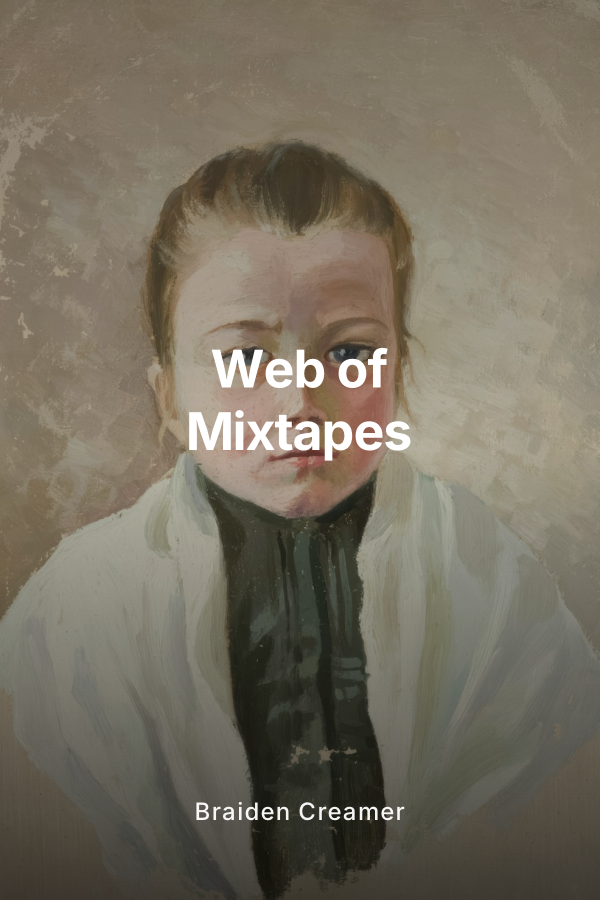
This book follows Braiden, a teenage hero whose story is intentionally structured and paced like a classic Spider Man arc while remaining an original work with its own characters, stakes, and setting. The tone blends grounded high school drama with street level superhero action, rooted in a nostalgic 1990s atmosphere complete with Walkmans, hand recorded mixtapes, payphones on corners, and conversations framed around the movies and bands of that decade .
At its core, Web of Mixtapes is a character driven journey about a boy forced to grow up too quickly. The book traces Braiden’s evolution from an overwhelmed, chronically late student who stumbles through his double life into someone who consciously chooses responsibility even when it costs him comfort, safety, and the normal teen experiences he desperately wants. His story is not about flawless heroism, but about faltering, getting back up, and deciding again and again that other people’s safety matters more than his own fear.
The emotional center of the book is Braiden’s relationship with Gwen, a girl who sees the patterns in his behavior long before she knows the truth. Their connection deepens over shared music, late night phone calls on crackling landlines, and the kind of honest conversations that only happen when both people feel slightly out of place in their own lives. When Braiden finally reveals his secret to her shortly before he is captured by the crime lord Fisk, Gwen’s reaction sets the trajectory for the rest of the story. She is not horrified, nor starstruck. Instead, she quietly tells him that his secret explains everything, and that quitting cannot be an option for him, no matter how exhausted he feels .
That moment is the hinge of the narrative. Up to that point, Braiden has toyed with the fantasy of walking away from the mask, believing that his constant lateness, broken plans, and endless bruises prove he is simply not cut out for this life. Gwen’s response does not trivialize his pain or dismiss his weariness. She acknowledges how hard it has been and still insists that what he does matters too much to abandon. Her support does not make his life easier, but it reshapes how he sees himself. In the chapters that follow, including and especially after his capture by Fisk, Braiden operates with a new internal compass: quitting is no longer on the table, so the real question becomes how to endure without losing himself completely.
The story’s structure mirrors a familiar superhero rise, fall, and rise again pattern, but the emotional and thematic emphasis remains on small, personal choices rather than cosmic destiny. The city is dangerous, but it is not an abstract playground for spectacle. It is composed of specific streets, cramped apartments, bodega doorbells, subway tunnels, and the spaces where teenagers carve out their identities between school, home, and the secret places they keep to themselves. The criminal threat posed by Fisk is grounded in realistic cruelty and control. His schemes do not revolve around world domination, but around choking the city economically and socially until no one can imagine resisting him.
Braiden’s conflicts therefore unfold on multiple levels at once. On the surface, he battles Fisk’s enforcers and confronts traps designed to exploit his compassion. At school, he risks expulsion due to his absences and late arrivals. In his personal life, he strains relationships with family and friends who interpret his secrecy as indifference or disrespect. Internally, he wrestles with guilt, fear, and a quiet resentment of the powers that made him someone the city needs instead of someone who can simply live. These threads intersect most powerfully around his connection with Gwen, who becomes a mirror for his better self.
After Braiden confides in her, Gwen is not relegated to a passive role. She begins actively shaping his path, offering practical support such as covering for him when he disappears, creating plausible excuses for his teachers, and understanding why certain promises cannot be kept. Her awareness comes with new risks, including the possibility that Fisk or others might use her to control or hurt Braiden. The book carefully explores this tension: knowledge is empowering, but it also paints a target where none existed before. As Braiden grows more strategic and disciplined after her encouragement, he must also confront the reality that everyone he lets close is now in more danger.
Thematically, Web of Mixtapes circles around three intertwined ideas. First, responsibility is not a one time decision but a daily practice that often feels thankless. Second, support does not remove hardship, but it changes how a person shoulders it. Gwen’s insistence that Braiden keep going does not erase his bruises or sleepless nights, yet it gives him a reason to endure that is anchored in love rather than pure duty. Third, identity is built from countless small sacrifices, many of which will never be publicly acknowledged. Braiden’s late arrivals, missed dates, and broken social plans are not just tropes, but the quiet cost of choosing to matter in a world that would be easier to ignore.
The 1990s setting intensifies the story’s sense of imbalance between ordinary life and secret heroism. The absence of smartphones forces Braiden to rely on payphones outside corner stores, scribbled directions on notebook paper, and the constant threat of missing a crucial call if he is not home at the right time. Mixtapes and Walkmans carry emotional weight, serving as both a soundtrack to his journey and a tangible symbol of the people he is trying to protect. When Gwen hands him a tape carefully curated for “days when you forget who you are,” it becomes one of the book’s most important artifacts: a physical reminder that someone knows him beyond the mask.
Structurally, the five chapters of the book will track a clear arc:
Chapter 1 introduces Braiden’s double life, his pattern of lateness, and the strains this causes at school and at home, while seeding the larger threat of Fisk in the background.
Chapter 2 deepens his connection with Gwen, using shared music and pop culture as the lens through which they reveal themselves to each other, even as Braiden’s secrecy widens the gap between his lives.
Chapter 3 escalates both the external danger and Braiden’s internal crisis, leading to his serious contemplation of quitting and culminating in the pivotal scene where he finally tells Gwen the truth about who he is and what he has been doing.
Chapter 4 follows the immediate consequences, including Braiden’s capture by Fisk and Gwen’s response to his confession. This section explores her choice to believe in him and to urge him not to quit, even when the risks to both of them become unmistakably real.
Chapter 5 portrays Braiden’s transformation after Gwen’s words take root. He becomes more focused and purposeful, accepts the inevitable sacrifices that come with his role, and confronts Fisk not as a frightened boy in over his head, but as a young man who has decided that his city and the people he loves are worth every cost he must pay.
Throughout, the narrative voice remains intimate and grounded, more concerned with how Braiden feels than with spectacle for its own sake. Action scenes are filtered through his senses and insecurities: the sting of gravel in his palms when he misses a swing, the ringing in his ears after a fall, the humiliation of realizing he has once again missed something important in his normal life because he chose to save a stranger. Dialogue is sharpened by the era’s cultural references, as characters quote the movies and bands that shape their worldview, with space left in the final text to attribute those influences properly outside the narrative itself .
Web of Mixtapes ultimately aims to resonate with readers who love classic masked hero stories but crave a more intimate, emotionally honest exploration of what that life would feel like from the inside, particularly for a teenager who never asked for it. It speaks to anyone who has ever felt torn between who they want to be and what the world seems to need from them, and to those who know that sometimes a single person’s quiet encouragement can keep you standing when you are ready to fall.