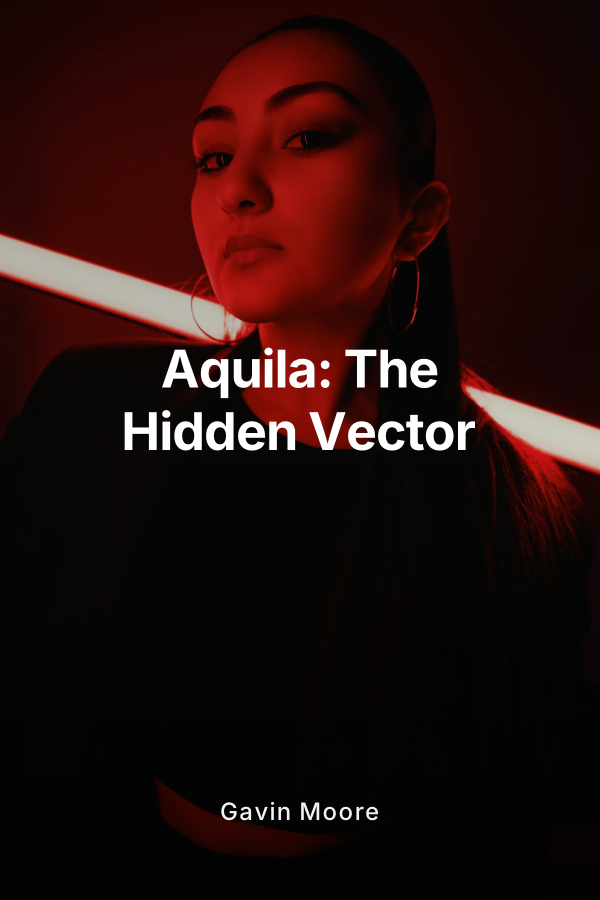
This book follows a middle aged, emotionally exhausted man named Tom and his estranged, forever scheming friend Geoff, who are bound together by a secret they barely understand and definitely cannot control: an alien machine called Aquila that can bend vectors in spacetime.
The novel is structured in five chapters that each track a different scientific and emotional “phase transition” in their relationship and in the way they misuse Aquila. Although the tone is technical and futurist in its treatment of the device and its physics, the story is grounded in shabby British suburbia, grubby scams, and bad decisions. The comedy comes from how spectacularly human frailty contaminates a piece of technology that is far beyond them, and how the universe seems to enforce a kind of chaotic cosmic accounting.
Chapter 1: Initial Conditions
The first chapter establishes Tom’s collapsing orbit around ordinary life. He is a father trying to look stable in a semi detached house that feels like a slowly failing life support pod. His marriage is under low level strain, his job is an exercise in quiet humiliation, and his one reliable skill is telling half truths to keep things from falling apart.
Years earlier, Tom and Geoff discovered Aquila, a smooth, matte, gravity indifferent object half buried in an abandoned quarry. It responded to thought and intention, folding spacetime locally so that it could translate, rotate, and accelerate in ways that ignored classical constraints. They hid it, used it, and finally lied about it. Geoff slipped fully into using Aquila as infrastructure for scams, illusions and criminal shortcuts. Tom tried to pretend it had all been a phase.
Then Tom walked away. Or at least, that is the story he tells himself. Geoff believes Tom abandoned him at the exact moment when Aquila became too dangerous to handle alone. Both men carry miscalibrated guilt vectors about Aquila and about each other, each convinced that he is the responsible one and that the other chose cowardice.
We see Tom’s home life in meticulously observed technical detail he notices power consumption readouts on his smart meter, the humming thermal signature of the refrigerator, his children’s glowing screens like micro singularities of attention. Domesticity is rendered as a fragile control system held inside tight parameters. The chapter sets up the contrast between this constrained, measurable world and the impossible, continuous parameter space Aquila offers.
Chapter 2: The Hidden Machine
The second chapter rewinds to reveal how they first explored Aquila. It is told in a braided timeline Tom’s memory, Geoff’s retellings to marks, and the raw physical events that actually happened. Aquila is not a “ship” in the familiar sense but a manipulable transform in local spacetime, something like a configurable Jacobian wrapped into a minimal surface. When they step “inside” they are actually stepping into a coordinate system that Aquila maintains.
At first they play. They hover above the quarry, erase inertia, test how quickly they can displace themselves without inducing biological shock. Aquila translates energy differently from human expectation; it cancels acceleration fields so that bruises and impact are selectively filtered. Tom runs careful experiments, logging changes in heart rate variability, visual latency, and vestibular confusion. Geoff, in contrast, improvises: making things vanish, “teleporting” short distances, staging demonstrations that look like low budget miracles.
Their secrecy is not noble. It is cowardly and self interested. They do not alert authorities, scientists, or anyone who might frame Aquila as a planetary event. They hide it in a sealed lockup, then in a storage unit accessed via a derelict industrial estate. The more Aquila proves it can do, the more they compress their world around it into lie after lie.
The chapter examines the ethics of asymmetrical access to transformative technology. Aquila is a singularity in their lives. They could have redefined energy distribution, transport, or planetary defense. Instead they use it to simplify theft, cheat distance on a commute, or fake levitation at a fringe spiritualist event. The hard science tone details how Aquila bends vectors and fields, while the narrative observes how it deforms their character and friendship.
Chapter 3: Divergent Orbits
The third chapter covers the fracture. Geoff leans fully into what he calls “applied vector theology,” building a cultish scam around Aquila’s capabilities. He performs weightless ascents in abandoned churches, fakes poltergeist activity by slipping objects through phase adjusted trajectories, and sells access to “higher planes” that are really just carefully choreographed translations into Aquila’s internal space.
Tom, who once loved the equations underlying it all, begins to feel physically sick each time he enters the machine. His sense of responsibility spikes with every new misuse. He sees headlines that never happened as phantom predictions in his mind: illicit military interest, people vanishing, governments building countermeasures. The more Geoff accelerates, the more Tom slams on imaginary brakes.
Their argument is couched in scientific language but is fundamentally about fear and shame. Tom insists that they lack the instrumentation, the theoretical framework, and the governance structures to handle something like Aquila. Geoff taunts him for using the language of systems while ignoring the actual system they live in: one where power is always grabbed by those willing to act first. If they do not exploit Aquila, he argues, some future finder or surveillance net will, and it will be worse.
The break happens during a botched demonstration that blurs the line between con and catastrophe. Geoff uses Aquila to stage a “spontaneous ascension” that goes partially off vector, briefly phasing a person through a structural beam. There is no gore but the person comes back altered, convinced they saw a nonlocal geometry in the brief discontinuity. Their testimony spreads in occult forums. Tom sees this as the countdown starting.
He walks. He tells himself he is protecting his family, choosing stability over chaos. In practice, he leaves Geoff with the machine and a head full of unstable ideas. Geoff experiences it instead as an abandonment in the middle of a complex maneuver. The chapter closes with Aquila locked in darkness and both men telling incompatible versions of why.
Chapter 4: Reentry
Years later, Tom’s ordered life reenters Aquila’s gravitational field. Strange anomalies begin to cluster around his area: GPS glitches at specific junctions, CCTV frames that show impossible parallax, local magnetic readings briefly spiking around a certain derelict estate. Corrupt local officials start making curious investments in properties near where he and Geoff once hid Aquila. Rumors leak of an “invisible asset” that certain police and council figures protect with unusual vigor.
Tom realizes Geoff has not only kept using Aquila but has integrated it into a mesh of scams and corrupt protection schemes. Aquila is now the black box at the heart of a local shadow economy. Geoff, having never fully mastered its physics, has nonetheless mastered its optics. He has turned an alien coordinate transformer into the engine of darkly comic crime, a sort of extradimensional getaway car that doubles as a miracle machine for carefully selected audiences.
Circumstances force Tom back toward Geoff perhaps through a financial collapse, a blackmail attempt based on old security footage, or his child stumbling into one of Geoff’s “shows.” The reunion is not heroic. It is petty, awkward, bitter. Each man arrives preloaded with blame vectors. Geoff accuses Tom of cowardice and hypocrisy. Tom accuses Geoff of weaponizing something they barely comprehended.
They are both right. And they are both wrong.
The chapter becomes a technical heist story. To survive coming scrutiny from increasingly dangerous officials, and to prevent Aquila from being seized by people even less scrupulous than Geoff, the two must collaborate again. They redesign their use of Aquila with real constraints, building protocols, safety margins, and fail safe trajectories. Tom derives operating envelopes; Geoff designs misdirection. The machine is no longer a toy. It is treated as hazardous high energy equipment that can also, inconveniently, fake angels, ghosts, and disappearances on demand.
Throughout, the book continues its hard science tone, exploring Aquila as a device that manipulates local curvature and vector fields, with practical problems like thermal bleed, biological tolerance, and information lag when coordinates are changed too fast. But the real system being debugged is their entangled guilt.
Chapter 5: The Darkly Comic Return
The final chapter delivers the promised darkly funny twist. In an attempt to “do the right thing,” Tom and Geoff decide they will remove Aquila from circulation entirely. They will use it one last time to translate it far beyond reach perhaps bury it inside the mantle, drop it into a Lagrange point obscured by debris, or send it along a trajectory that makes interception implausible with current technology.
Their plan is intricate. It involves staging one last spectacular con to distract corrupt officials and opportunistic mystics while they quietly route Aquila out of human hands. They calculate vector sums like penitent engineers, modeling gravitational scaffolds and signal horizons. Tom feels that if he can just solve this final problem, his moral ledger will rebalance. Geoff, more honest with himself, simply wants to exit the game before it consumes him.
Of course, the universe and Aquila do not particularly care about their intentions.
The operation misaligns by a tiny, almost comically small margin a fraction of a degree in a complex vector composition. Instead of depositing Aquila in a distant, empty nowhere, they trigger a cascade of translations that fold around their own local spacetime. For a brief instant, their entire town is part of Aquila’s internal coordinate graph. Streetlamps, rooftops, children’s playgrounds, and council offices all jitter in non intuitive directions then snap back.
Tom and Geoff, attempting a grand, noble exile, instead reappear in the most humiliating possible context. Aquila drops them out of invisibility into a hyper visible node of suburban life a village fete, a kids’ football match, or even Tom’s own cul de sac in full daylight, mid air, in some state of undress or bizarre costume left over from their distraction scheme. Parents scream, phones record, children cheer, corrupt officials stare as their invisible asset materializes in front of everyone.
The dark comedy lies not in cruelty but in cosmic pettiness. After years of elaborate hiding, equivocation, and half measures, revelation arrives as slapstick. The very technology that allowed them to evade observation now forces maximum observation. Their myths are instantly overwritten by shaky video and social media commentary. “Aliens at the allotments,” “flying con man crashes school fair,” and other memes proliferate.
Underneath the farce, the book delivers its thematic payload. Aquila treated their moral narratives as irrelevant metadata. It simply followed the vector math they gave it. The asymmetry that mattered was not access to advanced physics, but the asymmetry between what people claim they want to do with power and what they actually do.
The resolution does not involve planetary government storming in or a grand tour of the cosmos. It is smaller and more cutting. Tom must explain to his family why there is footage of him emerging from a glowing spatial defect in the sky. Geoff must confront the fact that he is no longer an occult rumor but a viral curiosity. The corrupt officials scramble to either weaponize or discredit what everyone has seen, only to discover that spectacle resists ownership.
Aquila itself is left ambiguous. It may have slipped away in the chaos, routing itself along some unobserved vector, or it may still be hiding in plain sight, phase shifted a few millimeters off reality in the most boring possible location. The machine, like guilt, never quite leaves.
Throughout the book, the scientific speculation about vector manipulation, coordinate systems, and spacetime curvature is used not to promise a bright technological future, but to expose how little humans change when handed impossible tools. Tom and Geoff’s story is one of ruined plans and broken orbits, where advanced machinery cannot compensate for ordinary cowardice and affection. The darkly comic twist at the end does not simply humiliate them; it finally forces them into the open, where almost nobody sees the situation clearly, but everyone at least sees something.
In that sense, Aquila is less a ship or a weapon and more a mirror wrapped in mathematics. The final image of two aging men dangling in mid air above a very normal English event, caught between an alien geometry and a bouncy castle, captures the book’s core question: what if the future arrived, and the people who found it were exactly like us?