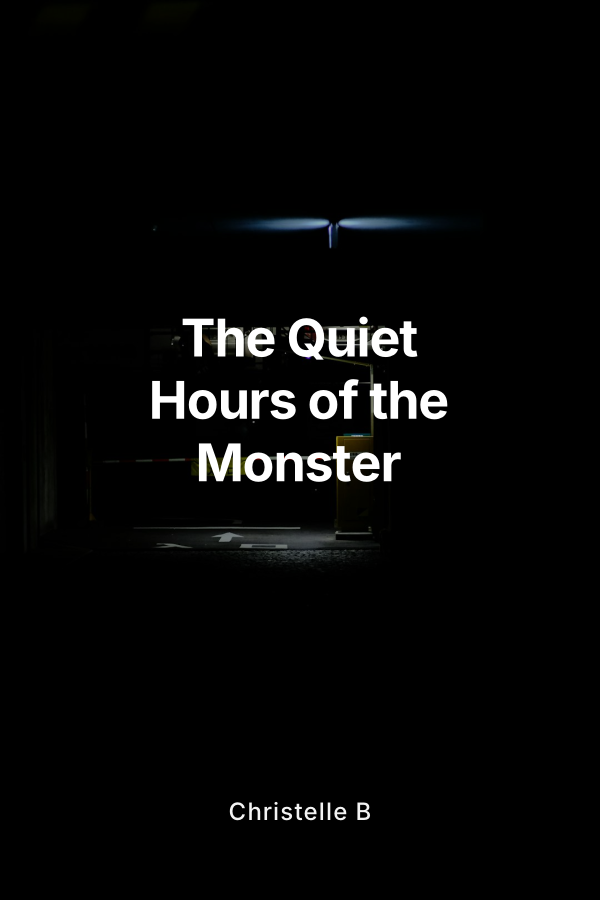
This book explores, in stark and unsettling intimacy, the birth, escalation, and final unraveling of a serial child predator and killer, entirely through written traces he and his victims leave behind. Structured as a mosaic of journals, letters, therapy notes, and official records, it traces the path from the killer’s earliest fantasies, through his first abduction and escalating sadism, to his final moments facing execution in the electric chair, interwoven with the broken, defiant, and haunting voices of the children he destroyed.
The narrative is built around five major movements, each corresponding to a chapter that adds a new lens and deepening emotional impact rather than repeating what has come before.
Chapter 1 follows the offender long before anyone knows his name. In private notebooks he begins with seemingly small fantasies that feel, at first, like thought experiments he can control. He uses clinical, detached language as he records what he watches online, the videos he replays in the dark, and the rules he invents about what he will and will not do. The entries track a chilling progression. He moves from voyeuristic curiosity and grooming behavior to boundary testing with local children, honing a method of approach that feels both rehearsed and improvised. The reader watches, almost in real time, as rationalizations grow thicker and empathy thins. When his first kidnapping finally happens, it is both meticulously prepared and shockingly impulsive. The diary entry that follows his first act of torture, rape, and finger cutting reveals how he clings to ritual language and euphemisms, trying to keep the reality of what he has done out of frame even as he meticulously documents every detail.
Chapter 2 turns away from him and opens the notebooks of his victims. Two to four core children, each with a distinct age, family background, and writing style, come forward through their own pages. One might be a younger teen with a spiral notebook that shifts between school assignments and fearful doodles, her slang filled with nervous humor that frays over time. Another might be a quieter child from a chaotic or abusive home, whose short, broken sentences and lists show someone unused to being listened to. A third could come from a strict religious household, framing every confusion and danger in the language of sin, punishment, and prayer. Their diaries, text fragments, and letters never directly narrate their final encounter with the predator. Instead, they sketch the vulnerabilities that made them visible to him, the loneliness he sensed, and the way grooming slipped in disguised as kindness or attention. The reader learns to recognize grooming patterns and small violations of trust as the children experience them, often without understanding.
Chapter 3 braids the two strands together. The killer’s later journals, written after he has already kidnapped, raped, and mutilated more than once, are juxtaposed with the victims’ last surviving entries. On his side, the language grows bolder, more technical, almost procedural. He records how he refines his kidnapping method, how he keeps trophies, how watching his own videos becomes both ritual and fuel. His rules become more elaborate and contradictory, oscillating between strict plans and impulsive breaks of those plans. On the children’s side, their writing styles shift as the danger closes in. Pages show sudden absences, references to a “man from the park” or “the neighbor who gives me rides,” or an online friend who asks for secret photos. A sense of dread builds as the reader sees the two trajectories bend toward collision: he moves closer to his next victim while they sense, but cannot name, that something is coming. The horror comes less from graphic description than from the awful knowledge that these are the last days when another path might still have been possible.
Chapter 4 begins after the spiral of violence has finally been exposed and halted. The killer is arrested, tried, and sentenced to death by electrocution. His writings in prison form the backbone of this section. At first, he performs for an imagined audience, adopting grandiose justifications and half baked philosophies, clinging to the belief that he remains in control of the narrative. Over time, as appeals fail and the execution date draws near, the bravado cracks. In some entries he rages at parents, at society, at an uncaring world. In others he turns religious, alternating between claiming redemption and insisting his crimes were not as bad as portrayed. Most chilling are the moments when he briefly sees his victims clearly, recalling a single face, a laugh, or a sentence from one of their diaries he has seen quoted in court, then snapping shut again. These prison pages are intercut with reports from therapists, legal notes, and possibly a surviving victim or family member’s final reflections, confronting the gap between his self perception and the destruction he caused.
Chapter 5 carries the reader through the final hours on death row to the execution chamber itself. The last diary entry he writes before walking to the chair is spare and strangely calm, a controlled attempt to define himself one more time. Official documents, such as the execution log and witness statements, provide a contrasting, almost sterile description of the procedure. The narrative lingers on small human details, like the way he reacts to having his head shaved, or the moment he is asked for any final words. Interwoven are final voices from the dead children’s journals and perhaps a closing note from one of the professionals who studied him, offering no easy answers or neat moral. The electrocution is not presented as catharsis, but as a stark endpoint to a chain of choices and failures that began long before the first fantasy was written down. The book closes with a mirror of one victim’s last page set against his last words, leaving the reader unsettled with the knowledge that no punishment can truly balance what has been taken.
Across its five chapters, The Quiet Hours of the Monster is intended for mature readers who can engage with difficult themes of sexual violence, exploitation, and capital punishment without expectation of comfort. Its distinctive power lies in how it uses written traces to show, rather than tell, the anatomy of predation. Each chapter adds new perspectives and emotional layers, from the internal logic of a growing monster to the fragile, vivid lives of his victims, and finally to the hollow theater of his death. Without glorifying him or dwelling gratuitously on suffering, the book insists that every act of violence is preceded by a hundred smaller moments and that the voices of the harmed, however fragmented, must be heard alongside the confession of the one who harmed them.