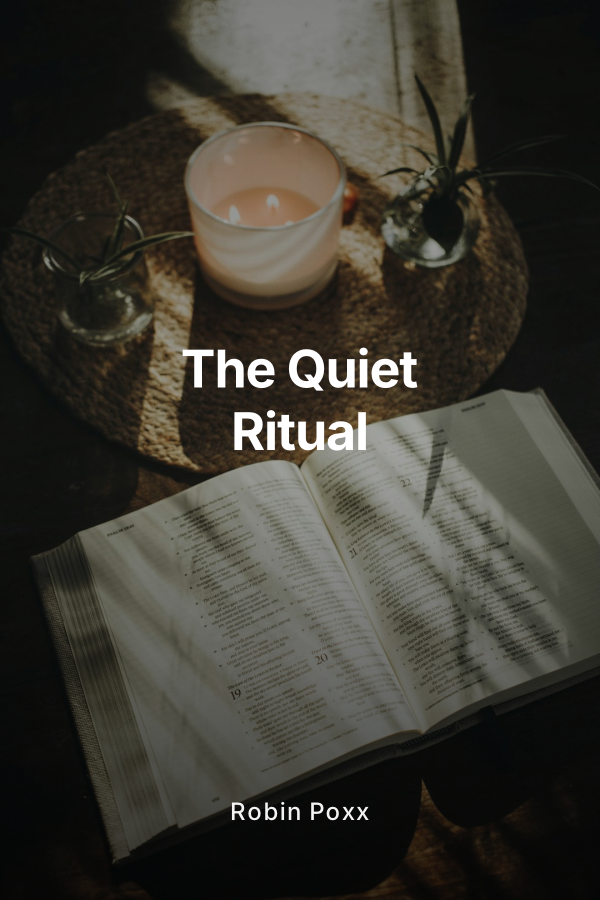
In a fragile republic that has only just survived a devastating war, peace is proving more suffocating than battle. The Quiet Ritual is an intimate, character driven duology that follows two of the last living veterans of an elite unit as they navigate political fallout, survivor guilt, and a private, wordless intimacy that keeps them functioning in a world that no longer understands them. Shaped by the reader’s request for a bittersweet yet comforting tone and explicit, recurrent intimacy, the book tightens its focus to a single room, a handful of nights, and the evolving bond between two people who refuse to name what they are to each other .
Mara was the strategist who never expected to live long enough to sit at a negotiation table. Now she is the de facto architect of the republic’s future, spending her days in suffocating conference halls, parsing unfamiliar diplomatic jargon and insincere smiles. Iren was the unit’s quiet blade, a captain whose reputation was built on ruthless efficiency and unshakable composure. In the so called time of peace, he finds himself sidelined into security briefings and ceremonial guard duties that feel like a mockery of the sacrifices that brought the war to an end.
They are, as far as anyone can tell, the last two survivors of their old squad, relics of a bloody past that the government would prefer to repurpose into symbols of unity. Their comrades are gone, remembered only in speeches and parades. Yet there remains one sanctuary the rest of the world has forgotten, a shuttered veterans’ lounge at headquarters that no one bothers to enter anymore. It is here that Mara and Iren retreat after long days of compromise and calculation, and it is here that they resurrect an intimate ritual they once swore they would never return to.
Years earlier, in the thick of the war, Mara found a single, unorthodox way to quiet her racing mind. The act centered entirely on Iren’s pleasure, a private, physical service that grounded her when the world outside was chaos. He let her, not out of selfishness, but because he saw how her breathing steadied, how the manic edge in her expression softened while she focused on the simplicity of his body rather than the impossibility of their odds. It became a rhythm that belonged only to them until a now dead comrade stumbled across them, shame and fear forced them to stop, and the war eventually tore the rest of their unit away.
In the uneasy calm that follows victory, Mara’s responsibilities multiply and her coping mechanisms collapse. Officially she is the face of the new world, incisive, composed, unflappable. Unofficially she is fraying in places only Iren can see. Her colleagues and the younger soldiers notice only that she returns from each negotiation strangely serene, a little more self possessed than before. They never see the path that leads from the council chamber to the abandoned lounge or the way Iren wordlessly takes her coat, sits, and pulls her down to him so she can surrender to the one habit that still silences the noise in her head .
The Quiet Ritual traces a series of these encounters across several weeks, each one emerging in the wake of a specific political pressure or internal breaking point, yet the narrative itself stays tightly bound to their private space. Other characters appear only as echoes in Mara’s memory or as distant voices outside the door; there are no near walk ins, no convenient interruptions, no comic misunderstandings. The world presses in through reports and recollections, but the reader is invited to inhabit only the sealed off sanctuary Mara and Iren have carved out for themselves .
Within that room, conversation is sparse. The dynamic unfolds through nonverbal cues, quiet breaths, the twitch of a hand, the way Mara’s shoulders finally drop after being braced all day. She sometimes talks to Iren’s body with an irreverent, half joking tenderness, a shield against how desperately she needs this release. He responds in low, restrained sounds rather than speeches, letting his reactions and small, practical gestures say what he cannot. He cleans her glasses when they are smudged, smooths her hair, offers a clean handkerchief, and never once asks her to explain why she keeps coming back. It is an arrangement they both understand and fiercely protect, something they share without labels or promises, a coping mechanism that has calcified into a ritual .
Beneath the physical routine runs the deeper current of their shared history. The book allows only glancing flashes of the past: a night by the barracks when they first fell into this pattern, the embarrassed laugh of the comrade who once caught them, the grim roll calls as names were slowly crossed off the roster. These memories are not lavishly detailed war scenes but brief, sharp intrusions that highlight how much has been lost and why this small pocket of stolen comfort feels so vital. The focus remains on the present day tension between who they were as soldiers and who they are expected to become as symbols of peace.
Although the story honors the explicit, graphic nature of their encounters as requested, the summary emphasizes their emotional architecture rather than enumerating every physical detail. What matters most is how Mara uses the act to repress her panic and sense of impending failure, how the intimacy becomes less about lust and more about surrendering control in the only safe way she knows. For Iren, allowing himself to receive is its own vulnerability, yet he finds a quiet purpose in being the one person who can give her visible, tangible relief after each punishing meeting.
Across the two chapters, The Quiet Ritual builds toward a subtle shift that both of them almost miss as it happens. At first, only the frequency changes: Iren notices that Mara begins to seek him out after not only major negotiations but minor briefings, inspections, any moment that stirs up the creeping dread that peace is nothing more than a fragile illusion. He says nothing, simply shows up, sits down, lets her do what she needs to do, and holds his questions behind his teeth .
What begins to transform their dynamic is his decision, late in the book, to ask whether she will let him return the favor. He suggests, with an uncharacteristically awkward directness, that perhaps her body deserves tending as much as her mind does. The proposal unsettles her because it flips the roles that have kept her safe. Giving herself over to his touch means admitting she is not simply using him as a calming tool, that she is also profoundly affected. She jokes, deflects, argues that their old pattern works well enough. Yet the question lodges in her, and the second chapter follows the nights when she tentatively allows the roles to reverse, only to discover new fault lines in her carefully maintained composure .
These reversal scenes do not negate the original ritual, nor do they turn the book into a conventional romance. Mara quickly realizes that while she can be undone by his hands and mouth, and while part of her craves the vulnerability of being cared for, true comfort still comes most reliably when she focuses on him instead of on herself. The story respects that preference rather than treating it as something she must overcome. Iren accepts her answer without bitterness. The reversed roles become an occasional variation, a quiet reminder that he is willing and able to hold her if she ever decides to let him, but the pulse of their connection remains the act that first kept her sane in the trenches.
Throughout, Mara appears outwardly functional to everyone else: sharp in committees, brisk with junior officers, the very picture of a competent architect of peace. Only Iren witnesses the tiny fractures, the way her hands tremble when she keys in the access code to their lounge, the lingering seconds before she drops to her knees or folds over his lap and breathes out like someone surfacing from deep water. No one notices that she returns from these disappearances calmer, more focused, as if an invisible storm has passed. The book leans into this duality, fulfilling the reader’s request that only he sees the cracks while others simply register her new composure without guessing the cause .
The final scenes of The Quiet Ritual do not culminate in a declaration, a breakup, or a blaze of external conflict. Instead, they deliver a layered emotional resolution that feels honest to who these characters are. After the worst negotiation of the book, one that forces Mara to concede ground that betrays her own ideals, she arrives at the lounge on the verge of collapse. Their ritual unfolds as always, yet this time when it ends she does not immediately pull away. Exhausted, she lets herself be gathered against Iren’s chest, their bodies still tangled, her breathing slowly syncing with his. He cleans her up with the same practical care he has always shown, but the tenderness is more obvious now, less hidden beneath routines.
In one resonant moment, he nearly speaks the words the reader has been expecting. His mouth forms the beginning of a confession about how many times he has imagined losing her too, how this small, strange arrangement has become his anchor as much as hers. Then he stops, swallowing the words as he has swallowed so many before. Naming it would change it, might even shatter it. Instead he simply holds her a little closer, and she lets him, not asking what he almost said.
The book closes on a night that looks, from the outside, much like all the others. Another meeting, another retreat to the forgotten lounge, another enactment of the quiet ritual that sustains them. Yet the reader understands that something has shifted. They have allowed glimpses of reversed roles and shared softness into the pattern, accepted that this is not only Mara’s coping mechanism but a shared lifeline. They remain label free by choice rather than by avoidance. The war is over in name only, its echoes alive in their bodies and in the republic they are helping to build, but within the four walls of their sanctuary they have built a small, fiercely guarded peace.
The Quiet Ritual is therefore less a traditional plot driven narrative and more a concentrated study of intimacy as survival. By honoring the requested emphasis on explicit, repeated encounters, a confined setting, and a relationship that neither character is willing to define, the book offers a haunting, deeply human portrait of what it means to live through both war and the strange, disorienting calm that follows .