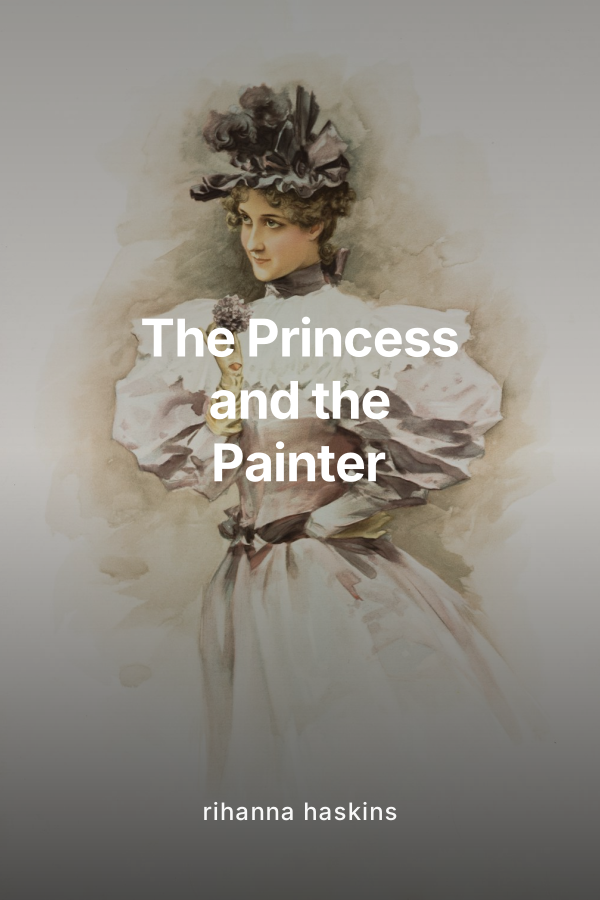
In an England stitched together by etiquette and executions, Princess Stella, the youngest daughter of Queen Charlotte and King George, grows up in a palace that feels more like a gilded prison than a home. She is her mother’s favorite among fifteen children, yet also the one least understood. Stella loves what court ignores: paint beneath her fingernails, the quiet language of flowers, the hush of the garden at dusk, and the comfort of her dog, Snowball, who never flinches at her oddities. She speaks too quickly, notices too much, feels too deeply. In an age that has no name for autism or panic attacks, people simply call her strange and whisper that she carries her father’s illness.
Queen Charlotte, brilliant and watchful, adores her but refuses to let her marry. Two suitors have already retreated, declaring Stella too peculiar, too difficult, too much. Stella aches for the very things her mother withholds: a husband, a household of her own, a life beyond palace walls. Tea with the Queen, readings of scandalous gossip sheets, rare, supervised walks in the gardens this is the narrow orbit of her days. Her father, the only parent who ever felt like a safe harbor, lives apart in fragile seclusion, and she is the only child who truly visits and speaks with him. The court thinks she inherited his madness. Stella knows she inherited his tenderness.
One night, desperation finally outweighs obedience. Stella slips past the guards and escapes into the city, trading the suffocating order of the palace for streets humming with life and danger. In that stolen slice of freedom, she collides quite literally with Mr Benedict Bridgerton, a gentleman known for charm, wit, and a restless soul that has never settled on love or marriage. He is a painter at heart, more at home with canvases than contracts, with color than with courtship. Until Stella.
Their first meeting is a shock of recognition, an instant, visceral pull that neither of them can explain or ignore. It feels like they have known each other for years instead of minutes, like their lives have been quietly orbiting the same star and have finally crashed into alignment. Eyes linger too long. Words stumble. Both walk away haunted, caught in a fever of thoughts they cannot shake. Stella returns to the palace with paint on her fingers and a stranger in her mind. Benedict goes home with the curve of a princess’s mouth burned into his imagination and the terrifying sense that, for the first time, he actually wants forever.
From that encounter blooms a dangerous, clandestine romance. What begins as stolen glances and hesitant, shared paintings grows into secret meetings that stretch late into the night. Stella and Benedict are drawn together by art and loneliness, by the way he listens when she rambles and never calls her odd, by how she looks at his work and sees the parts of himself he hides. The love between them is fast and consuming, an intoxicating mix of innocence and obsession. Benedict becomes entirely devoted to her, protective to the point of recklessness, the very definition of a man who has finally found the one person he cannot bear to live without.
But the world pressing in around them is ruthless. Queen Charlotte views her daughter’s “oddities” as both vulnerability and weapon. The court will not forgive a princess who fails to behave like a polished ornament. Stella’s every misstep is magnified, every tremor of anxiety interpreted as proof of inherited madness. Rumors swirl. Suitors are evaluated not for their hearts but for their usefulness to the Crown. When whispers spread about Stella’s strangeness and the failed engagements behind her, the palace walls tighten further. Her mother insists that remaining unmarried is safer, more controlled. Stella hears only that love is something she is unfit to receive.
As passion between Stella and Benedict deepens, so do the stakes of their affair. Their connection is not gentle and distant; it is urgent, hungry, and fraught with power. Stella is inexperienced but eager, craving not only his touch but his instruction, entrusting him with the parts of herself she has never been allowed to explore. Benedict, older and far more worldly, becomes both her teacher and her tempter. Their moments together sway between tender reverence and a sharper, breathless intensity. He praises her, adores her, and quietly lays down rules that bind them closer, his devotion threaded through with possessiveness and the fierce conviction that she belongs with him and no one else.
This consuming bond does not go unnoticed. Political necessity rears its head when the Queen, under mounting pressure, entertains a new engagement for Stella. The man is suitable on paper and cold in person, a convenient match meant to quiet gossip and reinforce alliances. Stella, whose heart and body already belong elsewhere, is coerced toward the betrothal. The announcement is staged to appear inevitable and permanent, with all the machinery of court whirring into motion around her. Silk fittings are scheduled. Contracts are murmured over. Stella feels herself trapped, her one taste of freedom with Benedict souring into heartbreak as duty closes in.
Benedict, watching from the margins of power, unravels. His obsession transforms into prowling protectiveness. He cannot bear the thought of other men looking at her as their future bride, of her being paraded as a prize for someone who will never understand her. In his desperation to keep her, he starts to manipulate the few levers available to him, inserting himself into palace spaces where he does not belong, maneuvering to steal more moments with her, and quietly scaring off any rival who gets too close. Stella senses the danger and is both thrilled and terrified by its intensity, caught between the safety of being wanted so absolutely and the fear of losing herself to someone else’s need.
The pressure cooker of court politics, illness in the shadows, and a forbidden love at its center builds toward catastrophe. At a critical breaking point, Benedict makes the cruelest choice of his life. Believing that letting her go is the only way to save her from ruin, he wields words as weapons, pretending he never loved her, calling her too strange and unsuitable for any future he might offer. His calculated cruelty shatters her, cutting at the heart of her deepest wound that she is fundamentally unlovable, too different to keep. Stella walks away convinced she has misread everything, that the man who saw her more clearly than anyone else has finally decided she is not worth the cost.
What follows is a stretch of bleak separation, where duty and despair battle every lingering memory. Stella submits to fittings and formalities with the hollow obedience of someone who has lost the last thing she dared to want. Benedict tries to drown his guilt in work and isolation, but he cannot stop painting her, cannot stop dreaming of her, cannot stop replaying the look on her face when he struck her with his lies. The world around them grows darker. Gossip sharpens. Secrets about the King’s condition and the Crown’s desperate need for stability deepen the sense that both Stella’s freedom and Benedict’s future are hanging by a thread.
Their inevitable collision comes on the edge of disaster. Pushed to the brink by the looming engagement and the terror of losing her life to a loveless union, Stella seeks Benedict out one last time. Their confrontation is a storm of anger and ache, of accusations and confessions. The emotional dam finally breaks, and what begins as a furious argument collapses into a desperate, forbidden surrender. She begs him to truly claim what he has already taken from her heart. He tries to resist, repeating that he should not touch her, that he has no right, that he will destroy her. But he cannot stop. The pull between them, threaded with years of fear and longing, ignites into a first time that is both rough and reverent, a frantic attempt to etch their love into each other’s bodies before the world tears them apart.
In the quiet aftermath, as Stella sleeps against him and the reality of what they have done sinks in, Benedict makes a decision that will change both their lives. No more lies, no more distance. He will make it right, no matter the cost. Gone is the man who felt safer hiding behind charm and avoidance. In his place stands someone ready to risk reputation, comfort, even exile if necessary, to claim the woman he loves in the only way that might protect her.
The next day, he walks into the lion’s den. Facing Queen Charlotte in a calm but icy negotiation, he presents himself not as a supplicant but as a man who has already tied his fate to her daughter’s. The Queen tests him with cutting elegance, wielding her power over both their lives. She knows her daughter will never be “normal” by court standards and has long used that fact as both shield and chain. She demands proof, sacrifice, and terms. Benedict, stripped of pretense, offers everything he has his name, his loyalty, his future. He does not beg for Stella’s hand as a favor. He insists on it as the only honest conclusion to what he and Stella have already begun.
Around this central confrontation swirl unresolved tensions: the fragile King whose shadow lies over Stella’s every panic, the siblings who do not know how to love her without trying to fix or hide her, the threat of scandal and even execution in an era when disobedience can cost a neck at the gallows. The story does not flinch from the darkness of its world, from isolation, historical medical cruelty, or the way society punishes those who do not fit its narrow mold. Yet within that darkness, it nurtures a stubborn thread of hope.
Across five chapters, The Princess and the Painter traces Stella and Benedict’s journey from star struck strangers to forbidden lovers; from manipulation and self sabotage to honesty and sacrifice; from two lonely souls defined by what the world calls wrong to a pair who insist on building a life precisely around those differences. The tone remains dark and angsty, shot through with explicit, emotionally charged intimacy, yet there are embers of tenderness and humor that never fully die. Fluff appears in unexpected corners an afternoon in the garden, Snowball asleep at their feet, paint smeared on royal sleeves a reminder that even in a brutal age, small joys survive.
Ultimately, this is a story about ownership and freedom, about who gets to decide what kind of life a woman like Stella deserves. Is she an ornament, a political piece, a fragile echo of her father’s illness to be hidden away, or is she a whole person whose strangeness is simply another form of beauty? Benedict’s arc mirrors hers as he moves from charming observer to a man who must act, who must choose between comfort and conviction. Together, they push against a world determined to script their roles for them.
The Princess and the Painter promises readers a volatile blend of love at first sight, illicit meetings, obsessive devotion, palace intrigue, and high stakes passion. It offers not just steam and scandal but a fierce emotional journey through fear, desire, shame, and finally, the hard won possibility of a future that belongs to them alone.