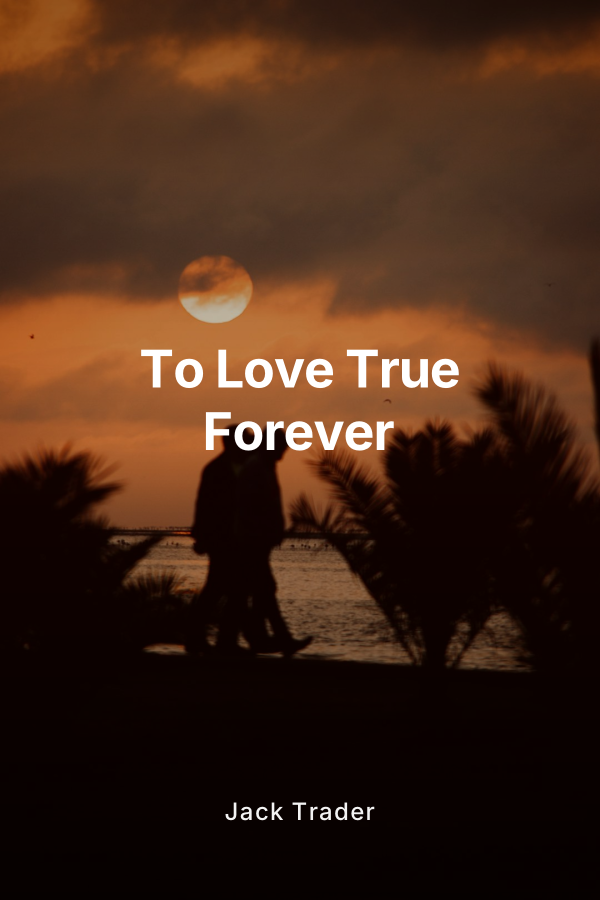
This book traces the unlikely, emotionally charged journey between Jack, a Philly introvert who lives half inside stories, and Bey, a shy Texas farm girl whose face is stolen by a stranger online. Built from a single uncanny meeting at a pumpkin patch and the digital echoes that preceded it, their love story unfolds from initial confusion into a fierce, chosen devotion.
At its heart, the novel asks what it means to be truly seen in an age where identity can be borrowed with a screenshot and a username. It explores how two “misfits” who have always felt out of place in their own lives use fiction, fandom, and humor as a shared language long before they dare to use the word love. Along the way, it examines consent, vulnerability, the weight of family history, and the fragile courage it takes to say yes to forever.
The story begins with a fake girl who seems perfect.
For weeks, Jack receives playful, flirty DMs from an Instagram account called @shecreamfork, a loud, confident Texas girl who seems to know exactly how to grab his attention. She calls him cute, asks if he is single, tells him to keep it that way “till I see you,” and dodges every attempt he makes to meet in person. The intimacy is addictive and hollow at once. Jack knows only the glow of his screen and the fantasy of the girl in the pictures.
Then autumn comes.
At a small-town Texas pumpkin patch filled with kettle corn and cold wind, Jack is out with his little sister when he sees her: the same face from his DMs, but attached to a different body language. This Bey smells like vanilla, speaks with a soft Southern drawl, and startles when Jack says her name. She has never heard of @shecreamfork. She barely uses Instagram at all.
Their first conversation is threaded with disbelief and fascination. Jack shows her the fake account. Bey studies her own stolen photograph, stunned. Together, they walk the fairgrounds trying to make sense of how someone turned Bey into a persona without her consent. Ming skips ahead while they talk about farm chores, books, and the quiet ache of wanting a bigger life than the one you were born into.
What begins as a mutual investigation shifts quickly into something more intimate. They discover shared obsessions with The Hitchhiker’s Guide and anime, trading thoughts on absurd sci‑fi, the strange comfort of apocalypses, and the stubborn optimism of characters like Naruto. Stories become a bridge between them, a way to say “this is how I think” without yet daring to say “this is how I feel.”
Bey opens up about her small-town life, the ice cream shop she runs with her mother, the dullness she sometimes fears will swallow her whole. Jack confesses how easily he vanishes into books for days at a time, how fiction has always felt simpler than people.
In this liminal space between strangers and something else, they strike an unspoken pact: to help each other figure out the truth behind the catfish and, perhaps, the truth of their own loneliness.
As they continue to spend time together, Jack and Bey’s conversations deepen from fandom chatter into their private wounds. Jack jokes about his “wizard pact” to stay a virgin long enough to become something more than human, yet beneath the humor lies a tangle of fear, religious echoes, and a deep wish to give his firsts to someone who will not treat them lightly. Bey admits she knows too well what it means to be misread and underestimated in a town that only half understands her.
Slowly, they choose each other.
They forge a mutual vow to live as their full, strange selves when they are together, no longer contorting to fit other people’s expectations. The catfish incident, instead of driving them apart, becomes the catalyst that pushes them toward a radical sort of honesty. In private, they experiment with the language of touch and desire, always circling back to explicit consent, to the question “are you sure?” and the reassurance “we do not have to do anything you are not ready for.”
The novel is unflinchingly intimate but always grounded in emotion rather than spectacle. Sexual discovery is framed as an act of trust and reverence. Bey describes her secret fantasy not as conquest but as being worshipped, cherished from head to toe by someone who sees her body as worthy of awe. Jack, shy and inexpert, offers what he has instead: patience, curiosity, and a willingness to learn her specific map of pleasure.
Together, they turn a series of firsts into a language of devotion.
As their physical connection unfolds, the story lingers on the quiet aftermaths: the wordless giggles when they notice the mess they have made of each other, the way Bey gently wipes Jack’s face with her shirt, the soft, sleepy gratitude of lying chest to chest listening to the other breathe. What matters is not prowess, but the repeated, trembling decision to be seen naked in every sense and stay.
Family shadows weave through this tenderness. Jack carries the ache of separated parents and the fragmentation of home. Bey shoulders the expectations of a mother, a farm, a town that imagines it knows who she is. Their love grows in defiance of those unspoken rules. On a field Bey jokingly calls the “Field of Dreams,” she walks Jack through the hidden corners of her land, narrating the stories of other couples who came here to picnic and fall in love under the stars. It becomes their private chapel, a place where they draft new vows for themselves.
The central turning point of the book arrives when Jack, heart hammering, finally asks for what he really wants.
“Would you kindly no longer fear me and love me forever?” he blurts out one afternoon when the light is low and their bodies are still tangled from making love. It is an echo of a video game line they both know, turned inside out into a plea. The question contains all his terror that someone will one day recoil from who he is, and all his wild hope that she might not.
Bey’s answer is a soft, devastating yes. She calls him her home, the only one she has ever truly had. She promises not only to love him but to drive him “plumb crazy” for the rest of their natural lives, binding humor to devotion as easily as she braids her hair. She says forever as if it is an ordinary word, as if it is as simple as feeding the animals at dawn or counting the cash drawer at closing.
From that moment, the book follows the slow, sometimes frightened, always earnest work of making good on such dangerous promises.
Across five chapters, the narrative moves from digital illusion to embodied truth. It charts:
-
The Catfish and the Mirror: Jack’s weeks of DMs with a fabricated Bey, his disorientation when the girl from the screen appears in a Texas pumpkin patch with no idea who he is, and the strange, budding alliance between them as they confront the theft of her image.
-
Field of Misfits: Their early days wandering the farm, sharing stories of books, anime, and the secret fears that trail them. They form a pact to be themselves around each other and to refuse the roles their worlds have written for them.
-
Learning the Body’s Language: The tender, awkward, reverent exploration of intimacy between a boy determined to save intercourse for marriage and a girl who dreams of being worshipped. Consent, vulnerability, and mutual pleasure become the grammar of their new shared tongue.
-
Ghosts of Other Homes: The intrusion of family obligations, old heartbreaks, and the lingering unease of the catfish account, which forces them to confront how fragile trust can be in a world where anyone can wear another person’s face. They must decide whether their bond is an escape or a foundation.
-
To Love True Forever: In the golden light of another afternoon on the farm, Jack and Bey seal their own makeshift covenant. They accept that forever is not a spell that prevents pain but a choice to walk through pain without letting go of each other’s hands. Their “forever” begins not with a wedding, but with a simple, unadorned promise to remain honest, even when honesty is hard.
Throughout, the prose lingers on sensory details and interior monologues. The smell of kettle corn, the scratch of hay bales under their backs, the texture of calloused hands on soft skin, the taste of shared breath. These details ground an online-born romance in tangible earth and weather, in pumpkins and fence posts and a small-town Texas sky.
To Love True Forever is, above all, a story about choosing reality over fantasy, and then discovering that reality can be more miraculous than anything the screen promised. It asks what happens when two people who have spent their lives hiding behind jokes, usernames, and fictional worlds finally risk showing each other everything.
In the end, their greatest act of love is not the sex they share or the lines they quote, but the quiet, everyday courage of staying.