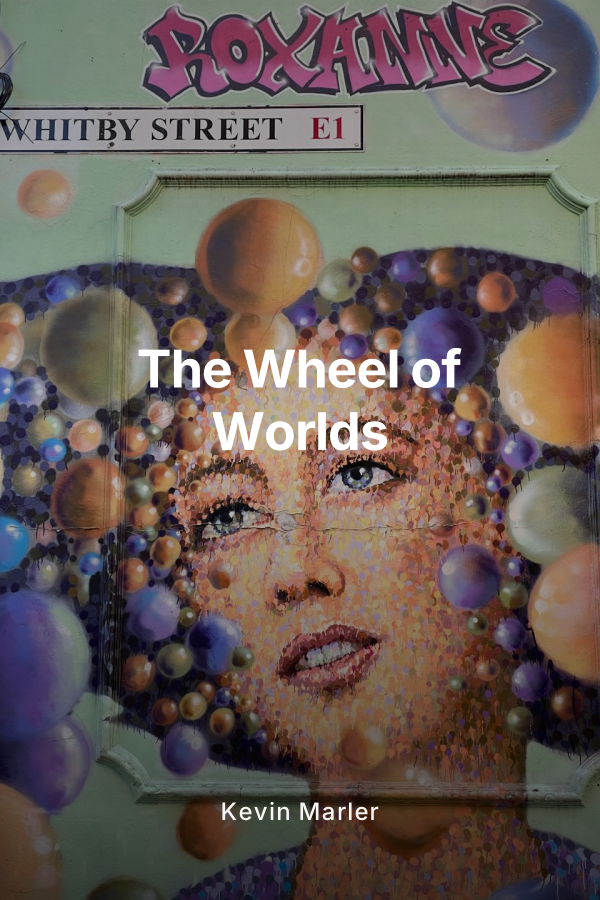
In The Wheel of Worlds, three longtime friends stumble into a game that reshapes reality itself. Each spin of Leo’s mysterious wheel does not merely create a scenario. It births an entire world, a complete timeline with people, histories, and futures. Kevin, Gregory, and Greg awaken inside these constructed realities as altered versions of themselves, with new roles, partners, children, and responsibilities. The catch is brutal yet simple. When the wheel spins again, the trio leaves that world behind forever, yet the world continues to exist without them, its inhabitants still loving, grieving, and remembering.
What begins as an intoxicating experiment in possibility becomes a profound examination of attachment, responsibility, and the unbearable weight of unclosed chapters. Kevin is hit the hardest. He falls deeply into each life, keeping meticulous track of every partner and child across realities, filling notebooks with names, birthdays, in-jokes, and promises. Over time, his heart becomes a palimpsest of abandoned families, each new world layered over the last, never truly replacing it. He pleads for “vacation runs” just to visit old families, fights to extend quests so he can linger a little longer, and flirts with sabotaging missions rather than tolerate another wrenching farewell.
Gregory is also hit hard, though his reaction is more guarded. He adapts, compartmentalizes, and tries to convince himself it is all a sophisticated game, even as the faces of left-behind children surface in his dreams. Greg is affected too, if not with the same visible intensity. He becomes the group’s uneasy pragmatist, the one who insists that they keep moving forward even as part of him breaks quietly with every departure. The dynamic among the three friends fractures under the pressure of compounded grief and impossible choices. Each spin of the wheel tests their loyalty to one another and their competing loyalties to the countless families who never chose to be temporary.
Standing at the center of this labyrinth is Leo, the enigmatic architect and ringmaster. He serves as both guide and provocateur, a host who revels in their evolving histories. Leo constantly inquires about their love lives and their children across the worlds, prying at the raw edges of their experiences. His running commentary often strays into their sex lives in various realities, treating their most intimate bonds as recurring entertainment. His attitude introduces a streak of dark comedy, but also something more unsettling. For Leo, their heartbreaks and attachments seem like fascinating data points, emotional content for an endless series.
How Kevin, Gregory, and Greg respond to Leo’s intrusions becomes a crucial substory. At first, they laugh off his innuendo and crass jokes, leaning on gallows humor to stay sane. Over time, tolerance gives way to tension. One of them snaps in open anger. Another goes uncomfortably silent. A third tries to mediate, torn between gratitude for Leo’s guidance and revulsion at his voyeuristic enjoyment. Eventually, Leo crosses a line, forcing the friends to confront not only him but the entire moral structure of the wheel itself. Is Leo merely a facilitator following fixed rules, or does he treat their lives as a show because he knows they can never truly leave?
The core rule is merciless. Worlds cannot be erased. Once created, a world continues indefinitely, seeded by the trio’s actions, relationships, and mistakes. There is no reset. No clean erasure. No “it never happened.” Every farewell is real, every broken promise permanent. And yet, the system holds out one strange mercy. Players can choose to step into Leo’s role or to retire. Retiring is not simple escape. It comes with its own haunting privilege. Retired players retain the ability to visit the worlds where they have families, moving between realities with a kind of constrained grace.
These visits, however, cannot be casual fantasies of omnipotence. The retired are bound by emerging norms and self-imposed ethics. They might have reduced powers or strict personal rules such as never altering a child’s destiny for convenience or refusing to exert “god-mode” influence to fix every problem. They must decide whether their presence heals or harms, whether their reappearances are gifts or wounds to those left behind. Over time, a quiet, informal council of retired players forms. They observe the vast constellation of worlds they helped create, watching, intervening sparingly, and wrestling with the knowledge that their best intentions can distort entire civilizations.
Across its five chapters, The Wheel of Worlds explores several intertwined arcs. First is the emotional descent of the trio. Kevin’s notebooks evolve from hopeful catalogs into testaments of heartbreak. His urge to “rescue” a loved one by bringing them into another world tempts him toward a transgressive solution that could tear the rules apart. Gregory’s stoic front cracks, revealing a man who has built defenses around a core of genuine tenderness. Greg’s seeming resilience hides quieter forms of damage that surface in unexpected decisions and moral compromises.
Second is the shifting relationship with Leo. Initially a quirky host with a penchant for inappropriate humor, Leo becomes a focal point for the trio’s anger, dependence, and suspicion. His questions about their sex lives and families, once shrugged off as awkward banter, increasingly feel like intrusive audits. Depending on the reader’s interpretation, Leo emerges either as a complex, constrained figure doing his best within cruel rules or as a manipulator cloaking detachment in irreverence. The friends must decide how far they will go to confront or even replace him.
Third is the philosophical backbone of the story. The continuing existence of each world forces the characters and the reader to grapple with what responsibility one holds to lives that are real yet unreachable most of the time. Is choosing not to visit a form of mercy or abandonment? Is visiting to soothe one’s own guilt just another selfish act? The book probes the ethics of infinite second chances that are never quite second chances at all, only new contexts layered over old regrets.
As the narrative progresses, the question of retirement looms larger. Stepping into Leo’s role offers control without peace, while retiring offers access without mastery. To retire is to become a pilgrim across your own past, visiting ghosts who do not know they are ghosts, or worse, who do. The retired players’ informal council serves as a mirror for the trio’s development. It shows what long-term exposure to the wheel’s reality can produce: some become gentle guardians, others rigid rule-makers, and a few seductive nihilists who argue that interference is always vanity.
The Wheel of Worlds ultimately asks what it means to live ethically when every choice spawns irrevocable lives. Kevin, Gregory, and Greg start as friends bonded by curiosity and bravado, but end as figures burdened by a godlike legacy they never wanted. Their bond is tested not by simple disagreements, but by opposing answers to the same searing questions. How many families can one heart hold before it shatters? At what point does seeking closure become a form of cruelty? And if you can never undo a world you have touched, how do you forgive yourself enough to move at all?
This book is written for readers who enjoy emotionally charged speculative fiction centered on character, consequence, and moral complexity. Without leaning on dense technical lore or ornate metaphysics, it uses the simple device of an unerasable multiverse to examine love, friendship, trauma, and the slow evolution of personal ethics. Its tone balances dark humor with sincerity, capturing the absurdity of discussing sex lives across timelines in the same breath as debating the fate of entire realities.
By the end of the story, the wheel still spins, but the way the characters see it has changed. The thrill of novelty gives way to reverence for the lives within each world. Retirement is no longer a surrender, but a solemn vow. The decision each friend makes about whether to keep playing, to take on Leo’s mantle, or to step back and watch over their scattered families becomes the emotional heart of the conclusion. The Wheel of Worlds leaves readers with an enduring image of three friends standing before an infinite array of doors, finally understanding that every door they ever opened led not just to adventure, but to people who now stand on the other side, waiting.