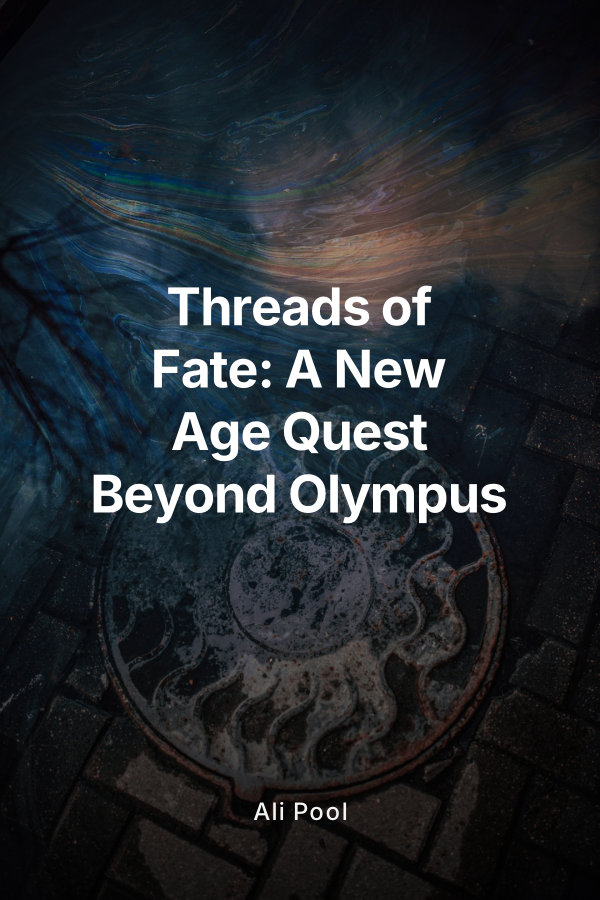
This book is a young adult mythic adventure inspired by the sweeping, ensemble style of modern demigod sagas, yet set in an original universe with its own pantheon, prophecies, and stakes that reach from New York City to forgotten realms between worlds. It follows seven teenagers who discover that the ancient powers shaping history never vanished. They simply learned to hide in the cracks of modern life.
Across five long chapters, the story will weave together a quest structure, character driven growth, and an escalating mystery about a lost goddess whose symbol is the owl. This missing deity is tied to a “Mark” that appears on chosen heroes whenever the balance between wisdom and war begins to fail. The tone balances humor with danger, explores loyalty, sacrifice, and found family, and places emotionally real teens inside a world of prophecies, monsters, and impossible choices.
Core Premise
In a world where myths are not stories but contracts, every city belongs to a hidden Patron. New York’s Patron once was the Lady of Insight, an ancient power who kept the peace between rival factions of gods, spirits, and mortals. Decades ago, she vanished without a trace. Since then, the city has become a pressure cooker of competing pantheons and rogue creatures, all held in check by fragile truces.
The book opens when seven strangers, each from a different corner of the city and a different cultural background, are marked by a radiant, shifting symbol that looks like an owl in flight. The Mark appears on their skin at the same time, in separate scenes, during a strange citywide blackout accompanied by a chorus of disembodied whispers. Overnight, they become targets for factions that either want the Patron restored or want her power stolen and reshaped in their own image.
The Mark does not grant them easy power. Instead, it sharpens what was already there: a gift for strategy becomes battle precognition, artistic vision becomes the ability to see hidden paths, empathy becomes literal insight into others’ fears. The heroes must learn to trust these emerging abilities while uncovering why they were chosen and what price the city will demand of them.
The Seven Heroes
The ensemble cast sits at the emotional heart of the book. Each character brings a different strength, insecurity, and relationship to myth and belief:
- The reluctant strategist who hates conflict but thinks three moves ahead of everyone else.
- The street artist who paints murals that mysteriously come to life at night.
- The scholarship student balancing three jobs and a secret connection to an underground cult of seers.
- The first generation immigrant gamer whose online handle accidentally matches an ancient war title.
- The aspiring journalist obsessed with conspiracy theories, who suddenly discovers that many are real.
- The quiet choir singer who hears harmonies lurking within storms and subway tracks.
- The runaway whose only constant companion is an old, chipped owl figurine that begins to speak.
Each chapter deepens their backstories and interlocking arcs as they transform from isolated misfits into a tightly bound, quarrelsome, loyal family of choice. Conflicts arise not only from external monsters but from clashing values, secrets, and different ideas of what “saving the city” truly means.
Setting and Mythology
The story’s primary setting is contemporary New York City, reimagined as a crossroads where multiple mythic traditions operate under a fragile code. Hidden markets open in abandoned subway tunnels. Rooftop gardens are tended by spirits who remember the world before skyscrapers. Corporate boardrooms host contracts scrawled in blood and starlight.
Instead of focusing on a single established mythology, the narrative introduces an original metaphysical system in which belief crystallizes into distinct “Houses” of power. Each House governs a domain like memory, storms, thresholds, or invention. The missing Patron of Insight once held secret treaties between these Houses, using subtle influence rather than brute force. Without her, rival Houses have turned to proxy wars through mortal intermediaries.
The Mark of the owl is an anomaly. It should not exist because the Patron’s line was thought extinguished. The heroes must navigate this landscape of Houses and hidden rules while remaining true to their own moral compasses. Key locations include:
- The Archive Behind the Library, an extradimensional space where forgotten versions of the city coexist.
- The Bridge of Echoes, a spectral double of a real bridge, visible only during storms, where vows cannot be broken.
- The Hollow Theater, where myths are rehearsed before they are allowed to bleed into reality.
These and other locations provide a playground for daring action scenes, riddling trials, and intimate character moments.
Plot Overview by Chapter
Chapter 1: The Night of Seven Marks
The book opens in fragmented vignettes across the city on the night of the blackout. Each of the seven teens experiences a surreal event linked to their personal fears or desires, culminating in the sudden appearance of the owl shaped Mark somewhere on their body.
The blackout causes chaos. Creatures usually hidden behind glamours stumble into view. Ordinary people half remember what they saw and half convince themselves it was a shared hallucination. The heroes’ first challenge is to survive until morning without understanding why they are being hunted.
By the end of the chapter, threads converge at a seemingly ordinary corner of the city where an impossible door appears in a graffiti covered wall. All seven, pursued by different forces, are drawn to the door at the exact same moment. When they pass through, they find themselves in the Archive Behind the Library, a bastion preserved by the last loyalists of the missing Patron. Here, they receive fragments of the truth but no clear instructions, only a prophecy like puzzle that suggests the Patron can be restored only if someone bears the Mark into the heart of the storm.
Chapter 2: Houses of Power and Hidden Agendas
The second chapter broadens the canvas. As the heroes return to their everyday lives, they begin to realize that “everyday” no longer exists. Each House of power sends representatives to recruit, manipulate, or neutralize them.
The teens split into smaller groups, tempted by different offers. Some are drawn to the promise of safety for their families. Others want training or information. A few push back against any form of control. This leads to sharp internal conflict and tests of loyalty.
We learn more about the Patron of Insight and how her disappearance allowed a ruthless House devoted to conquest to extend its reach into the city’s police, corporations, and even schools. The Marked teens become both potential weapons and potential saboteurs in this struggle.
Throughout this chapter, New York itself transforms from backdrop into character. Familiar spaces reveal secret layers. Ordinary landmarks become contested territory in an invisible war. The tone balances humor, awe, and dread as the heroes try to manage high school, jobs, and family obligations while also fending off mythic assassins and navigating surreal diplomatic dinners in sky high penthouses.
Chapter 3: Trials of the Broken Owl
The third chapter sends the newly forged group on a quest that carries the physical travel energy readers love in epic adventures, while remaining tightly tied to the city. The Patron of Insight, as it turns out, was not merely missing. Her essence was broken into seven “feathers” that fell into different forgotten corners of the urban landscape when she vanished.
To reforge the Patron or choose a new bearer of her power, the heroes must find and retrieve these feathers. Each feather resides in a place that mirrors a hero’s deepest wound, insecurity, or secret, forcing personal growth as much as outward struggle.
Examples include:
- A memory soaked train station where every departure platform plays out a different “what if” life for one of the teens, tempting them to abandon the quest.
- An underground arena where the street artist must literally face living murals of all the labels and stereotypes projected onto them.
- A derelict church repurposed as a shelter for runaway myths, where the runaway teen must confront why they left home and what forgiveness might cost.
These trials are not tests of brute strength but of insight, compassion, and the ability to choose the harder right over the easier wrong. As they collect feathers, the Marks on their bodies intensify, linking their senses and allowing them to share glimpses of each other’s memories. Secrets spill, bonds deepen, and disagreements become fiercer because they can no longer hide from who they are.
Chapter 4: Betrayal at the Bridge of Echoes
With most of the feathers gathered, the teens believe they are close to restoring the Patron and stabilizing the city. The power hungry House of conquest, however, has no intention of allowing them to succeed. The heroes are lured into a seemingly straightforward negotiation on the Bridge of Echoes, a liminal space where promises are binding and lies cost blood.
In a climactic sequence, one team member appears to betray the others, striking a bargain that would hand the feathers to the enemy in exchange for saving a loved one. The group shatters under this apparent treachery. Trust unravels. Some heroes question whether the entire quest has been manipulated from the beginning. Maybe the Patron’s return is not a blessing but another form of control.
This chapter tests the central theme of the book: insight is not only about seeing the hidden world, but about seeing one another clearly, even in moments of pain. The group’s fracture provides space for raw emotional confrontations, revelations about past sacrifices that went unnoticed, and the painful realization that sometimes wisdom requires letting go instead of holding tighter.
By the end of the chapter, the truth behind the “betrayal” is partially revealed. The apparent traitor made a hidden second bargain, one that may give the heroes a narrow chance to outwit the House of conquest but at extraordinary personal cost.
Chapter 5: The New Mark of Insight
The final chapter brings all threads together in a storm that centers on the Hollow Theater, where myths are rehearsed before becoming real. The Houses converge, each intending to imprint their own version of the Patron onto the waiting feathers. The city teeters on the edge of open conflict that would spill mythic warfare into public view.
The teens must decide whether to restore the old Patron as she was, create a new incarnation shaped by their own values, or break the cycle entirely by dissolving the power structure that keeps mortals as pawns. No option is clean. Every path has consequences for millions of lives.
Action and introspection interweave as battles erupt across shifting sets on the Hollow Theater’s stage, each set reflecting an alternative future. The heroes exploit what they have learned about each House’s blind spots and manipulate the very rules of mythic contracts that once held them in check.
In the end, the Mark on their skin changes. Instead of representing a single distant goddess, it becomes a living symbol of shared guardianship. The Patron of Insight is reborn, not as a towering singular entity, but as a distributed force linked to the seven of them and, eventually, to others they will choose. Power is no longer hoarded at the top of a hierarchy. It flows through a network of guardians anchored in diverse communities.
The city survives, altered and aware that something profound has shifted. The public remains largely oblivious to the details, but subtle changes ripple through policy, art, and daily life. The Houses retreat to rethink their strategies. Some will adapt. Others will plot revenge. The heroes return to school, to work, to family dinners that suddenly matter more than ever, knowing that their Mark is both a gift and a permanent responsibility.
The book closes with a quiet scene on a rooftop garden at dawn. The seven sit together, nursing bruises and difficult truths, as an ordinary owl lands nearby. Its eyes reflect not the glow of ancient power, but the sunrise over their city. For the first time, they see the future as something they are not merely trying to survive, but something they are actively helping to write. The final lines hint at future adventures, unresolved threats, and the enduring question of how to wield insight without losing one’s humanity.
Themes and Emotional Resonance
Throughout the book, several themes interlock to create depth for YA readers and beyond:
- Found family versus blood family, and the idea that both can wound and heal in different ways.
- The conflict between safety and freedom, as Houses offer protective cages in exchange for obedience.
- The tension between prophecy and choice. Are the seven truly chosen, or did they step into their roles by making small, brave decisions long before the Mark appeared?
- The ethics of power. Is it better to reassemble old systems with a kinder face, or to risk chaos by trying something new?
Humor arises naturally from the characters’ voices, culture clashes between ancient beings and modern teens, and the absurdity of cramming a mythic crisis between homework and late night shifts. The narrative never undercuts genuine emotion with irony, instead treating the heroes’ struggles with respect.
Series Potential
While the book stands alone with a complete arc about the restoration and redefinition of the Patron of Insight, it also seeds possibilities for future installments. Other cities still serve other Patrons, some benevolent, some tyrannical. The Mark that now defines the seven can resonate beyond New York, attracting new allies and fresh enemies.
Future stories could explore:
- How the distributed Patron model challenges ancient traditions elsewhere.
- What happens when ordinary people begin to notice cracks in the veil between myth and modern life.
- Whether the seven can remain united as their paths diverge in adulthood.
In all cases, the focus remains on character driven growth within a world of living myths and evolving power structures.
This book, “Threads of Fate: A New Age Quest Beyond Olympus,” is designed to captivate readers who love ensemble adventures, sharp banter, emotional stakes, and the thrill of watching young heroes reshape the rules of the worlds they inherit.