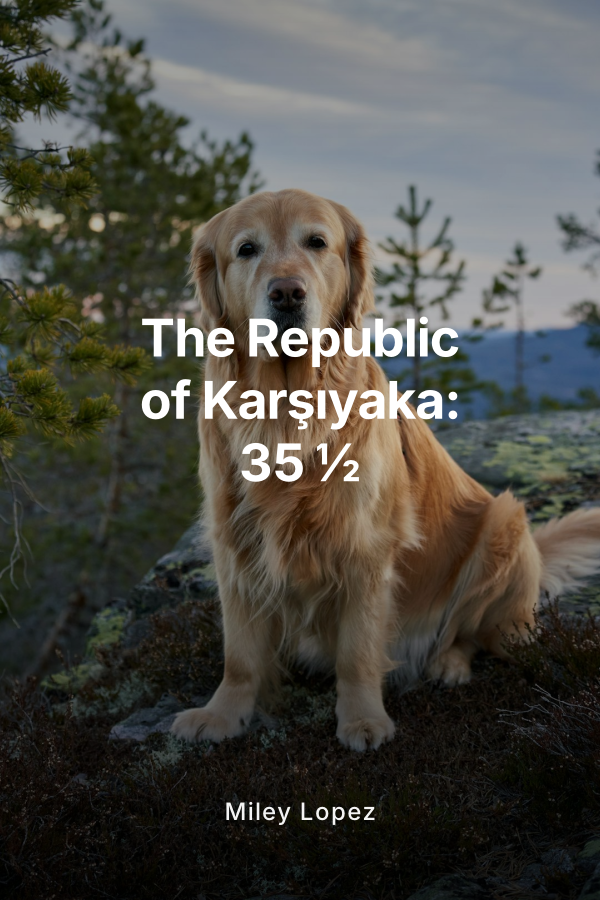
This book is a compact, image rich storytelling album created as a gift for an American friend who has never been to Turkey. It uses the story of one neighborhood, Karşıyaka, to explain not only a place but a mentality. Through short, powerful texts in clear English, supported by photographs and small cultural explanations, it invites the reader into a local world that sees itself as a proud, rebellious micro republic inside the city of Izmir.
At its core, the book argues that to understand the narrator, you must first understand where they come from. Karşıyaka is presented not as an address but as a state of mind: fiercely secular, stubbornly free, loud with football chants, and tender with nostalgia. It is a neighborhood that believes it has its own number 35 ½ in addition to the city code 35 because its people feel just different enough to claim a separate identity while still belonging to a larger whole.
The narrative unfolds as a visual and emotional journey rather than a dry history. It opens with a manifesto like introduction spoken directly to the neighbor. Here, the narrator makes a bold promise. This will not be a book about the self in the narrow sense, but about the unique spirit that shaped them. The tone is intimate, almost conspiratorial, as if the reader is being taken backstage into the true personality of a city that outsiders only half understand.
From there, the book widens its lens to the legendary city of Izmir, historically known as Smyrna, to show that Karşıyaka grew out of an already remarkable landscape. Izmir is introduced as a city built in myth by Amazons and associated with the ancient poet Homer. These references are used not as academic claims but as poetic signposts, giving the American reader a sense that this coastline has carried human stories for thousands of years. The label “Gavur Izmir” is explained in simple terms as a nickname that once implied “infidel” but was transformed into a badge of honor for a city that chose modernity, joy, and openness over tight conservatism. Through this, the reader learns that Karşıyaka is the stronghold of a secular, free thinking culture within Turkey.
The book then narrows its focus back across the bay to Karşıyaka’s own ancient and mythic roots. It situates the neighborhood beneath the mountain where the tomb of Tantalus lies, introducing the English verb “to tantalize” and linking it to this local legend. This connection allows the narrator to frame the people of Karşıyaka as spiritual cousins to Spartans of popular imagination. They are pictured as disciplined in pride, resistant to submission, and historically allergic to authority that demands blind obedience. Without claiming literal Spartan heritage, the narrative draws on that image to make the neighborhood’s stubborn temper instantly legible to a foreign reader.
A central episode in the book is the story of the 1922 “flag moment” connected to Mustafa Kemal Atatürk, the founder of modern Turkey. When he enters the liberated city, an enemy flag is placed at his feet so he can walk on it as revenge. Instead, he refuses. A flag, even an enemy’s, he says, is a nation’s honor and cannot be trampled. This concise scene is used as a moral keystone. The narrator presents it as a lesson in gentlemanliness that defines Karşıyaka more deeply than any military triumph. Power, the book suggests, is empty without nobility. Being from Karşıyaka therefore means learning that real strength is measured by respect, even toward those you have defeated.
From history, the book moves into memory. It paints the golden years from the 1970s to the 1990s through snapshots of local daily life. Instead of timelines, the reader is given strong images: families gathering in open air cinemas under the night sky, drinking local soda called gazoz and cracking sunflower seeds rather than watching Netflix at home. The ritual of “Piyasa” is explained, not as a market for goods but a strolling tradition along the seaside where people dress up simply to walk, see, and be seen. By telling these stories in short, cinematic vignettes, the book helps an American reader feel what social life looked like in an era before smartphones and streaming, while also anchoring it in local flavor through carefully glossed Turkish words.
The modern era section shows how the skyline and lifestyle have changed while insisting that the deeper soul has not. Karşıyaka is described as having transformed from a cozy town into a denser metropolis in the last quarter century, with glass towers in districts like Mavişehir and third wave coffee shops replacing older cafés. Yet in photos, the reader still sees the same green and red colors of the local club on balconies and walls, and hears in text the continuity of chants, graffiti, and youthful loyalty. What could have been a story of gentrification becomes instead a story of stubborn continuity, where technology and architecture update but the emotional code remains the same.
The book also introduces the figure of Zübeyde Hanım, the mother of Atatürk, whose grave is in Karşıyaka. This fact is not presented as trivia but as the emotional core of a civic duty. The people of Karşıyaka describe themselves as the guardians of the “Mother,” entrusted personally by her son. The tone here shifts into reverence. For a foreign reader, this reveals how national history can be localized into a neighborhood’s sense of mission, and how public space can carry layers of affection and responsibility that go far beyond tourism.
Throughout the book, Turkish terms like “Gavur,” “Piyasa,” “Gazoz,” and “35 ½” appear in the English text, each briefly explained in plain language. This bilingual seasoning is deliberate. The goal is to keep the narrative fully accessible to someone who speaks only English, while preserving just enough native vocabulary to feel the grain of the culture. The explanations are compact so that the reading experience stays smooth and non academic for the American neighbor, who is the primary audience.
Visually, the project is conceived as a 20 to 30 page hardcover photo book that can live on a coffee table. The structure is balanced between impactful imagery and succinct storytelling, with each spread pairing one or two photographs with a short, concentrated English text. The intention is not to overload the reader with data but to give them a guided emotional tour. Some pages speak in the voice of a guide to a foreigner. Others slip into remembrance and confession, as if the narrator is telling childhood stories over coffee while turning the pages.
The back cover uses the local joke of “35 ½” to end on a playful yet meaningful note. The license plate code for Izmir is 35. Karşıyaka’s adoption of 35 ½ becomes shorthand for a paradox. The neighborhood is absolutely part of the city, the region, and the country, yet its people nurture a sense of difference, a slightly separate pride. The American friend, by the time they reach this final line, is meant to understand that this fraction is not a math problem but an identity statement. It says, with a touch of humor, that Karşıyaka stands inside the whole but in a league of its own.
Thematically, the book weaves together four strands.
First, there is rebellion. Karşıyaka is shown as a place that resists being tamed, from its ancient warrior associations around Tantalus to its contemporary football terraces and street culture. The word rebel here is not violent but principled, signaling a refusal to conform to narrow expectations, whether religious, political, or cultural.
Second, there is honor. The Atatürk flag moment and the guardianship of Zübeyde Hanım’s grave teach that true pride is inseparable from respect. Revenge taken too far would dishonor oneself. Protecting the memory of a mother figure ennobles an entire community. The book suggests that Karşıyaka’s rebelliousness is anchored in this code of dignity.
Third, there is nostalgia. The golden years chapter, with its open air cinemas and seaside promenades, positions the past not as a lost paradise but as a living reference point. The reader comes to see that even the youngest residents of today carry some echo of those rituals in how they gather, dress, and celebrate.
Fourth, there is transformation without erasure. High rises and espresso bars arrive. Cars change, fashions shift, and smartphones light up the night. Yet the same colors, chants, nicknames, and moral reference points stay visible. In this tension between modernization and memory, the book quietly argues that places do not have to choose between the two. Karşıyaka is presented as an example of how a community can adopt the new while fiercely guarding its sense of self.
Stylistically, the intended full book will be written in fluent, compact English tailored to readers who may know nothing about Turkey. References to history and myth are framed in approachable language. Every potentially unfamiliar word or name is either briefly explained or placed in a context that makes its meaning intuitive. The tone alternates between poetic and conversational, always returning to a direct relationship: “Dear Neighbor.” The aim is that by the end, the American friend will feel not only that they understand where the narrator comes from, but that they have been personally invited into that world.
Across its planned two chapters in long form, the expanded book will deepen each of these segments. The first chapter will concentrate on roots and values, following a path from mythic Izmir to the birth of Karşıyaka’s character and its lesson in honor. The second will move through everyday life, from nostalgic evenings at the seaside to present day cityscapes, ending with the quiet declaration of 35 ½ as a way of saying: now you know who we are, and therefore who I am.
In the end, The Republic of Karşıyaka: 35 ½ is both a love letter and a user manual. It is a love letter to a neighborhood that refuses to dilute itself, and a user manual for reading a person through the place that raised them. For the American neighbor, it answers a simple question in an unforgettable way. If you want to know me, start with my city. If you want to know my city, start with this stubborn corner that calls itself a republic.