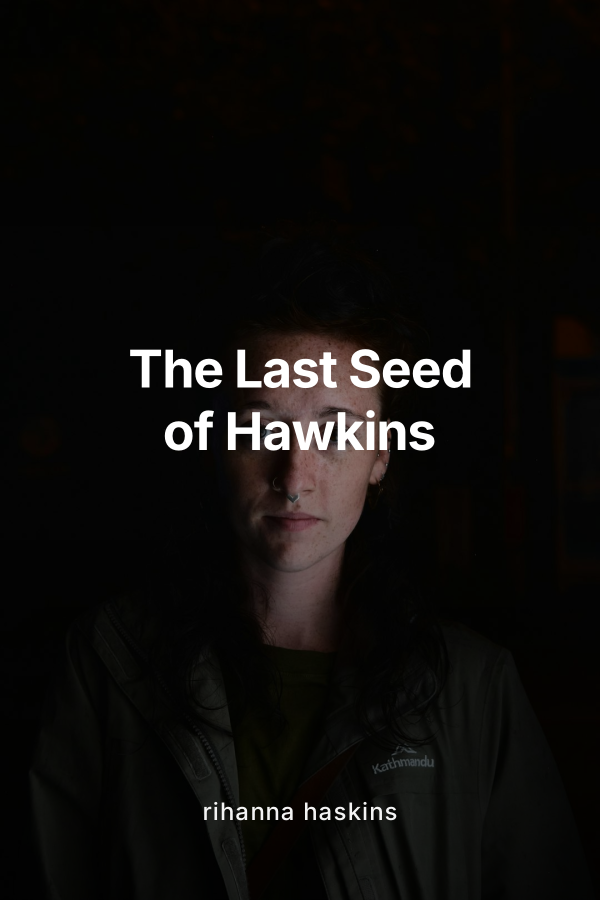
In the ruins of a dead world, hope survives in the most fragile and dangerous form: human bodies that can still carry life. Nearly all of humanity has fallen, leaving only a small cluster of survivors clinging to what remains of Hawkins, a once unremarkable town now turned into a fortress, a prison, and a crude experiment in rebuilding a species. At the center of this harsh new order stand two people who were never meant to meet, bound together by blood, law, and a hunger neither of them can deny.
Sarah is nineteen, sunshine carved out of wreckage. She is small and golden, with blonde hair, blue eyes, and a slim, softly curved body that should have grown up in gardens and libraries, not on killing fields. Before Hawkins, she had a group of her own, a family she loved and tried to protect until the world took them one by one. Alone, freezing, and covered in blood that is not all her own, she walks until her body quits and the woods claim her. She expects to die there.
Instead, she wakes in the hands of Steve.
Steve Harrington is twenty five and built like the walls that guard Hawkins, towering, muscled, and scarred. In the first quiet years after the apocalypse, he became the leader by sheer force of will and violence, the man who made the rules and enforced them without flinching. To save what was left of their people, the council designed a brutal solution. Every fertile body must be matched, every marriage must be a breeding contract, every womb a resource. Steve refused a wife from the beginning, both because he did not want one and because the numbers were too thin to waste on the man already feared by everyone else. Hawkins called it sacrifice. Steve called it balance.
Then his patrol finds Sarah collapsed in the woods and everything that held him steady starts to tilt.
She should be a ghost. Instead she is furious.
Half conscious, bleeding, and shaking from cold, Sarah still fights when Steve tries to lift her, nails and teeth and what little strength she has left. Her terror is obvious, but so is the part of her that refuses to surrender. She claws at the man who could crush her without effort, and Steve, who has put down raiders with his bare hands, cannot just walk away. Anger burns first. He hates that she risked herself, hates whoever left her like this, hates the way her stubbornness sparks something hot and possessive in his chest. Beneath the fury is fascination, sharp and instant. Even as she swings at him, he scoops her up and carries her through the trees to safety, deciding in that single raw moment that she will not die, that she will not be given to anyone else, that she will be his.
Hawkins sees a breeding resource. Steve sees the only person in years who sparked more than fear or obedience in him.
Within a system built on forced unions, Sarah’s arrival rewrites the balance of power. The council wants her assigned and pregnant as quickly as possible, another womb managed and counted. Steve, who never asked for a wife, claims her anyway, folding the official order into his own relentless need to protect and possess. Their marriage is, on paper, non negotiable. In reality, it becomes something far more complicated. What begins as a coerced bond inside a brutal policy slowly turns into a volatile, consuming relationship where roughness and safety exist side by side.
The nights they share are as central to their story as any monster at the gate. Their intimacy starts hard edged, thick with anger, breeding talk, and the awareness that Sarah’s body is now the site of Hawkins’s survival. Steve is dominant, relentless, obsessed with filling her, with making sure life takes root and stays. Yet even in the roughest moments, lines remain. The same man who terrifies raiders and subordinates never raises a hand to her in rage, never uses his strength to break rather than claim and shield. He might shout, he might pin her to the bed with bruising hands and a jaw tight with jealousy, but he is also the one who gathers her close afterward, checks every mark on her skin, and lets his huge frame curl around her smaller one until she falls asleep breathing against his throat.
Over time, sex stops being just a grim civic duty and turns into the language through which they fight, reconcile, and confess the things neither of them can say out loud. Arguments blaze over his rules, her habit of risking herself, the number of children they are expected to produce, and the men who look at her too long. Voices rise, doors slam, accusations fly. She calls him controlling. He calls her reckless. At the peak of each clash, they snap toward each other, collisions of teeth and hands, anger burning down into rough, claiming encounters that end in sweat, bruises, and the kind of touch that promises, in its own furious way, that neither of them is letting go. Later, once the heat has broken, there are slow nights too, especially when she is pregnant and aching, when his hands move with unusual care over the soft swell of her belly and his dominance softens into fierce tenderness.
Around them, the world is far from safe. Human raiders still haunt the edges of Hawkins territory, desperate and brutal. Old monsters sometimes lurch back out of the dark during supply runs, half legend, half lingering mutation. Attacks are not abstract rumors but vivid, bloody scenes that crack open the fragile peace Steve has tried to build. One supply run in particular becomes a turning point. Whether Sarah is on the mission with official permission or because she slipped past Steve’s orders, the ambush leaves her close to death, and for a brief, howling span of time Steve believes he has lost her. The rage that follows nearly tears Hawkins apart. It also forces both of them to confront the cost of her independence and his need to control everything that touches her.
As their bond deepens, so does the complexity of the world inside Hawkins’s walls. The group around them Nancy, Robin, Eddie, Dustin, and others add texture and pressure rather than stealing focus. Friends and rivals challenge Steve’s authority, question the ethics of the breeding system, and, in at least one devastating case, betray the fragile trust holding the settlement together. That betrayal becomes the emotional core of the book’s darkest section, threatening not only Steve’s leadership but Sarah’s safety and the children they begin to raise. Someone close to them chooses power, fear, or survival over loyalty, and the resulting chaos forces Steve into an impossible choice between his role as protector of the town and his responsibility as husband and father.
Throughout it all, the evolution of Sarah and Steve themselves forms the spine of the story. Sarah starts as a broken yet fiercely hopeful girl who has lost everything, a beam of sunlight dragged through mud. Over the years, she learns to bend without breaking, to stand up not only to raiders at the gate but to the man who makes the rules inside their walls. She challenges Steve publicly when his anger crosses into cruelty with others, defends her right to join missions, and most dangerously of all, demands that the number and timing of their pregnancies be something she has a say in. Steve, who once relied only on fear and violence, slowly becomes softer in one place only with her. Where others see the same gruff, terrifying leader, Sarah experiences the man who lies awake counting her breaths, who takes a monster’s claws himself rather than let them touch her, who learns, grudgingly and painfully, to apologize.
The book unfolds in five broad arcs, echoing the key turning points that define their journey. It begins with the brutal poetry of their first meeting and the forced marriage that follows, then moves into the raw, lust heavy early years where rough sex and survival blur together. The middle chapters widen the lens to show the external threats and the seismic betrayal that nearly destroys them. As time jumps forward, readers see Sarah and Steve as parents, their home crowded with children whose existence is both duty fulfilled and hard won miracle. Domestic mornings, soft with flour from Sarah’s baking and dirt from her garden, sit alongside whispered, desperate nights where danger outside the walls drives Steve back into her arms with a need to mark and be reassured that what they have is still real.
By the end of the story, the question is no longer whether humanity can survive in Hawkins. Enough children have been born, enough raids survived, enough rules written in blood and compromise. The question becomes more intimate and more frightening. Can love anchored in coercion and violence transform into something free enough to endure? Can a man built out of fury and command accept that the woman who saved him from his own anger owes him nothing but the love she chooses to return? Can a girl who began as a resource, a womb on a ledger, claim herself so fully that even a world as broken as this one must bend around her?
The Last Seed of Hawkins is a dark, explicit, emotionally charged saga for adult readers who are comfortable with rough intimacy, forced marriage structures that grow into obsessive, protective love, and a detailed apocalypse setting where danger is both outside the walls and inside the bed. It offers not a gentle romance but a relentless, addictive one, threaded with pregnancy, jealousy, betrayal, and the stubborn, ordinary domestic joys that somehow manage to survive the end of the world. Every chapter hums with tension sexual, emotional, and mortal inviting readers to watch two flawed, feral people drag each other, step by bloody step, from survival into something that finally resembles a life.