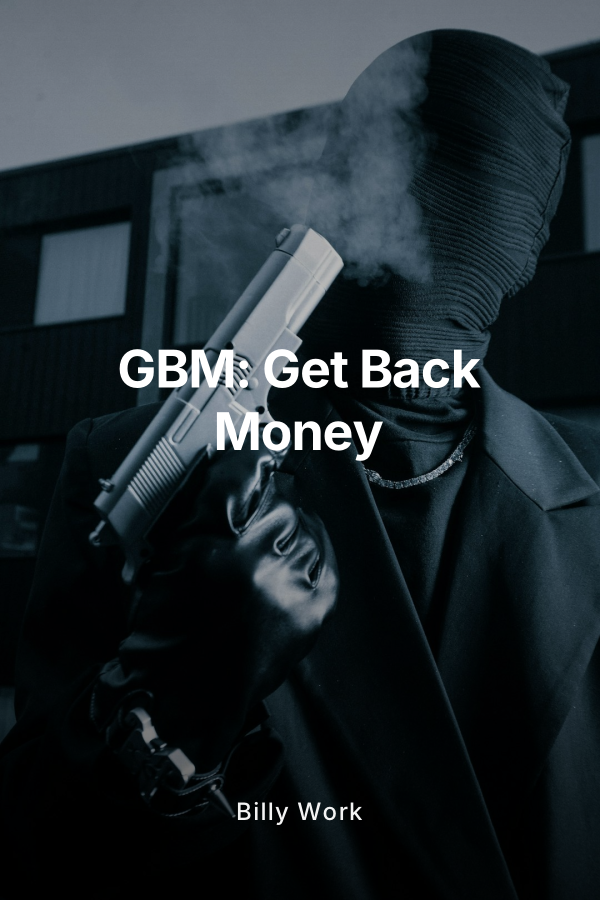
This book is a high intensity urban crime saga that reads like a boardroom thriller wired directly into the veins of the street. It follows Billy Bandz, an ex inmate from the Bronx who refuses to come home and chase corner fame. Instead, he decides to treat the underworld like a hostile market he intends to dominate with discipline, structure, and a ruthless grasp of numbers. GBM is the name he gives his vision and his company a vertically integrated criminal corporation designed to move in silence while thinking like a Fortune 500.
On the surface, GBM is a story about dope, robberies, crypto kidnappings, and guns. Underneath, it is a study of what happens when corporate logic is grafted onto a world of cages, coffins, and men who think violence is their only language. Every chapter raises the same question in a different way: once you start treating people as units of risk and return, what part of your own humanity is left untouched?
At its center stands Billy, a man who processes his first murder not as a rupture in his soul but as a capital injection. In a motel room in El Paso, he kills a mid level supplier and walks away with thirty keys of heroin and enough seed money to redraw his entire life. On the flight back to New York, he silently converts blood on motel carpet into an org chart only he can see. By the time the plane lands, GBM already exists in his head as a structure waiting to be built.
Back in the Bronx, he locks himself in a cramped bedroom in his aunt’s apartment and begins drafting a criminal Fortune 500 on three sheets of scavenged printer paper. Across the top of each he prints the same three letters: GBM. Under one heading he writes Supply, Distribution, Security. Under another, regions of New York. On a third, he starts sketching the crews that will eventually answer to him without ever seeing his face. The duffel from El Paso sits open on the bed, bricks repackaged and waiting. They are product, but Billy refuses to mistake product for business. His focus is architecture.
He recruits three men from his past and renames them with titles borrowed from boardrooms that never expected to share language with a parole office. Rico becomes his Chief Financial Officer, a numbers obsessive who turns corner chaos into ledgers that would pass a casual audit. Javier becomes Director of Logistics, designing routes that move heroin and cash through the city like oxygen disguised as freight. Tariq becomes Security Architect, a paranoid strategist who treats every building, every car, every exchange as a security exercise. Together they are not a crew. They are the first executives of GBM.
The early chapters show GBM’s rise from that bedroom into a hidden infrastructure woven through warehouses, truck yards, and anonymous office suites labeled GBM Logistics LLC. To the outside world, it is a small freight brokerage that moves pallets and paper. Inside, it is an invisible heroin engine that feeds crews across multiple boroughs. Crates are double walled. Trucks are rerouted on red lined backups whenever a checkpoint appears. Money is washed through car dealerships, laundromats, and construction contracts that function as both fronts and functioning businesses.
On the street, low level dealers are offered something they have never seen before: stability. Instead of chasing unreliable middlemen, they sign informal vendor agreements with GBM. They get guaranteed drops, consistent purity, and a single point of contact that never misses an appointment. In return, they surrender improvisation and accept tight protocols. Some crews balk and cling to the old chaos. Most of them disappear. The ones who align with GBM survive and thrive under a new order they only half understand.
As the heroin vertical scales, so does the attention. DEA analysts in fluorescent war rooms start to see anomalies. Seizures with the same purity and packaging in different boroughs on the same day, shipments that look more like corporate distributions than random hustle. They circle “GBM” on whiteboards and argue about whether it is a code, a crew, or a rumor. On their screens, GBM is a ghost. In Billy’s condo, seizure charts and arrest stats look like quarterly reports in a market he is still beating.
Rico introduces a metric that quietly reshapes the story: heat. He tracks overdoses, task force memos, prosecutor speeches, and media narratives about organized heroin. He color codes these signals in a spreadsheet tab labeled Attention, watching the lines of revenue and exposure approach each other. When he shows the curves to Billy over coffee in a bland office kitchen, both men understand what the numbers imply long before any indictment lands. They have a window. GBM must exit heroin on its own terms, before the government learns its real shape.
Billy convenes a meeting on what the crew calls the floor a cleared out warehouse that serves as their unofficial boardroom. There, surrounded by executives and regional heads, he announces a decision that would sound suicidal to any ordinary kingpin. GBM is shutting down the heroin engine that made it a quiet giant. Margins are shrinking, heat is rising, and the product has become a traceable beacon that no longer fits the firm’s risk profile. Rico warns that manipulating the internal books to ease the transition will corrode trust. Billy answers that loyalty is only a story, while control is math. It is the book’s first clear look at how far he is willing to bend his own people to protect the company.
Heroin evaporates from GBM’s balance sheet, but the corporation does not shrink. It pivots. Chapter Two follows that pivot into high end robberies executed with the precision of special operations. Here, GBM stops supplying drug corners and starts raiding boutiques and family owned jewelry stores across New York and Connecticut. Tariq’s teams spend weeks shadowing owners, mapping their routines, studying alarm codes and keys. On the night of the operation, crews break into homes, drag jewelers back to their storefronts, and strip safes and display cases under a strict directive: no one dies. By dawn, they have taken roughly ten million dollars in inventory while leaving behind a crime pattern the DEA barely registers.
The aftermath reveals Billy’s coldest internal play so far. In a storage unit ceremony dressed up as a moment of recognition, he pays the team one million dollars in cash and tells them it represents ten percent of what a fence paid for their haul. In reality, he has never called a fence. Every piece of jewelry remains under GBM’s control, sitting in storage as future capital. The million on the table comes from existing reserves. He has paid his people a sliver of money they already helped earn, while quietly converting their risk into his own private leverage. To the crew, it feels like generosity. To Rico, who later confronts him with the numbers, it is a line crossed inside the company they built together.
This deception sets the tone for the next phase. GBM’s robberies scale. Jewelry reserves swell into an unspoken fund. Tariq tightens protocols. Javier expands storage. Crews on the street start to talk about GBM not just as a plug but as a shadow company that moves product, metal, and fear with the consistency of a multinational. On paper, their crimes are scattered burglaries and home invasions. In reality, they are a new, cleaner revenue vertical integrated into Billy’s larger architecture.
Chapter Three raises the stakes again. In a Porsche on a quiet night, Billy confides in a close female friend about his long game. He insists that every ruthless choice he makes is for GBM, for the organization that will eventually pivot into legitimate money and leave the cage and coffin world behind. She believes his ambition and warns him about envy. For readers, the scene clarifies how fully Billy has fused his own identity with the company. There is no longer a clean line between the man and the machine.
From that conversation, the narrative accelerates into GBM’s most ambitious operation yet a multi target hit that fuses the old world of guns with the new frontier of digital wealth. In one night, GBM strikes four high volume gun stores and kidnaps an ultra wealthy crypto investor. The plan is laid out in a warehouse meeting that feels less like a crew huddle and more like a risk committee briefing. Billy walks his people through timing, sequencing, and contingencies. A joke about the job being “light” is shut down with a cold reminder that underestimating risk is the only unforgivable sin.
The crypto kidnapping reads like a hostile takeover staged at gunpoint. Billy intercepts the target at a traffic light while dressed as a construction worker, knocks him unconscious with a measured chemical burst, and has him transported to a controlled warehouse. Another team simultaneously hits the victim’s home for devices. When the investor wakes, he faces his screens, his own phone, and a phalanx of weapons. Under tight instructions and immediate fear, he moves seventy five million dollars in cryptocurrency across multiple wallets. The sequence plays out like a corporate wire room, only with bleach instead of compliance officers at the end. The man is left alive yet stripped of the one thing that defined his status.
In parallel, four GBM teams snatch gun store owners outside their shops, force entry with their keys and codes, and empty shelves and backrooms. One robbery erupts into chaos when a hidden boot gun triggers a firefight, exposing how fragile even GBM’s perfect planning becomes once human panic enters the room. Still, by the end of the night, the crews have captured nearly four thousand firearms and the crypto whale’s fortune. GBM’s portfolio now includes a weapon pipeline and a vast pool of digital cash that no task force has yet connected on a single board.
Billy’s internal math grows even colder. To the organization, he announces that the crypto job yielded twenty five million and pays them accordingly. In truth, he has captured seventy five and quarantined fifty million in wallets no one else will see or touch. He tells himself this hidden war chest belongs to GBM, to its long term survival rather than to any one man’s exit fantasy. Rico, once again, senses that the line between company reserves and Billy’s personal control is thinning to a hair.
By Chapter Four, the story widens to show the ecosystem GBM now dominates. On the street, small operators feel both protected and trapped under GBM’s umbrella. They benefit from stable supply and organized fences, but every success ties them tighter to a supplier whose reach has extended into guns and crypto, domains that draw sharper law enforcement interest. Inside, Rico fights a losing battle to keep the ledgers honest while Billy insists that certain numbers must stay off any shared books as ghosts in long term strategy. Tariq builds thicker walls between core leadership and satellite crews, while Javier redraws transportation routes to hide gun shipments from license plate readers and networked cameras. The company restructures itself the way a public firm might react to a new regulator climate.
On the other side of the city, investigators slowly catch a blurred outline. Ballistics, stolen weapons, and a missing crypto figure begin to surface in the same conversations where “GBM” used to mean heroin. Whiteboards change. Now they carry headlines about gun pipelines, high end robberies, and a mysterious digital score that no one can fully map. Yet law enforcement remains a step, sometimes years, behind. Every time they recalibrate, Billy has already exited the vertical that drew their eye. The book keeps returning to this asymmetry to show how a disciplined criminal corporation can pivot faster than institutions built to stop it.
The final chapter turns inward, not through confession, but through the pressure that years of control exert on a human mind. Billy lives above the boardroom of violence in a condo no one knows he owns, staring out at a city whose hidden balance sheet he has helped rewrite. He tells himself that every body threatened, every terrified family, every crew member shorted on a payout was necessary for GBM’s survival. The narrative refuses to grant him redemption. Instead, it presents him as the logical conclusion of a philosophy that converts all relationships into leverage, all loyalty into risk, all people into lines on a spreadsheet.
Behind the scenes, other structures rise. A polished banker named Pryce appears with charts and nested holdings, offering Billy not just laundering but something more radical: an exit vehicle. Together with Rico and Tariq, he lays the groundwork for Northbridge Infrastructure Partners, a fund that will use GBM’s dirty capital as seed money to buy warehouses, logistics hubs, and data centers. On public documents, Northbridge is just another infrastructure play backed by anonymous high net worth individuals. Inside GBM, it is simply called the exit vehicle, a long planned bridge from blood soaked capital to assets defended by laws and pension boards.
Rico maintains a private ledger that no one else sees, a hidden sheet where he tracks not just assets but exposure the intertwining of heroin profits, jewelry reserves, crypto flows, and Northbridge’s real estate holdings. He understands better than anyone that once public money enters the structure, new kinds of victims will stand near GBM’s blast radius retirees and workers whose pensions unknowingly ride on a fund born from motel room murder and warehouse terror. The book leaves this tension unresolved on purpose.
Across its five chapter span, GBM: Get Back Money is built for readers who want both grit and rigor. It delivers robberies, kidnappings, and dope runs in vivid detail, but it also slows down for planning meetings, spreadsheets, and reorganizations that feel ripped from corporate life and dropped into the underworld. It refuses to glorify Billy as a folk hero, yet it does not flatten him into a simple villain. Instead, it treats him as a case study in how power behaves when it is measured only in control.
By the final page, the question that opened the book has inverted. At first, it seems to ask how far an ex inmate can go if he treats crime like a corporation. In the end, it quietly asks how different his world really is from the clean one, where funds like Northbridge exist in every market and ledgers everywhere hide costs in the margins. In Billy’s story, every soul carries a price. The real discomfort comes when readers begin to wonder how unusual that logic actually is.