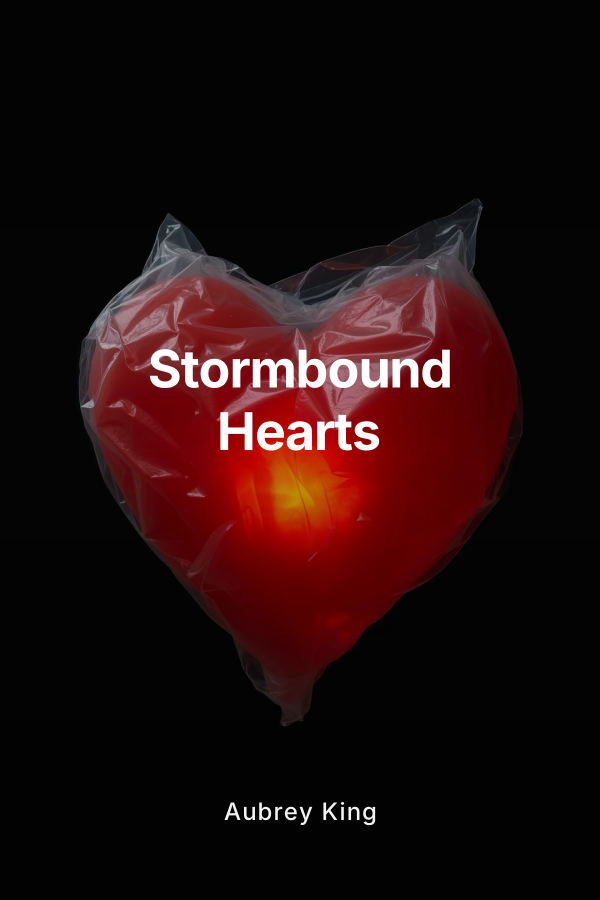
This book follows Elowen, a young woman whose emotions are literal storms, and whose inner world has been shaped by trauma, abandonment, and the heavy, clumsy love of a chaotic found family. Rooted in the emotional landscape of borderline personality disorder, depression, and chronic suicidality, the story traces her life from haunted childhood to hard-won healing, always grounded in how people like her truly feel, cope, and grow .
Across five parts that mirror the storms she carries inside, the book explores how a girl who believes she is “too much” and “never enough” at the same time slowly learns to live with the weather in her chest instead of trying to destroy it.
Chapter 1 introduces Elowen as a child whose moods arrive like sudden squalls. With Philza’s quiet, steady presence as her anchor, Wilbur’s gentle comfort, Techno’s protective watchfulness, and Tommy’s noisy deflections, we see early signs of emotional intensity, terror of abandonment, and identity confusion long before anyone has language for diagnoses . Her “storms” are taken both literally and metaphorically: gusts of wind, static crackles, and strange weather swirl when she spirals, revealing a magical realism layer that externalizes her mental state. The family’s different reactions to her outbursts form the emotional blueprint that will shape her relationships for years.
Chapter 2 follows Elowen into adolescence, when her symptoms sharpen and her world becomes more volatile. Ordinary slights feel like soul-deep betrayals. Small arguments trigger disproportionate rage, terror, or dissociation. She swings between idolizing people and suddenly believing they secretly hate her. Friendships, crushes, and family bonds all become battlegrounds for her fear of being left behind. At the same time, she starts to notice that other people’s minds do not work like hers. She tries to mask her instability with humor, caretaking, or reckless decisions, but the storms only grow. This section delves into self-harm, suicidal ideation, and the desperate search for something to numb the pain without glamorizing it, always emphasizing the complexity and humanity behind those urges rather than reducing them to shock value.
Chapter 3 centers on collapse and diagnosis. A series of losses and misunderstandings culminate in a crisis that Elowen cannot outrun. Her storms become dangerous, threatening both herself and the people she loves. Intervention follows: hospital stays, confused professionals, labels she does not want but also secretly clings to because they promise an explanation. Borderline personality disorder, depression, chronic suicidality, and trauma-related symptoms come into focus, but the book avoids turning her into a caricature or a textbook. Instead, it lingers on the shame, the relief, the anger, and the grief that come with naming what has always felt like a personal failing. Her family must confront their own patterns too: saving, enabling, minimizing, or overreacting. This chapter explores the painful gap between being “treated” and truly being understood.
Chapter 4 explores the slow, non-linear work of healing. Elowen begins therapy that actually fits her, learns practical skills to ride out emotional storms, and experiments with boundaries that terrify her because they risk conflict and abandonment. Relapses happen. Suicidal thoughts still whisper. Some relationships fracture; others deepen and change shape. She learns to see her younger self with compassion instead of contempt. The magical storms that once only erupted in chaos now start to respond to her choices and coping strategies, becoming a visual metaphor for regulation, acceptance, and the idea that feelings can be intense without being lethal. This chapter focuses on survival tools, crisis plans, supportive communication, and the reality that getting better is rarely a straight upward line.
Chapter 5 looks at what it means for someone like Elowen not to be “cured,” but to build a life that can hold both her pain and her joy. She redefines self worth, shifting from “am I lovable” to “how can I love and be loved in ways that do not destroy me.” Her relationship with her found family matures: they step back from constant rescuing and toward mutual, healthier interdependence. Elowen starts to imagine a future that is bigger than her diagnosis trauma, where her sensitivity becomes a strength in creativity, empathy, and connection. The storms remain part of her, but they are no longer the enemy. They are weather that she has learned to read, respect, and move through without always losing herself.
Throughout, the book is written for readers who live with intense emotions, identity instability, trauma, or chronic suicidal thoughts, as well as those who love them and want to understand. It neither romanticizes suffering nor flattens it into neat lessons. Instead, it treats Elowen’s inner world with seriousness and respect, showing how survival often looks like small choices: answering a text, going to one more appointment, sitting through one more wave of pain instead of acting on it.
“Stormbound Hearts” is ultimately a story of persistence in the face of a brain that often feels like an enemy. It invites readers to see the beauty and strength inside people who are told they are “too much,” and to believe that even the fiercest storms can become part of a life worth staying for.