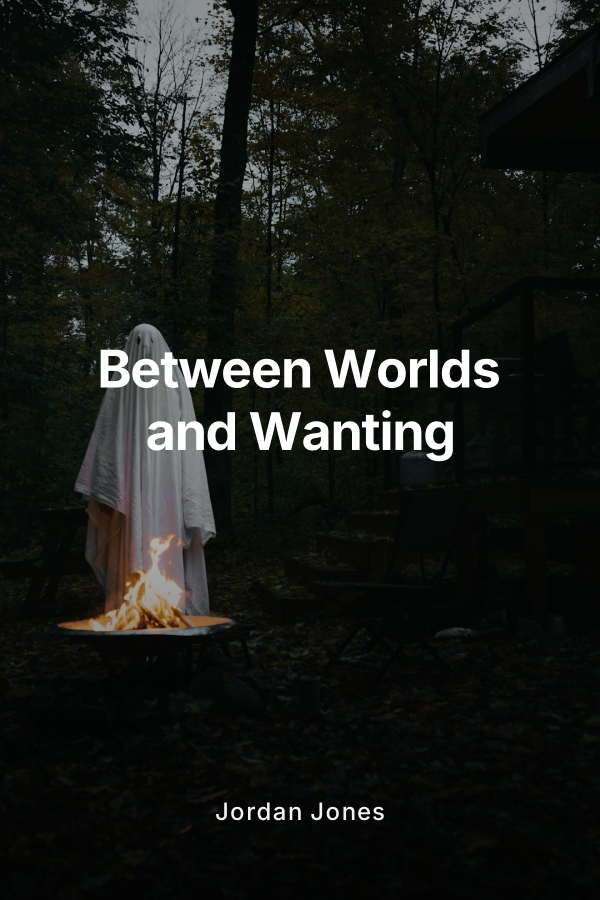
This book is a character driven paranormal romance about Alex, a living, anxious overthinker who has always felt too much and spoken too little, and the two ghosts he slowly, bewilderedly, falls in love with: Isaac, a tender historian with a restless soul, and Nigel, a sharp tongued skeptic who hides a soft heart under his hauntings. Their story unfolds in a contemporary city that feels a little too cold and a little too crowded, where the supernatural exists just out of sight and grief lingers in stairwells and empty rooms.
At its core, the book explores how intimacy can bloom outside of normal rules, how consent and boundaries matter even beyond death, and how love reshapes what a “body” and “touch” can mean when one partner is flesh and the other two are made of memory and will. It follows Alex from lonely numbness into a vivid, confusing, deeply sensual life in which every tingle of phantom fingers, every chill of air, every brush of unseen lips becomes both a question and a promise.
The book will be roughly 10000 words, divided into five chapters, each building on Alex’s emotional and sensual education as he negotiates being desired by people who no longer have bodies, but who still have wants, fears, and very real capacity to hurt and be hurt.
Chapter 1 introduces Alex in a liminal state. He lives in a small apartment that feels borrowed rather than owned and works a job that drains him. His one real anchor is Sam, a grounded friend who keeps him tethered to the living world. Alex begins to notice odd sensations in his space: the subtle pressure of a thumb along his wrist when no one is there, a warmth at the back of his neck like someone leaning in to read over his shoulder, cold sparks across his shoulders that feel almost like laughter. These are ghost touches, but at first they register only as anxiety. As the chapter progresses, a pattern emerges. The touches react to his moods, pulling away when he is overwhelmed, returning when he calms and opens up. This is the first hint that someone, not something, is reaching out.
Chapter 2 reveals Isaac and Nigel as distinct presences. Isaac’s touch is feather light and careful, more like warm breath or sun on skin, testing boundaries and waiting for permission. Nigel’s touch is sharper and more direct, a cool palm against a hot cheek, a firm hand at the back of Alex’s neck when he spirals. As Alex starts to speak to the empty room, the touches grow more coordinated, answering questions with a brush against his pulse, a pressure at his shoulder, a tightening around his fingers. When he gives explicit verbal consent for the sensations to stay, something shifts. The air thickens, outlines shimmer, and Alex catches his first brief, blurred glimpse of Isaac’s shape leaning against his bookshelf and Nigel’s tall, watchful form by the window. These flashes of visibility are tied to trust and emotional openness. The more honestly Alex speaks, the clearer they become. The chapter becomes a slow burn study of how three people can begin to know one another when two of them are half invisible, centering small, careful experiments with touch and the discovery that they can all feel pleasure, comfort, and even a form of shared warmth through focused intention.
Chapter 3 focuses on rules, boundaries, and the ethics of haunting. As the romance between Alex, Isaac, and Nigel deepens, they realize that intimacy without structure could easily become overwhelming or coercive. Together they establish consent practices that respect Alex’s autonomy and the ghosts’ vulnerabilities. They agree that no ghostly touch happens without a clear yes, whether spoken aloud or signaled through a practiced energetic “opening.” They set up safe words and gestures so that any of them can stop at once, and they discuss hard limits like no full body possession, no touching Alex in public without warning, and no manipulating his emotions to get stronger manifestations. These conversations are frank, awkward, and tender, revealing Isaac’s fear of vanishing if Alex pulls away, Nigel’s guilt over the times he pushed boundaries when he was newly dead, and Alex’s terror of being “too much” or “not enough” for them. The supernatural rules of ghost sensation are explained in detail: the way ghosts can selectively make themselves tangible only where they are invited, how they feel human warmth and arousal as ripples of energy rather than nerve signals, and how pushing through resistance burns or drains them, leaving lingering marks that are emotional rather than physical.
Chapter 4 explores what it means to build a polyamorous relationship that bridges life and death. With a foundation of negotiated consent, the triad experiments with ways of being together that honor each partner’s needs. Isaac and Nigel each cultivate separate dynamics with Alex, as well as a shared, evolving bond between all three of them. Isaac becomes the patient teacher of slow, layered sensation, guiding Alex to notice how a faint shiver against his ribs can be as intimate as a kiss, how ghostly touches can map his body without leaving marks. Nigel becomes the guardian of boundaries and reality checks, the one who calls breaks when Alex dissociates or when the energy between them spikes into something that could hurt. The chapter shows how their different styles blend into nights of passion that are as much about talking and reassuring as they are about arousal, focusing on nuanced depictions of sensory experiences rather than explicit acts. At the same time, they all face the outside world: Sam’s concern about Alex “dating the dead,” the social impossibility of explaining his new partners, and the way loneliness returns as soon as he steps outside the haunted apartment. The question becomes whether intimacy that lives mostly in one room can truly sustain them all.
Chapter 5 brings everything to a head. A crisis forces the trio to test the limits of their rules. Maybe a surge of Alex’s fear threatens to cut him off from seeing or feeling Isaac and Nigel at all, or a reckless attempt at deeper connection edges close to possession, triggering all their old wounds. The boundaries they negotiated are strained and nearly broken, with real costs. Isaac weakens and flickers, Nigel risks disappearing completely by pouring too much of himself into protecting Alex, and Alex faces the possibility of losing both of them. Through painful but honest confrontation, they reaffirm their consent agreements and rewrite some of them, recognizing that love cannot be safe without also being flexible and evolving. The climax is less about spectacle and more about emotional clarity: Alex chooses a life that includes the dead, Isaac and Nigel choose to exist with less control in order to respect Alex’s humanity, and together they create a new understanding of what bodies and love can be. The story closes on an image of Alex lying in bed between two outlines that are finally clear to him, feeling their hands in his and knowing that every touch is both a miracle and a choice they keep making, again and again.
Throughout, the book stays focused on sensuality, communication, and the intricate dance of consent in a relationship where physical, emotional, and supernatural boundaries constantly overlap. It is meant for adult readers who enjoy paranormal romance, polyamorous dynamics, and intimate psychological detail, and who want a story where trust, negotiation, and mutual care are every bit as charged and compelling as the ghostly touches that bring three lonely souls together across the line between life and death.