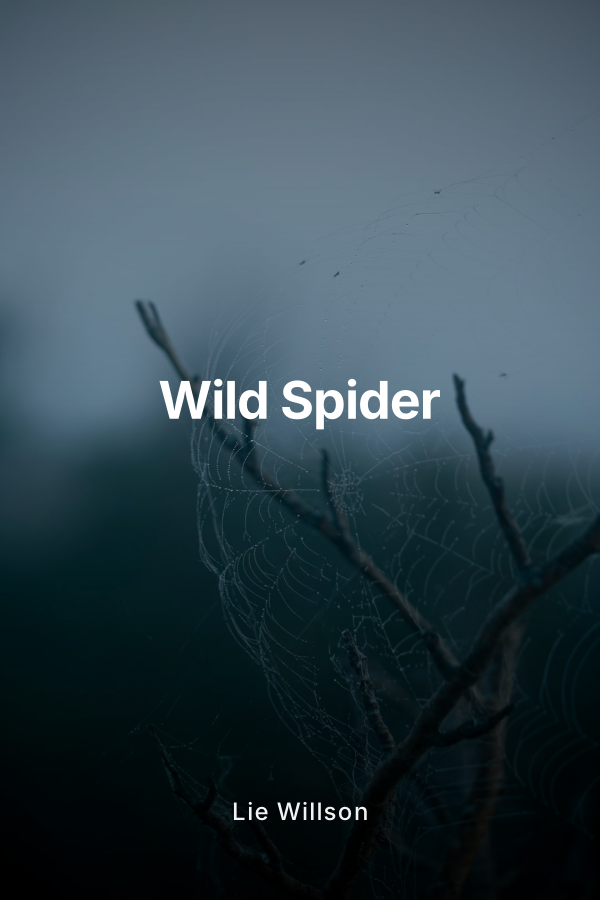
This psychological horror novel follows a shy, lonely seventeen year old boy whose life is quietly suffocating under school bullying, family tension, and an unspoken history surrounding his grandparents’ chemical laboratory. One ordinary evening, as he returns home from shopping with his aunt, grandmother, grandmother’s sister, and uncle, he is bitten on the palm by a strange yellow spider in the driveway. At first the spider feels oddly soft, then its body hardens, its legs lock, and a needle like sting buries itself deep into his hand. This ordinary moment becomes the pivot of his entire existence, the point where reality begins to rot from the inside out .
He tries to dismiss the bite as nothing, but in the days that follow, unease seeps into every corner of his life. The front door had been found unlocked and already open when they arrived that evening, yet no break in is reported and nothing appears stolen. Instead, small, disquieting anomalies accumulate. He hears faint scratching behind walls where no rats have ever been. Shadows linger half a second too long in the corners of his vision. His reflection seems off, not by anything obvious, but by a subtle wrongness that makes him avoid mirrors. As the bite mark on his palm darkens and bruises into an almost web like pattern, he starts losing time. Gaps appear in his memory. Hours vanish. He wakes with aching muscles, grime under his fingernails, and the metallic smell of blood on his clothes, with no idea what he has done.
The novel begins as a slow burn psychological thriller. The boy’s inner world becomes the battlefield, as hallucinated figures and an elusive unknown entity appear at the edge of perception. Shapes crawl on the ceiling only when he is alone. Humanlike silhouettes move with spiderlike jerks and angles. Voices whisper from vents, from drains, from the dark gap under his bed. He cannot tell whether he is losing his mind or being hunted by something that came in with the bite. The deeper terror is that the hunter feels intimately connected to him, as if the entity is not just outside, but growing inside his thoughts, his nerves, his bones .
As fear and paranoia rise, his family’s behavior adds to the sense of unreality. His aunt watches him for a second too long before forcing a smile. His grandmother insists nothing is wrong, yet avoids talking about the old laboratory their family once owned. The grandmother’s sister changes the subject every time the past comes up. His uncle keeps the basement door locked, muttering about “dangerous junk” left from the old days. Each relative seems potentially innocent and yet suspicious in their own way. Their evasions, half answers, and secretive glances around the house push him closer to the edge, feeding the impression that there is some long running family secret linked to the spider, the bite, and the unlocked front door .
Gradually, the story shifts from the boy feeling hunted to something more insidious. His personality begins to warp. The shy, gentle teen grows irritable and cold. His movements become unsettlingly precise. His senses sharpen at night, especially to vibrations and distant sounds. He starts to notice strange marks on walls and ceilings that match the clawed pattern of his own altered fingers. His body lengthens and tightens in ways he cannot share with anyone. He feels a crawling under his skin, like threads being pulled into a new shape. Yet his conscious mind remains in denial. He truly believes he is the victim of an unseen predator, not realizing that his body and mind are slowly being overtaken by a spider entity that uses him as its host and vessel .
The first killings occur only after the transformation is complete. There is no half human struggle in the moment of attack. Once the entity fully asserts itself, it hunts with inhuman focus and speed, leaving no physical trace that ordinary investigators can recognize. Victims die in incidents that look at first like bizarre accidents: a fall from a window, a car swerving inexplicably, a sudden disappearance from a quiet street with no blood, no footprints, no witnesses. The neighborhood starts whispering about a curse, about something that moves too quickly to be seen. The boy, losing more and more of his memory, wakes with blurred flashes of faces, the echo of screams that might be dreams, and the cloying scent of fear in his nostrils.
The family home becomes the central stage of dread. During a particularly frantic night, as the entity prowls the house, an innocent relative is chased into the basement. This relative, previously just another background figure in the household, is forced into the role of accidental investigator to survive. They stumble onto a hidden suitcase beneath rotten boards, concealed under layers of dust and spiderwebs. Inside they find burned research files, charred at the edges yet still legible, along with old newspaper articles. The reports describe a fatal incident at a privately owned chemical laboratory that once belonged to the boy’s family. There are references to experimental spiders exposed to unknown chemicals and vague mentions of a leak that caused the lab to be abandoned after unexplained deaths .
In those frantic pages, the truth begins to loosen its bonds. The relative realizes that the wild yellow spider which bit the boy was not an ordinary creature. It was a remnant of the abandoned experiments, a surviving vector contaminated by a secret chemical mix. More horrifying still, buried among the half burned pages are laboratory notes that reference using the DNA of an infant relation in experimental procedures. The boy, bitten years later, was in fact bound to the experiment from the day he was born. His genetic material was attached to an experimental spider strain in his infancy, making him uniquely susceptible to the entity that would later awaken through the bite. The lab “accident” turns out to be the direct result of his own grandparents’ reckless work, a catastrophe his family covered up and tried to bury along with the lab .
The basement chase culminates in a harrowing confrontation. The transformed boy, now more spider entity than human, corners the relative. Yet instead of an immediate kill, the scene turns into a tense, nightmarish standoff between predator and prey, knowledge and ignorance. The relative’s terror is sharpened by the dawning realization that the monster before them is someone they once loved. They manage to flee in a desperate scramble, suffering grave injuries but escaping the house alive. Barely clinging to consciousness, they are found and rushed to the hospital, surviving just long enough to become the only living witness to what stalks the neighborhood .
In the hospital, the psychological thriller reaches a cruel peak. The traumatized relative tries to explain what they saw. They speak of a human spider entity, of a family experiment gone wrong, of burned files and an old lab logo. Their story is met with calm disbelief. Doctors attribute their testimony to shock and delirium. Police listen, take a bland report, and classify the account as unstable rambling. There are no obvious claw marks, no unusual bodies, no official record of the long abandoned laboratory beyond a few archived mentions of a minor “industrial accident.” Without physical proof, the relative is dismissed as mentally disturbed and gently steered toward psychiatric evaluation. Their truth is smothered by polite, institutional skepticism .
Yet the evidence is not entirely lost. Among the burned documents in the suitcase, the relative had glimpsed the family name and logo clearly printed on old lab files. Signatures from the boy’s grandparents link them directly to the experiments and the fatal leak. This realization shatters any lingering belief that the horror might be an accident of fate. The monster haunting the neighborhood is not a random curse. It is the living legacy of a family’s ambition and secrecy. Though the authorities do not accept the story, the reader is allowed to see the chain of responsibility from the lab, to the wild spider, to the bite, to the boy, to the mounting trail of bodies .
Meanwhile, the entity itself vanishes. After the hospital incident and the relative’s failed attempt to expose the truth, there are no more confirmed sightings at the family home. The boy is no longer seen. The house grows quiet. All that remains at the original scene is a disturbing scratch mark, carved deeply into a surface in a way no human tool could easily replicate. The mark looks almost like a jagged web, or a signature left by something that knows how to hide. This solitary piece of evidence is too ambiguous to be used in any official report, yet too unsettling to be entirely ignored. It becomes the seed for the legend that follows .
From here, the narrative jumps forward in time and shifts form. The story widens into the domain of urban legend and digital folklore. Rumors begin to spread on dark, fringe forums where paranormal enthusiasts gather. Anonymous users trade stories about a “spider boy” who haunts a nameless neighborhood, attacking victims so quickly and cleanly that deaths resemble accidents. Witnesses describe feeling an oppressive presence near an abandoned chemical lab on foggy nights. Some posts share glitchy CCTV clips showing a distorted shape darting across a frame before the video turns to static. Others claim to have captured a blurry human spider shadow in the mist near an overgrown building, or to have heard strange, rhythmic clicking sounds echoing from inside the sealed lab at night .
A small group of obsessive researchers on one of these dark forums takes the stories seriously. They map scattered missing kid reports that cluster around the same general area and time patterns. They collect screenshots, frozen frames of corrupted footage, and snippets of eerie audio captured near the abandoned lab. In the clips, a faint scraping or tapping noise can be heard under the hum of the recorder, like many tiny legs moving in unison. The evidence remains ambiguous enough to be debunked by skeptics, yet consistent enough to drown out simple coincidence. Some threads speculate about a chemical experiment gone wrong. Others hint at a cursed family with blood soaked secrets. The original relative’s story, distorted and secondhand, appears in fragments: someone mentions a hospitalized “crazy cousin” who spoke of a spider creature, another references half burned lab papers with a family logo that no one can verify anymore .
In this shifting digital labyrinth, belief and disbelief mingle. Many commenters mock the idea, calling it an obvious fabrication. Others half believe, half hope it is not real. A dedicated minority, however, treat the legend like a case file, constructing timelines, comparing photographs, and planning late night trips to the old lab’s perimeter. One anonymous paranormal fan begins posting as a self styled investigator, claiming to live near the neighborhood. They upload a low resolution picture of a dark street corner, insisting that if the image is brightened, a thin, impossibly jointed figure can be seen clinging to the side of a building. The thread explodes in argument. Is it a trick of light? A manipulated photo? Or something else?
What makes the book haunting is that it never gives the comfort of a final answer. The entity is never captured or conclusively proven. The boy’s fate remains unresolved. There is no scene of redemption, no courtroom reckoning for the grandparents’ sins. Instead, the horror migrates from the physical neighborhood into the collective imagination. It lives in public rumor, private nightmares, and the invisible paths of the internet. Missing child reports continue to appear with disturbing regularity, following a pattern that the book deliberately keeps undescribed and elusive. Some vanish on foggy nights, others near the cracked walls of the old lab. Each disappearance is officially explained away, yet an undercurrent of fear persists among those who know the rumors .
In the closing movement, the narrative lingers on this “no end” sensation. The final chapters intercut between late night forum threads, empty streets around the lab, and unseen eyes watching from darkness. A small circle of online researchers, convinced the legend is real, pushes further, preparing to visit the abandoned site in person. One poster hints that they are already near the building, that they hear something moving just out of sight, that the air tastes metallic. Another thread compiles missing kid articles from different years, highlighting the same unsettling phrase repeated in neighbors’ testimonies: “We did not hear anything at all.” The story leans into the terror of silent violence, of a predator whose approach leaves no warning until it is too late .
The book ends on a chillingly open note. There is no climactic battle in which the monster is slain, no reveal that the horror was only in someone’s mind. Instead, a final image lingers. Somewhere in the neighborhood, mist rolls in over cracked pavement near the old lab. A camera records for a moment, capturing a faint, elongated shadow that moves along the fog like something part human, part spider. The footage flickers, warps into static, and the recording cuts out. On the dark forum, a new post appears with the corrupted clip attached. Comments begin to stack below, some laughing, some swearing it looks real, some begging for more details. The last line suggests, without stating outright, that the entity is still out there, hungry, patient, and watching those who dare to speak its name online.
“Wild Spider: The Experiment, the Bite, and the Birth of an Urban Legend” is crafted for readers who relish psychologically driven horror, morally tainted family secrets, and stories that blur the line between mental breakdown and supernatural invasion. It traces one boy’s transformation from bullied, gentle teenager to inhuman predator, not through heroic arcs or clear resolutions, but through a chain of choices, cover ups, and scientific arrogance that infects an entire community. The novel refuses to tie its terror off neatly. Instead, it lets the horror seep into the reader’s own reality, suggesting that some experiments never truly end, that some doors stay open long after everyone insists they were closed, and that the monsters we create rarely stay where we left them.