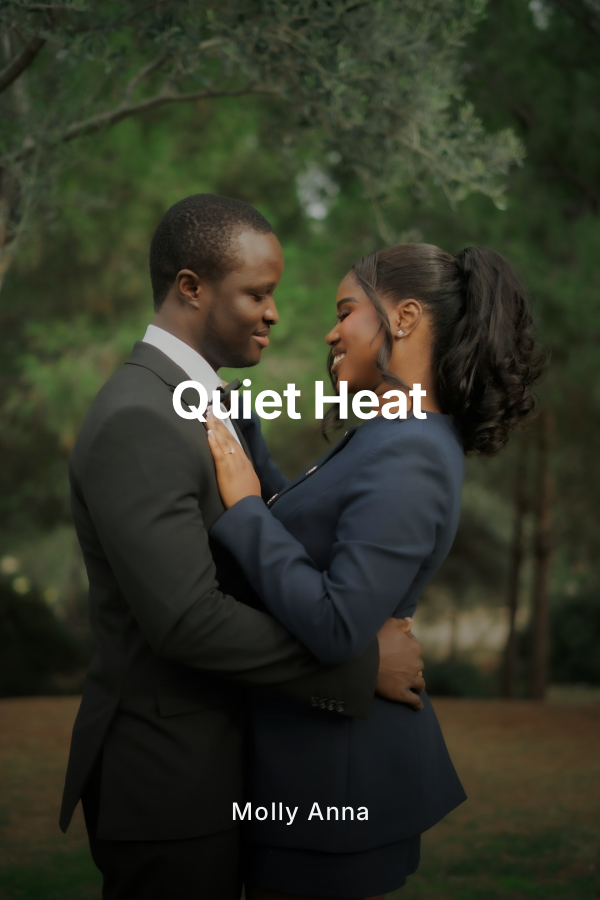
Quiet Heat is an intimate, character driven Southern queer romance that traces the slow burn and sharp edges of life between Adam, a gruff fifty six year old retired war veteran, and Marcus, a twenty four year old tattoo artist who has quietly wrapped his whole life around this older man. Built around domestic ritual, power that never needs naming, and sex that takes up entire nights and entire chapters, the book explores how two emotionally guarded men build something solid out of silence, habit, and a shared hunger they never quite put into words .
At its core, the story lives in the small details of their daily life. Adam is all worn edges and heavy presence, a large, weathered Southern man with a tired face, a soft but powerful body, and skin covered in old ink and war memories. He smokes, drinks his whiskey, moves slow, and talks even slower. He rarely shows feeling, yet his whole day bends around where Marcus is, what Marcus is doing, whether Marcus has eaten or slept. He treats Marcus like a quiet responsibility he never quite agreed to but would never let go of, a mix of ward, possession, and beloved pet he keeps close with a big hand and a sharp word .
Marcus, by contrast, is young, inked, and boyish, with a modern mullet and metal at his tongue, nose, brow, ears, and skin. He is confident and relaxed in himself yet soft spoken and stoic, a gentle presence who rarely raises his voice or pushes for more than Adam will give. His life outside the house circles around the tattoo studio, smoke breaks, and the simple routine of coming home to Adam’s heavy tread and cigarette smell. Inside their shared space, he is calm, almost passive, always drifting toward Adam when pulled and settling against him like he belongs there. He is addicted to him in a quiet way, never dramatic, but unmistakable in the way he always ends up within Adam’s reach .
The book follows them three years into their relationship, long after the first spark, when the affair between ex soldier and tattoo apprentice has already turned into cohabitation, shared groceries, and worn routines. Their origin stays in the background as context Adam’s first appointment with Marcus when Marcus was a nineteen year old intern at the shop yet the focus lies firmly on the present, on the way their age gap and size difference settle into their bones as something lived in and daily, rather than new and shiny. The story moves through quiet mornings, slow evenings, Marcus leaving for the studio while Adam stays home, and the low, constant tension of an older man who pretends he does not need anyone and a younger one who knows better but never says it out loud .
Across five chapters, Quiet Heat balances two distinct but intertwined modes. Most of the book lives in the domestic, where nothing sensational happens and everything important does. Adam cooks with absent minded competence, Marcus cleans without being asked, they share cigarettes on the porch in the dim light, or sit together while Marcus sketches new designs and Adam watches television with one tired eye. Even their mild conflicts grow out of these routines Marcus smoking weed when Adam would rather he did not, Adam growing taciturn and restless when Marcus is at work too long, texting him in gruff, bored messages that barely hide how empty the house feels without him .
Within those slow scenes, the power dynamic hums low. Adam is physically dominant without theory or labels, working from instinct rather than kink vocabulary. He is bossy, possessive, and unapologetically hands on, manhandling Marcus into chairs, tugging him out of rooms, guiding his chin, his shoulders, his waist with a big scarred palm. Marcus, for his part, leans into that treatment with a steady, bratty ease. He enjoys being pushed, pinned, and corrected. His rebellion is light and sardonic, then melts instantly into obedience when Adam decides enough is enough. They never sit down to name these things, never talk about rules or titles, yet their strict unspoken script is clear in every mundane interaction .
The remaining chapters are sexual in focus, and the tone sharpens from cozy to feral without losing its thread of affection. Those chapters are not quick interludes tucked into the plot but whole night long explorations of their dynamic. The first explicit chapter centers on a late summer night, after Adam steps from a hot shower, steam curling off his older, inked, towel wrapped body. Marcus waits on the bed, quiet and steady, then simply asks him to come closer. From that soft beginning the scene builds into an intense display of Adam’s rough, unstudied dominance and Marcus’s eager submission, with the younger man’s piercings adding an edge of sensation that Adam responds to despite himself. His dirty talk is mean on the surface, full of gruff commands and cutting remarks, but undercut by the care in his grip and the way he checks Marcus’s reactions without ever calling it that .
The second sex focused chapter broadens the physical side of their relationship beyond a single encounter, turning the whole chapter into a continuous sequence of teasing, bratting, and consequential roughness. Marcus pushes at Adam’s patience with quiet defiance, and Adam, who has long reserves of calm, lets him run out the leash until the moment he does not. When that line is crossed, he takes Marcus in hand with an almost cruel intensity, using his size and strength without restraint but never without consent. The scene makes space for the way Marcus lights up under that treatment, how he craves being put in his place, while still making it clear that Adam’s harshness comes from an instinct to claim and keep, not to hurt. After, the aftercare is implicit in simple gestures shared smoke, shared shower, shared bed, bodies touching, words minimal but solid .
Throughout, the book refuses melodrama. Adam and Marcus do not declare love or indulge in romantic speeches. They are nearly unemotional on the surface, two men more comfortable with action than language. Yet their attachment is unmistakable in the way they orbit each other, in Adam’s wordless protectiveness and Marcus’s unwavering loyalty. The tension of their age gap and different eras of queerness surfaces in small ways Adam’s old fashioned views and language, Marcus’s modern ease and piercings yet never explodes into a dramatic fight. Instead, those differences become texture, part of the heat between them and the comfort they build in each other’s arms .
Quiet Heat is written for readers who savor slow, lived in queer relationships where power is instinctive rather than negotiated in long conversations, and where the most emotionally revealing scenes might be a cigarette shared in silence or a text from a bored older man to the younger one who keeps his world turning. It blends cozy Southern domesticity with unapologetically explicit, rough intimacy, always clear that what looks harsh from the outside is, for these two men, the deepest form of trust. By the end of the book, nothing flashy has changed, yet everything has settled. Adam is still grumpy and guarded, Marcus still soft and stoic, but their life together feels inevitable, like a long slow burn that has finally found its steady, quiet flame.