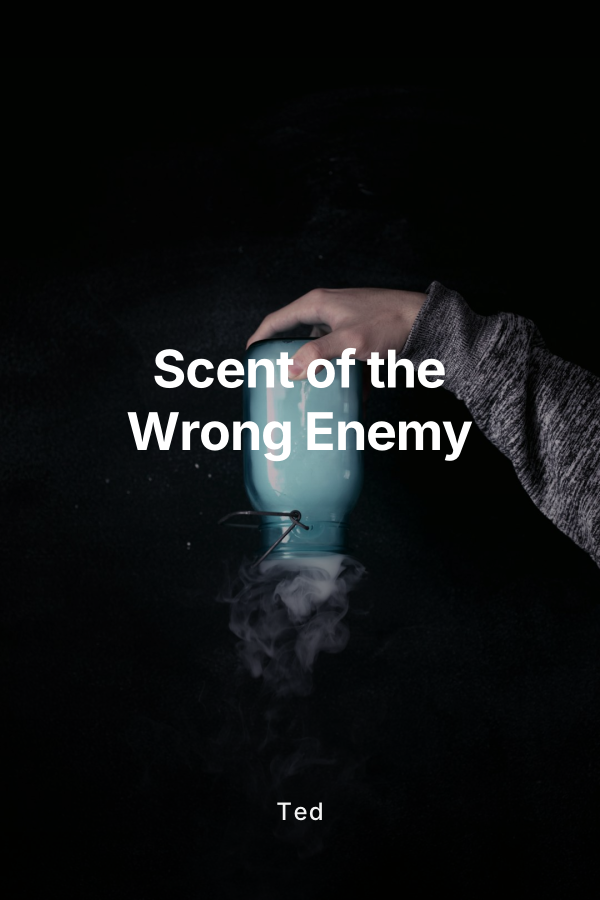
This book follows Mason and Connor through three distinct stages of their lives in a stratified, scent ruled society: brutal college years as enemies who cannot stop touching each other, the shattering separation that leaves Mason pregnant and alone, and the brittle, scandal driven marriage that forces them back into the same bed for the sake of a child who has no idea their parents can barely stand each other.
The story is an angsty, explicit, Omegaverse inspired slow burn centered on social hierarchy, ruts, pheromones, and the corrosive cost of pride. Mason begins as an exceptional beta who prides himself on being “better than all the others” because he cannot go into rut or heat and believes that makes him untouchable. In a world where betas are mocked and sidelined, he compensates with a sharp tongue, a motorbike, and a refusal to back down. His breaking point comes when an alpha taunts him one time too many on campus. Mason’s brutal response wins him sudden respect, and it is this fight that first draws the eye of Connor, a rare high status enigma with golden eyes, green apple and pine scent, and a body that screams control Mason cannot stand.
From that first clash, Mason and Connor are shoved into close quarters as dorm roommates. Mason already resents Connor because the girl he likes turns him down in favor of “someone more dominant,” meaning an alpha or enigma, and specifically because she likes Connor. The rejection solidifies Mason’s one sided vendetta. He reads every quiet look and careful distance from Connor as judgment, and he commits to hating him. In public, Mason is openly hostile and cutting, while Connor plays it off as a harmless, one sided grudge, which makes Mason seem like the only jerk in the room. Under the surface, though, Connor is watchful and quietly kind in small, deniable ways Mason refuses to see.
Everything fractures when Mason abruptly shifts from beta to alpha. Overnight, the hierarchy that once spat on him now regards him with wary respect and fear. His new biology, however, is nothing like he imagined. Pheromones he once ignored now make him nauseous. The girl who rejected him smells sickeningly sweet, and the fantasy of winning her over dies the instant his body recoils from her scent. Mason, raw and humiliated, fixates on Connor as the problem and convinces himself that it is Connor’s scent that makes him ill, not the memory of rejection knotted up with his own insecurity.
When Mason’s first rut hits unexpectedly, he is alone in their dorm, grateful that Connor left for a weekend with his rich, exacting family. The relief is short lived. Connor’s early return traps them together in a building lockdown, doors sealed and pheromones spiraling. Mason’s rut explodes into a suffocating storm, overwhelming both of them. Connor is not immune. As an enigma, his own instincts flare in response to Mason’s scent in a way he is not supposed to let anyone see. The only way through is physical, frantic, and rough. They give in. The sex is explosive, deeply instinctive, and far more mutual than either of them is willing to admit. They both agree, afterward, to pretend it never happened.
It is a promise they break over and over.
In the weeks that follow, the dynamic curdles into a private addiction. Mason, stuck in denial and bitterness, keeps seeking Connor’s scent without acknowledging why. He finds excuses to be in Connor’s space, steals his shirts, and begins, on instinct, to build a secret nest that smells like green apples, pine, and faint body spray of petrol and oil. Connor, for his part, lets himself be used while fighting his own growing obsession. He keeps one of Mason’s things tucked away, a small, pathetic echo of the nest Mason is unconsciously constructing. Connor acts cold during sex, grips too tight, and looks away afterward, leaving the dorm more often and withdrawing any casual warmth.
Outside the dorm, rumors swirl. One particularly lurid version of their first rut leak paints Mason as the aggressor and Connor as a careless user, but the story is so distorted it is easy for both of them to dismiss it as baseless gossip. Privately, it stings because it is the only part of their relationship anyone else ever guesses, and it still misses the truth. A sharp eyed girl, the same one who rejected Mason, notices that he suddenly smells “like someone else” and starts piecing things together. Her suspicions and accidental rumors cast a shadow over every class, every group project, every party where Mason’s hostile glares follow Connor across the room.
Amid this, a professor who half ships them and half wants to punish their disruptive tension keeps pairing them for high stakes assignments, forcing long nights of tight lipped bickering, unresolved sexual history, and unspoken need. A mutual acquaintance eventually calls Mason out directly for the way he treats Connor, pointing out that using someone and then publicly resenting them is not strength but cowardice. Mason shuts them down, yet the accusation lingers.
The turning point in the college arc comes at a party. Mason arrives drunk, already strung out and scent sensitive. He finds Connor laughing with someone else, their pheromones brushing against Connor’s as if they have any right. Jealousy and rut tinted instinct slam into him. He sees red, storms in, and drags Connor away on a pretext. The fight that follows in a dark corner of the party bleeds into an angry make out, then a second, fully conscious hookup that neither can blame on lockdown or uncontrolled rut. Back in their dorm, drunk and unguarded, Mason physically clings to Connor in sleep and wakes the next morning horrified to realize he spent the night in a nest made of Connor’s clothes and scent.
Their pattern continues, rough and secret, oscillating between desperate need and cutting distance. Connor slowly breaks under the weight of unspoken feelings. He avoids Mason’s eyes after sex, stops joking, and starts staying with friends more often. When Mason pushes too far in an argument, Connor goes quiet in a way that feels like an ending. One last hookup follows, emptier, with Connor’s touch still rough but his expression shuttered. Shortly after, Connor leaves to visit his family again, and Mason, alone with the lingering ache and scent, discovers he is pregnant.
In this world, an alpha pregnancy is possible but fraught, especially when entwined with a rare enigma’s genes and the politics that entails. Mason panics. Instead of telling Connor, he runs. No note. No explanation. Just absence where his bikes, clothes, and biting presence used to be. Connor returns to an emptied dorm, the subtle smell of change and fear in the air, and no answers. The college arc closes on parallel isolation: Mason alone with a new life he never meant to carry, and Connor alone with a missing enemy he cannot admit he loved.
Five years pass.
Mason surfaces in a far less glamorous corner of the city, an overworked single parent clocking basic shifts, counting coins, and pouring every soft thing he has left into a kid who smells like trouble and home. He has become bitter and closed off, jumpy around strong scents, but impossibly gentle when his child is in the room. Their world is small but fiercely defended. Mason avoids alphas, avoids campus districts, avoids any trace of green apples and pine.
Connor’s life, on paper, is the opposite. He is more successful than ever, folded tightly into a wealthy family that values his enigma status and expects him to marry into an equally impressive bloodline. They pressure him relentlessly to find a suitable spouse and produce a child that can carry the family name and scent forward. Outwardly, Connor dates, entertains prospects, and smiles through formal events. Inwardly, he never commits. No touch feels right. No scent settles him. The hole Mason left has calcified into something private and untouchable.
Their collision in the city is cruelly mundane. At a public place filled with mixed pheromones and background noise, Connor catches a scent that nearly stops his heart, not because it is identical to Mason’s, but because it carries threads of both of them. He follows it and finds a small child. When he calls “Mason” across the space, the man who turns and freezes looks older, more exhausted, but devastatingly familiar. The world narrows. Connor asks, “How old are they?” and does the math in seconds. Mason denies it, panicked, until Connor quietly lists the scent markers and instinct tells both of them the truth. Mason bolts, again.
Connor finds him anyway.
Once Connor has an address, he shows up at Mason’s cramped life, not as a lover, but as a father who has been robbed of knowing his child. Their confrontation is ugly and raw. Mason expects rage. Connor brings a lawyer and a threat. With his family’s resources, he can pursue full custody. The implication hangs heavy in the air. Mason’s fear is nuclear. The child, caught in the crossfire, only knows that two tense adults are using strange voices and that one of them smells faintly like home.
Connor is not heartless enough to follow through on the worst version of that threat. He sees Mason’s panic and the way the kid clings to him. Instead, he channels his family’s scandal management instincts. A child born out of wedlock between a high status enigma heir and a former beta turned alpha with a messy reputation is a story their elite circle will devour. The solution, as his family frames it, is simple: fix the scandal with a wedding.
Mason and Connor are pushed into a public engagement, complete with a fancy event where old classmates catch glimpses of them and gossip explodes anew about the college enemies who somehow ended up co parenting a child together. They move into a better home, but the emotional climate inside is far from upgraded. Their day to day life is cold and tense except when their kid is present. They share one bedroom for appearances. They sleep in the same bed because anything else would invite questions about legitimacy and intimacy from the hovering, judgmental social world around them.
At night, the bed becomes a border. In the early months, they keep to opposite edges, stiff spines and clenched fists, both hyper aware of scent and history. Sometimes they wake with the child wedged like a starfish between them, demanding “family cuddles” and forcing their bodies into accidental lines of warmth. Mason flinches when instincts spike, terrified of reaching for Connor out of habit. Connor holds himself rigid, careful not to crowd Mason even when his own rut and pheromones hum at the edge of control. When things get too charged, Mason locks himself in the bathroom until he can scrub his scent flat with hot water. On the other side of the door, Connor sits quietly, voice low and even, making sure the kid does not panic and that Mason knows someone is still there.
There is a long period with no sex at all. They establish an unspoken rule that what happened in college will not repeat, not in this house, not around their child. The cost of slipping is too high. Yet their biology and history do not vanish on command. One night, a shared instinct surge almost breaks them. Their scents spike, the air thickens, and they find themselves too close in a narrow hallway, breaths tangling, muscles trembling with remembered patterns. Both pull away at the last second, Mason nearly shaking, Connor’s nails dug into his own palms. The kid sleeps through it, blissfully unaware of how close their parents came to repeating old mistakes.
Between these sharp, private moments, life goes on. There are school events where the child demands both parents present, tiny hands tugging them to stand closer, to hold hands for a photo, to sit side by side in miniature chairs while paper crowns slide down their foreheads. To the outside world, they are a picture of complicated but functional domesticity. Rumors in their elite circle twist this into a romantic redemption arc for the ages. Only Mason and Connor know that under the polished surface, there is a minefield of unresolved betrayal, longing, and unspoken apologies.
Throughout this forced marriage, Connor continues to date on paper for optics but stops short of anything that looks like genuine emotional involvement. His family watches him with a mix of approval and impatience. Mason shoulders most of the day to day childcare, exhausted but fiercely competent, folding his life around the kid’s needs. At times, Connor sees the same ruthless protectiveness that drove Mason to fight that first bullying alpha now repurposed into late night fevers, frightening school calls, and meltdown soothing. Old resentment knots with new respect.
Slowly, soft moments seep in. There is a quiet morning where they end up cooking in the same kitchen, moving around each other efficiently, not quite touching but no longer flinching. A schoolyard afternoon where both burst into helpless laughter at something the kid says, then fall abruptly silent, aware of what they almost shared. The atmosphere shifts molecule by molecule. Their scents, once weapon and shield, start to settle more calmly in the shared space when they are not actively fighting.
The book refuses to rescue them with a neat confession or a grand romantic gesture. Mason never sits Connor down and admits that he imprinted on his scent years ago, that he built nests out of stolen shirts, that he ran not because he did not care but because he cared in a way he did not know how to bear. Connor never fully explains how much it broke him when the hostile roommate who had become his secret home vanished without a word. They are both too proud, too punished by the past, too scared of defining anything that could once again be lost or twisted.
Instead, the emotional core of the conclusion rests on a series of small, potent images. The kid asleep between them in the marital bed, tiny fingers latched around Mason’s wrist and one foot pressing against Connor’s side. Mason, wide awake in the dark, staring at the ceiling, while Connor reaches over the little body to pull the blanket up over Mason’s shoulder, fingers brushing bare skin for the first time in months. A fleeting moment where their scents soften around each other rather than spike in anger or rut, then steady into something that feels almost like peace.
The final scene leaves them there, in the narrow span of night when no one is watching, when the performance of “fixed scandal” and “respectable marriage” has slipped. They lie on opposite sides of their sleeping child, not lovers, not quite enemies, not healed, not completely broken. A small hope hangs in the air, fragile and unspoken, that if they keep choosing to stay in this complicated, imperfect orbit for the sake of the kid and maybe for their own sakes too, something gentler might one day grow. The book closes before answering whether they ever reach a real happy ending, inviting the reader to sit with the uncertainty, the ache, and the quiet possibility that the wrong enemy might still become the right home.