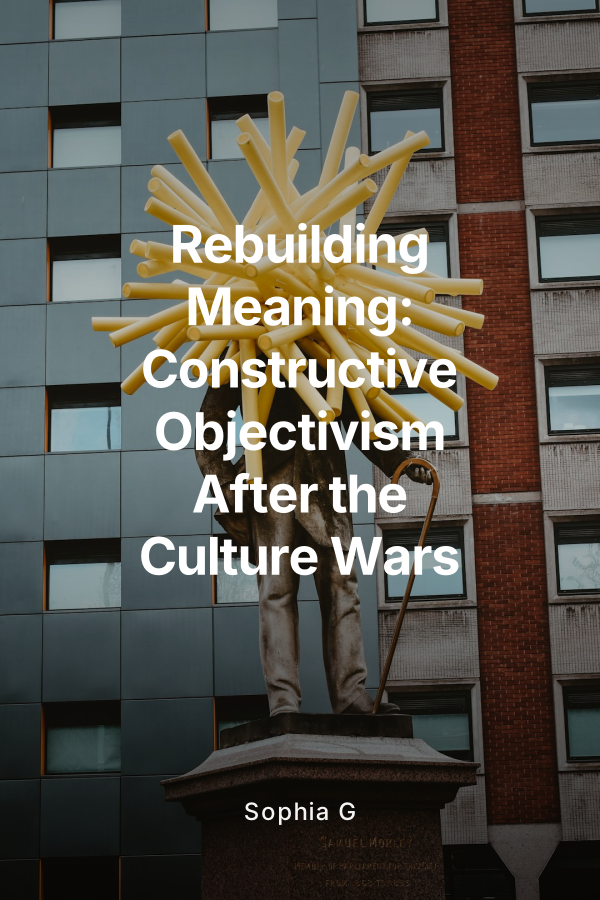
This book is a big–idea philosophical manifesto written for readers who feel that something in our culture has quietly come apart long before the shouting began. It speaks to Spectator‑style intellectuals, academics, commentators, and culture‑weary professionals who sense that contemporary life is thinner, noisier, and more hysterical, yet struggle to name exactly what has been lost. Drawing on a lineage that runs through classical philosophy, twentieth‑century cultural criticism, and recent debates about post‑truth and identity, the book proposes a single, unfashionable claim: reality has structure, and when we stop honoring that structure, judgment, belonging, and excellence die with it.
The project unfolds as a mostly diagnostic polemic that gradually becomes an architectural blueprint for reconstruction. It begins from the lived crises of the present, traces their intellectual roots, then builds an alternative called Constructive Objectivism. This is not an abstract novelty but a reframed synthesis: a philosophy that insists that existence is objective, form is real, and meaning is discovered rather than invented, while also treating beauty, culture, and tradition as indispensable ways in which reality discloses itself. The book aims to offer not a camp to join but a structure to inhabit, giving readers new language for what they already half‑know but cannot yet quite say.
Across five chapters, the argument moves the reader through a deliberate emotional arc: from vague unease, to clear anger, to sober grief, and finally to resolve and bracing hope. The tone shifts accordingly, from cool and analytic in the flagship philosophical chapters to a more prophetic clarity when confronting the cultural wastelands of deculturation and aesthetic vandalism. Throughout, the through‑line remains constant: when form collapses, everything worth wanting collapses with it.
Chapter 1 – The Death of Expertise and the Rise of Opinion
The opening chapter is the flagship, designed to be the most carefully argued and least culture‑war‑coded entry point into the book’s world. It addresses what the author identifies as the central crisis of our time: an epistemological breakdown in which knowledge has been flattened into mere opinion, and expertise is treated either as an elitist power grab or as just another voice in the endless scroll.
The chapter traces how digital culture, populist suspicion, and institutional failure have combined to erode hierarchies of knowledge. Social media timelines make the astrophysicist and the conspiracy theorist visually indistinguishable; classrooms and newsrooms hesitate to rank claims for fear of appearing “authoritarian”; public life oscillates between technocratic jargon and performative certainty. The result is decision paralysis in a world where “everything is valid” but nothing carries acknowledged weight.
Against this background, the author introduces the first core claims of Constructive Objectivism in implicit form. Knowledge, he argues, has structure. Not all opinions are equal, because reality is not infinitely pliable. Authority is not a function of identity, volume, or outrage but of form: a trained attention to the shape of things that allows one to discern what fits and what fails. Genuine expertise is a moral responsibility, not a caste privilege. By the end of the chapter, readers are meant to feel both anger and relief: anger at how lightly we treat serious knowledge, and relief that there remains a principled way to honor it without romanticizing old elites.
Chapter 2 – The Fragile Self: Therapy Culture and Moral Infantilism
If the first chapter tackles our crisis of knowledge, the second addresses the crisis of character that makes that epistemic collapse possible. Here the tone turns “sadly precise”: firm, unsentimental, but never mocking. The book anatomizes what it calls therapy culture, a moral atmosphere in which emotional safety has become the highest good and discomfort the greatest harm.
The chapter traces a cultural shift from stoic self‑mastery to a performative vulnerability that treats fragility as moral currency. Trigger warnings, micro‑aggression charts, and the constant injunction to “center my feelings” are not dismissed as trivial irritations, but analyzed as signs of a deeper anthropological change. Underneath them lies a new image of the human person: not as a responsible agent charged with forming the self, but as a delicate psyche in permanent need of validation and protection.
This is where another pillar of Constructive Objectivism quietly appears. Freedom, identity, and happiness, the author insists, do not come from unfiltered self‑expression but from form: the deliberate shaping of one’s capacities and desires in response to the structure of reality. You do not “find yourself” by endlessly narrating your wounds; you build yourself through habits of attention, discipline, and reverence for what is objectively worthy.
The chapter shows how the cult of emotional sovereignty undermines both resilience and moral agency. When every discomfort is reinterpreted as harm, judgment itself begins to feel like violence. People become incapable of enduring criticism, hierarchy, or beauty, because all three imply standards outside the self. This, the book argues, is the emotional precondition of postmodernity: a population too fragile to tolerate reality as something other than a projection of private feeling.
Chapter 3 – From Universal Dignity to Tribal Morality
The third chapter turns from the psyche to politics, arguing that our public life has moved from a framework of universal dignity to one of tribal moral accounting. Merging what might otherwise have been overlapping discussions of identity politics and anti‑racism into a single, sharper argument, the book reframes contemporary battles over race, gender, and group identity as symptoms of a deeper collapse of moral form.
Rather than producing another predictable skirmish over slogans and acronyms, the chapter treats critical‑theory‑influenced movements as case studies in what happens when justice is detached from any objective order and recast as a permanent struggle between oppressors and oppressed. Anti‑racist initiatives that began as attempts to secure equal dignity, the author suggests, have in many places hardened into inverse discrimination, moral partiality, and ritualized guilt. Public life becomes a theater of competing victimhoods, in which moral standing is assigned by group history rather than present character.
Here the Constructive Objectivist theme of scale and hierarchy comes to the fore. Justice, on this view, is not a free‑floating will to redress grievances but a disciplined attention to the ordered relations between persons and goods. When that order is replaced by pure power calculus, politics devolves into tribal bookkeeping and collective accusations. The chapter argues that this shift destroys individual moral agency. Citizens come to see themselves less as responsible actors embedded in a shared inheritance, and more as representatives of wounded collectives whose primary task is to assert rights rather than assume obligations.
By the end of the chapter, readers should feel both recognition and sober grief. Recognition, because these dynamics are visible everywhere from corporate HR departments to student manifestos; grief, because beneath the slogans lies a genuine longing for justice that has been sabotaged by a false metaphysics of power. The book does not deny structural wrongs; it insists that without an objective moral architecture, even righteous protest curdles into new forms of injustice.
Chapter 4 – The War on Beauty: Aesthetics After Ideology
The fourth chapter is deliberately chosen as the book’s culture‑war showcase, not on the familiar fronts of gender or race, but on the neglected terrain of beauty. Here the tone becomes more vivid and at times prophetic, because the argument is not only conceptual but architectural, visual, and atmospheric.
The book describes the degradation and politicization of beauty in contemporary art, architecture, and public space. Ugliness is defended as resistance, ornament is dismissed as oppressive, public monuments are read only as power symbols. Museums are “decolonized” by curators who resent the very notion of excellence; cityscapes are filled with structures that treat human beings as inconveniences.
Against this, the author unfolds one of the distinctive claims of Constructive Objectivism: beauty is not decoration. It is a mode of cognition. To learn to see beauty is to learn to recognize when something fits, works, and belongs. Beauty trains judgment by orienting our attention toward form and proportion, teaching us to distinguish the cheap and hysterical from the durable and sound. A culture that treats aesthetics as mere taste or propaganda blinds itself to one of reality’s most accessible ways of announcing its own structure.
Vivid contrasts carry the point home. The reader is invited to walk, imaginatively, through online spaces saturated with shrill imagery and flattening irony, then across parts of contemporary cities where historical cores have been replaced by anonymous glass and steel, and finally into landscapes and towns that still bear traces of ordered form. These are not nostalgic postcards but demonstrations of a thesis: culture is a moral ecology, and our built environments either cultivate attention, restraint, and gratitude or they erode them.
By the chapter’s end, Constructive Objectivism’s fusion of metaphysics and aesthetics is clear. Form is not just an artistic concern but an ontological one. The war on beauty is in fact a war on the idea that reality might tell us how to live.
Chapter 5 – Deculturation: When Societies Forget How to Belong
The final chapter widens the lens to examine culture itself as a fragile moral ecology. Here the voice becomes calmer and more anthropological, resisting the temptations of either sentimental lament or angry polemic. The focus is on deculturation: the erosion of cultural memory, shared rituals, and standards of belonging under conditions of relativism, globalization, and mass migration without assimilation.
The book describes how societies that once blended rootedness with openness have drifted into a shallow cosmopolitanism that treats all forms of life as interchangeable. National stories are recast as embarrassments, common rituals are hollowed out, and language itself is flattened into instrumental slogans. The result is not a utopia of liberated individuals but a landscape of people untethered from meaning‑making practices.
Migration debates appear here not as partisan talking points but as test cases for a broader thesis. When host cultures are taught to be embarrassed by their own inheritance, and newcomers are asked only to consume rather than to join, everyone loses. Without shared forms that precede and outlast us, there can be no genuine belonging, only parallel solitudes. The chapter insists that assimilation is not a demand for uniformity, but a recognition that every enduring community rests on a grammar of life that must be learned.
This is where the book’s recurring maxim, “when form collapses, judgment, belonging, and excellence die with it,” gathers all the threads. Epistemic form failed when expertise was flattened into opinion. Psychological form failed when therapy culture replaced self‑command with self‑pity. Moral form failed when universal dignity yielded to tribal bookkeeping. Aesthetic form failed when beauty was declared oppressive or irrelevant. Now cultural form is failing, as societies forget how to transmit a way of life.
Yet the chapter does not end in despair. It gestures forward to the constructive parts of the larger book from which this five‑chapter work is drawn: a positive exposition of Constructive Objectivism as a framework for reason, meaning, and culture, and a practical ethic for rebuilding institutions and selves. Reality, the author insists, has not ceased to be intelligible. Meaning still has depth. A good life is still something that can be built. The work ahead is to recover the courage to see form again, to honor it in thought and practice, and to become culture‑builders rather than culture‑consumers in an age that has forgotten the difference.