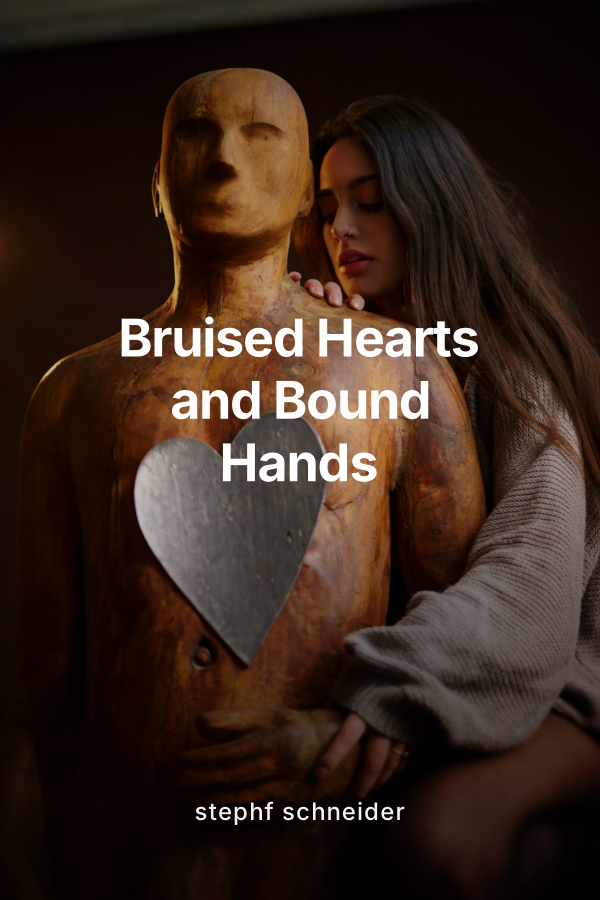
Bruised Hearts and Bound Hands is a dark, intimate, emotionally raw romance about two broken survivors who collide in a rain-soaked city and slowly, fiercely, learn how to hold what the world tried to destroy. Drawing on the tension, mood, and scenes developed in the existing draft of Isla and Cole’s story, this novel deepens their slow-burn connection, foregrounds the haunting bond between Cole and Noah, and drives relentlessly toward a violent confrontation with Isla’s abusive ex that ends in true, hard-won safety.
At its core, the book is about three people who should never have survived what they endured, trying to learn how to live, love, and trust in the aftermath.
Isla Warren has rebuilt a fragile life with two things: flour and fire. By day, she runs a small bakery and bakes until her scars ache, turning dough into order and pain into sugar. Baking is her therapy and rebellion, the one place she can shape the world instead of being reshaped by it. By night, she checks the locks twice, shuts the blinds three times, and lets no one close enough to see the brutal marks carved across her back and ankles, reminders of the years she spent surviving a man who treated her body like a battleground. She left Ethan Black with her son Noah on her hip and terror in her lungs, vowing never again to belong to anyone.
To protect Noah, she has become a fortress. She smiles for customers, swaps small talk with neighbors, laughs for her boy, and pretends strength is the same as wholeness. No one sees the tremors in her hands when a door slams. No one hears the way her breath snags when fingers brush too near her spine. No one knows that intimacy has become a minefield of triggers and flashbacks that she cannot risk detonating.
Except someone is watching.
Cole Maddox lives by rules. A contractor by trade and a ghost by choice, he moves through the city’s scaffolds and alleys like another shadow. Once, he had a sister whose laughter filled rooms and who believed she could fix the man who hurt her. She died under her husband’s hands. Cole was too late. That failure carved its own scars into him, teaching him that closeness is a liability and love is a weapon that always swings back. Since then, he has kept everyone at arm’s length and devoted himself to quiet interventions that keep other women from disappearing the way his sister did.
When Cole first sees Isla in the bakery window, hands buried in dough, shoulders squared in fragile defiance, something inside him shifts. She moves with the rigid control of someone who has survived too much. He recognizes the haunted set of her spine, the way she keeps her body carefully turned away, as if every angle is a calculation. The faint presence of her son nearby only intensifies the pull. Cole knows danger when he sees it, and he knows a survivor when he feels one.
He tells himself he will not interfere. He will not repeat old patterns. Yet he lingers across the street, walking the perimeter of her life. A silent, self-appointed guardian, he stays just beyond her vision, appearing in the reflection of glass doors, standing under awnings when she passes in the rain, hovering on the edge of every scene. The note he slips among her bakery supplies reads only Be careful, but his presence is a constant, wordless vow: No one touches you again.
The novel unfolds in three escalating movements:
Part One: Shadows and Longing
The first act is a slow, aching dance between anonymity and awareness. Isla feels the presence before she can name it. Alone in her apartment, in the quiet after Noah’s bedtime, she senses someone outside the window, a steady shadow that does not press closer but refuses to leave. The city is full of ghosts, but this one feels different. Protective. Dangerous. Familiar.
Cole’s chapters mirror hers with a stark counterpoint. From his vantage points across streets and fire escapes, he studies Isla with a mix of obsession and restraint. He watches her arrange flowers on her balcony like talismans of control, sees her shoulders tense when Ethan’s name appears on her phone, and notes each subtle flinch that betrays her carefully maintained composure.
He intervenes in small, morally grey ways. A stranger on the corner distracts Ethan at just the right moment, allowing Isla to slip away. A door latch in Isla’s building is quietly fixed before it can become an entry point. A coffee appears outside her apartment on the mornings after sleepless nights. Every act is designed to keep her safe without demanding her trust, to guide circumstances rather than dominate her body.
Isla, attuned to threat after years of gaslighting, begins to notice the pattern. The same broad-shouldered man at the construction site. The same silhouette under the awning when Ethan appears. The same electric awareness crawling over her skin whenever she feels watched but not hunted. Confusion battles with fear and a treacherous stirring of hope. Maybe not all shadows are predators. Maybe one of them is a shield.
Their first direct collision comes in the rain-soaked alley where Ethan corners her, words sharpened by ownership and cruelty. Noah’s small hand tightens around hers. Isla stands firm, but the old terror crawls up her spine. When Cole steps from the shadows and places his body between hers and Ethan’s, the air changes. His voice is low, controlled, lethal in its calm as he orders Ethan away. The confrontation ends not in blows but in the quiet strength of a man who radiates consequence. Ethan retreats for now.
That night marks a fracture line. For the first time, Isla sees her ghost’s face. For the first time, Cole lets himself cross the invisible line from watcher to protector. He leaves her with a warning that sounds more like a confession: You shouldn’t be alone. Not ever. In the storm’s roar, an unnamed bond snaps taut between them.
Part Two: Open Protection and Repair
The middle act is where the book deepens from suspenseful connection to raw, relentless emotional excavation. Cole and Isla begin to move in one another’s orbit openly. They cross paths in the bakery supply store, in the hall outside her apartment, on the street near Noah’s school. Banter becomes a shield and then a bridge. She tests him with sharp words. He answers with a dangerous mix of dry humor and unwavering attention.
Cole’s protective dominance shifts from anonymous to explicit. He is still careful with her, never crowding, never grabbing, but the authority in his voice and the steadiness in his stance awaken something in Isla she thought had died. A longing for safety that does not erase her autonomy. A craving for structure that is given, not forced. His guidance is not her ex’s control; it is a promise of shelter that waits for her consent.
Noah, bright and perceptive beneath his nightmares, becomes the quiet hinge on which their relationship swings. The first night he pads down the hall to Cole instead of his mother, shaking and tear-streaked from a nightmare of locked doors and shouted threats, is a defining moment. Cole, who has lost a child he loved once before, sits on the edge of the bed and talks Noah through the terror with simple, grounding commands. Breathe with me. Count the sounds in the room. Feel the mattress under your hands. He does not promise that monsters do not exist; he promises they will never reach Noah again.
That trust rearranges Cole’s world. In Noah’s trembling hand clutching his shirt, he recognizes something he never thought he would have: a family reaching back. For Isla, discovering that Noah confided in Cole first is both a knife and a balm. It hurts to know her son has carried this fear alone, but it heals something deep to see him lean into a man who does not manipulate that need for power. Their found-family triangle begins to knit itself together, thread by thread.
The pivotal “who did this to you” scene detonates in the quiet of Cole’s home. After a day-long storm of triggers, Isla finally agrees to stay at his place with Noah for safety. A simple touch, his palm brushing the back of her shirt as he reaches past her, sends her spiraling. Contact with her scars and bound ankles drags her into a flashback of Ethan’s violence. The narrative drops into brutal, explicit memories of what she endured, the reader forced to inhabit her terror in full. Cole, panicked but determined, grounds her through it. He keeps his distance but anchors her with his voice, his presence, the hard edges of the furniture he guides her to feel.
When the episode ends, Isla collapses into him, shaking. In the aftermath, her shirt rides up just enough for him to see the lattice of scars carved into her back. The sight explodes something in Cole that has been locked away since his sister’s death. Rage, grief, guilt, and a fierce, possessive tenderness collide. His whispered question, who did this to you, is not a demand for details but a covenant. From here on, your hurt is mine to shield. Her breakdown triggers his own buried trauma, and in the chaos, he finally confesses his sister’s story. Two histories of violence and loss lie between them, no longer hidden.
From that point, the relationship between control and consent becomes the novel’s emotional backbone. Cole’s protective instincts are intense, occasionally overwhelming. Isla pushes back, terrified of becoming someone else’s possession, determined not to vanish inside a man’s shadow again. Their arguments are raw, full of shouting and tears, each of them tearing at the other’s armor in a desperate attempt to be understood. When Isla tries to run so she will not “break” him, convinced that her damage will poison anyone who stays, Cole’s carefully maintained control finally fractures. He tells her, with devastating honesty, that he needs her. That she is not breaking him; she is the only thing holding his pieces together.
Their connection takes on subtle BDSM undertones not as erotic spectacle but as a language of healing. Safe words, negotiated boundaries, and deliberate choices around touch allow Isla to reclaim her body on her own terms, with Cole as the steady anchor she chooses rather than the force that claims her. Scenes of intimacy focus on trust, surrender, and mutual power instead of explicit sexual description, making the emotional stakes more intense than any physical act.
Throughout, Noah remains the secondary emotional arc and the story’s quiet heart. The way he clings to Cole’s hand at a school event, the way he leans against him on the couch, the night he shyly calls him in when a nightmare hits and whispers, you came, all tug relentlessly at the reader’s heartstrings. Cole’s journey from distant protector to reluctant father figure to chosen dad is as central as the romance itself.
Part Three: Return, Violence, Aftermath
The final act tightens every thread into a brutal, cathartic climax. Ethan, rattled but not defeated by Cole’s earlier interventions, escalates. He stalks the edges of Isla’s life, sends threatening messages, and finally chooses a night when he believes she will be isolated. He is wrong, but his miscalculation still costs them.
The self-defense confrontation is the novel’s most viscerally violent sequence. Ethan corners Isla again, this time forcing his way into a space that had become symbolic of safety. Isla fights back with everything she has learned, no longer the passive victim he remembers but a woman whose trauma has been tempered into steel. Even as he overpowers her, she buys time, makes noise, refuses to go silent. And then Cole arrives.
The fight that follows is not choreographed heroics. It is messy, brutal, and edged with the terrifying possibility that Cole could lose himself in the same violent rage that killed his sister’s husband. Every blow he lands is an argument with the past. Every time he stops just short of going too far is a choice not to become the thing he hates. The scene balances on the knife’s edge between vengeance and justice until outside intervention and the arrival of law enforcement rip it apart. Ethan survives but is finally, decisively overpowered.
The legal aftermath does not erase the damage, but it formally ends the immediate threat. Ethan is arrested and, through clear evidence of his abuse and the self-defense nature of Cole’s actions, sentenced to a long prison term. Isla’s terror of never truly escaping him finally finds an answer she can trust: a cell, a door she did not have to lock herself, bars she did not have to install.
The emotional aftermath is where the book truly delivers its promise. Cole struggles with what he did, fearing that the violence inside him makes him unworthy of the family he has found. Isla, covered in bruises but standing, becomes the one who steadies him this time. She tells him the truth he cannot give himself: he did not break her; he saved her. He did not repeat the past; he changed its ending.
In quiet, carefully rendered scenes, we see how survival begins to shift into living. Isla still has nightmares, but now, when she wakes shaking in Cole’s bed, he is already there, hand steady on her back, talking her through the waves. Noah still startles at sudden sounds, but he has a man to run to who will kneel, open his arms, and simply say, I have you. Cole still carries the guilt of his sister’s death, but it no longer defines him; it informs the ferocity with which he protects the people in his care.
The book closes not on courtroom drama or hospital monitors but on a small, intimate domestic tableau that captures everything they have fought for. Isla bakes in a kitchen that no longer feels like a bunker, flour dusting her arms. Cole works on a simple repair nearby, within arm’s reach, not hovering but present. Noah darting between them, laughing, asking Cole for help with something that only a dad can fix. The scars on Isla’s back will never disappear. Cole’s ghosts will never fully leave him. But the hands that once bound them now reach for one another by choice, not compulsion.
Themes and Tone
Bruised Hearts and Bound Hands is not a gentle romance. It is dark, explicit in its portrayal of abuse and PTSD, and unflinching in its depiction of how trauma invades bodies, relationships, and sleep. Flashbacks and panic episodes are shown in full, their intensity balanced by the grounding presence of characters who refuse to look away or let the other drown.
Yet it is also a profoundly hopeful story. The central thesis is that people are not cured by love but strengthened by it. Cole does not fix Isla; he stands beside her as she does the excruciating work of reclaiming herself. Isla does not heal Cole’s guilt by forgiving him; she forces him to see that his worth is not measured by his capacity to prevent every harm. Together, they build a life that acknowledges every fracture without letting any of them dictate the future.
The romance is built on consent, communication, and the complicated interplay between power and vulnerability. The protector fantasy is interrogated, not blindly indulged. Cole’s obsession is dangerous until he chooses accountability and transparency. Isla’s surrender is powerful because it is chosen, not taken. Their dynamic leans into dominance and submission only when it serves healing and trust, never as a reenactment of abuse.
For readers drawn to dark protector romances with deep emotional stakes, vivid psychological realism, and a focus on found family, Bruised Hearts and Bound Hands offers a gripping, cathartic journey. It asks difficult questions about what it means to keep someone safe, what it costs to love someone who has learned to live outside their own skin, and how two people with hands built for damage can teach themselves to touch gently.
Across five broad chapters, the full novel will expand this summary into approximately 10,000 words of layered character work, escalating tension, and intricate emotional beats, honoring the original concept’s tone and scenes while enriching every arc: Isla’s fight to live beyond her scars, Cole’s battle with his own capacity for violence and devotion, and Noah’s quiet transformation from haunted child to cherished son in a family that chose him and one another.