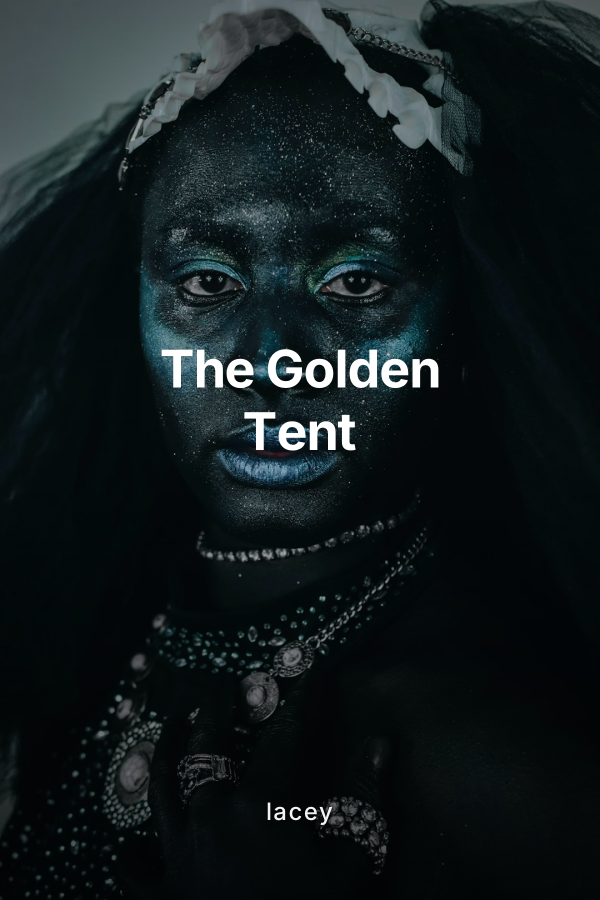
This romantic fantasy follows an exiled princess who must choose between the glittering prison of a cursed circus, the fragile bond with her younger sister, and the forbidden love she finds in a boy who is bound to the ringmaster by blood and torture. At its heart, it is a story about what we are willing to burn to the ground for the people we love most, and what it means to build something new from ash.
The heroine, the older of two royal sisters, is stolen across the border and bound by a magical contract to perform in a traveling circus famed for its impossible spectacles and whispered disappearances. The circus is ruled by a terrifying ringmaster whose power coils itself around every performer like a noose. Within this glittering nightmare, the heroine earns the mocking nickname “Cinder,” because every time she uses the dangerous magic in her veins, it leaves soot on her skin and smoke in her lungs. She clings to thoughts of home, of her younger sister who still wears a crown that technically belongs to her, and of a promise that one day she will reclaim her life.
Everything shifts when she meets Jorven, the ringmaster’s star illusionist and caged protégé. On the surface he is loyal, sardonic, and perfectly controlled, but beneath his polished performances is a boy carved by obedience, scarred by punishment, and secretly desperate for something like freedom. In the beginning, she sees him as part of the machinery that keeps her trapped, yet he keeps appearing where she is most vulnerable: backstage when she is shaking from magic overload, in the caravans when she cannot stop dreaming of fire, in the training ring when she fails a stunt and nearly dies. His presence infuriates her even as it steadies her.
The book charts the evolution of their connection from reluctant allies to partners bound by a future only they dare to imagine. When “Cinder” realizes that her younger sister has quietly arranged to shield her from political fallout at home, slipping her letters that cross borders through secret channels and coded ink, the center of her struggle changes. She is no longer just fighting to get back to a throne. She is fighting to keep her sister alive in a game rigged by the ringmaster and by the neighboring kingdom that quietly benefits from the circus’s cruelty. In this world, power is traded in contracts more binding than chains, and breaking one can cost more than blood.
Hidden between costume racks and tent ropes, she begins conspiring with another performer known only as “Cinder” in the troupe’s whispers, a title that now belongs less to an insult and more to a shared defiance. Together they start tampering with the enchanted contracts that trap the artists, loosening a clause here, warping a line of magic there, preparing the bones of a future rebellion. Every act of sabotage risks discovery, torture, or worse, yet the heroine finds herself unable to stop. The circus has become a crucible where her fear burns too hot to remain only fear; it must become resolve.
Jorven moves along a more treacherous edge. Outwardly he is the ringmaster’s golden boy, the obedient weapon whose illusions make crowds scream and pay, but in the quiet hours he becomes the heroine’s fiercest gamble. Without telling her, he starts taking the blame for her altered pages, inserting himself between her and the ringmaster’s suspicions. When punishments come, they fall on him, leaving new scars across skin that already bears too many. The heroine discovers his betrayal of the ringmaster in a moment that breaks her trust and then reshapes it completely: she catches him in the act of returning her contract, altered in her favor, his hands still trembling from the pain of a recent “lesson.” What begins as an accusation erupts into a confession on both sides, as anger melts into raw, helpless affection.
Threaded through the book is the letters between the sisters. In one particularly poignant exchange, the younger sister describes a dream of a circus that answers to no tyrant, sketching in the margin a tent rendered in delicate strokes of gold ink. She writes that if the older sister ever builds such a place, the crown will quietly protect them, even if history must pretend the rightful heir died beneath the sawdust and smoke. This letter plants a seed in the heroine and in Jorven, who reads it with reverent fingers. They begin to speak, when hiding from the ringmaster’s wrath, of a future circus that belongs to its performers, a sanctuary instead of a cage.
The emotional core of the story is the heroine’s impossible choices. As she grows more powerful and more willing to wield the magic that has always frightened her, she is forced to confront the cost of reclaiming her throne. She can attempt to escape across the border and stake her last claim as heir, likely triggering war and leaving scores of circus performers to die, or she can turn her back on that life forever and use every ounce of her royal authority to bargain for her sister’s safety from afar. Her love for Jorven further complicates this decision. He is bound to the ringmaster in ways that mean he cannot cross borders freely; if she flees alone, she abandons him to suffering he chose to endure to shield her.
The climax unfolds during a performance that has been meticulously rigged as part spectacle, part coup. The heroine and Jorven weave their magic together, transforming their act into a living contract that broadcasts itself to every noble guest, every spy, every wandering commoner in the stands. With the world as witness, she publicly sacrifices the last of her legal claim to the throne, offering it instead as part of a binding that protects her younger sister and the emerging rebellion inside the circus. The ringmaster attempts to subvert the magic and nearly kills them both, yet in that moment the heroine’s acceptance of who she is makes her unstoppable. She chooses her sister’s beating heart over a gilded crown and, by extension, chooses this ragged family of performers over the kingdom that cast her aside.
In the bloody confusion that follows, escape becomes a brutal, breathless thing. Jorven and the heroine drag stunned performers away from the burning big top. Not everyone makes it, and the cost of freedom lodges like broken glass in their love story. At the border, with smoke from the fallen circus still staining the horizon, the heroine faces her final decision in stark clarity. On one side lies home, a gate that would swing open if she speaks her birth name and claims her old life. On the other is a road that leads nowhere safe, flanked by caravans filled with injured performers and the boy whose wrists still bear the imprint of invisible shackles.
She chooses Jorven and the survivors. Turning her back on the border, she steps fully into the life of a circus girl, not as property but as architect. In a ruined barn where they hide from patrols, surrounded by the soft sounds of exhaustion and grief, she pulls out the younger sister’s letter with the golden tent sketch. With careful hands, she and Jorven begin to redesign it, naming the future circus they will one day build, one that will shelter runaways instead of collecting them. The name they choose speaks of ash and gold, of rebirth and doors that cannot be barred from the outside.
Their conversation in that hidden place is quiet yet transformative. They talk about the kind of leader she wishes to be without a crown and what it means for Jorven to unravel his loyalty to the man who owned his pain for so long. The intimacy of the scene rests less in grand gestures and more in the way he traces the curve of the drawn tent with a shaking finger, the way she folds her body into his without flinching from his scars. As they decide on a symbol, perhaps a rising flame or a key held in an open palm, they are not just sketching a logo; they are daring to believe in a world that has never existed for them.
The book ends not in neat resolution but in a promise. The younger sister’s final letter, smuggled through channels that could cost lives, confirms that the crown will protect their fledgling circus from the shadows as long as it can. It is an acknowledgment that the official story will name the older sister a tragic loss, swallowed by fire and spectacle, while the truth walks under new stars with a boy who was supposed to die in chains. Closing the letter, the heroine kisses Jorven beneath the crumbling rafters, tasting soot and hope, and speaks aloud the name of the circus they will build together.
Throughout, The Golden Tent is drenched in tenderness and hard choices. It is about sisters whose love can bend kingdoms, about found family born in the flicker of stage lights, and about a romance that survives under the constant threat of punishment and loss. There are moments of aching intimacy when the heroine tends Jorven’s wounds in the dim light of a caravan, or when he quietly teaches her how to transform her dangerous magic into breathtaking illusions that do not consume her. There are nights when they lie impatiently awake, listening to the distant roar of the crowd, planning impossible futures only to risk them all in the morning.
By the end of this first book, readers will have witnessed not only the slow-burning romance between two broken yet defiant souls, but also the birth of a legend that will eventually transform the very idea of what a circus can be. The heroine no longer dreams of a palace that never felt like home. She dreams of a golden tent rising from ash, filled with laughter, music, and dancers who leap because they choose to, never again because a contract commands it. Her journey from reluctant captive princess to the heart of a new, freer world is the emotional spine of this sweeping romantic fantasy.
The Golden Tent sets the stage for a larger saga in which love is not a distraction from revolution but the reason it happens at all.