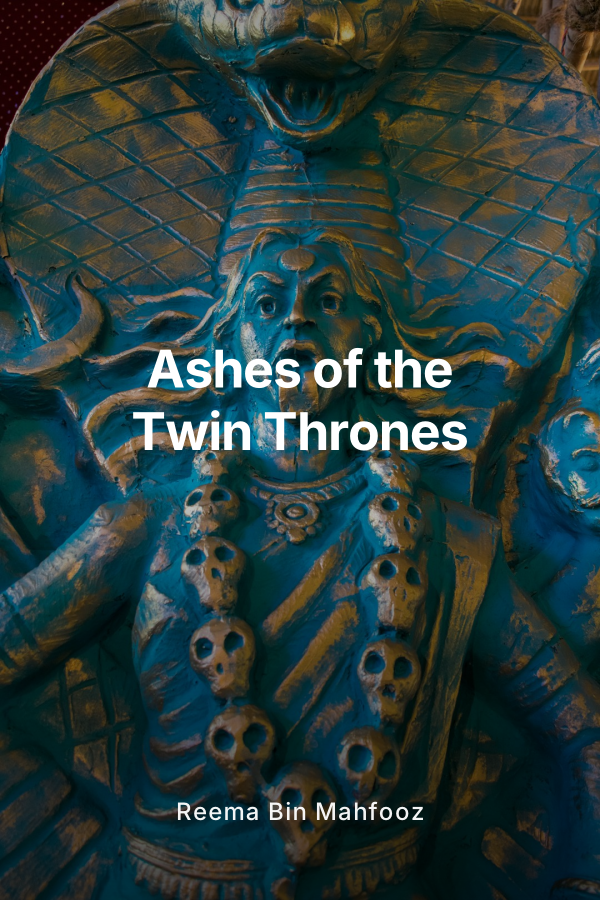
In a fractured empire haunted by legend and ruled by bloodstained crowns, two sisters share a single destiny across diverging timelines. At the heart of the story stands El Ackerman, a sharp minded, emotionally guarded girl who grows up believing that history is something written in books, not in the bones and blood of the living. By her side in the beginning is Elli, her four year old twin, soft voiced and bright eyed, a child whose only concerns are cream puffs, stories about dragons, and the simple comfort of her sister’s hand in hers. To the nobles of the Ackerman estate, they are curiosities. To the realm, they are nameless. To one another, they are everything.
The book opens with a quiet, intimate prologue. A warm, unseen adult voice retells the legend every imperial child knows. It speaks of an ancient war that almost shattered the world, a tide of chaos halted when a lone hero carved an empire from ruin and took the name Valecaria. The first emperor is described not as a monster but as a distant, grave savior. His sword ended the war. His laws bound nobles and commoners alike. His bloodline, it is said, still guards the realm. In the flickering half light of the twins’ nursery, El listens in rigid silence, frowning faintly as she tries to grasp why men would burn cities for power. Elli listens with innocent awe, giggling over the names of dragons and heroes, clapping softly when the savior emperor receives his crown.
This single bedtime story sows the seeds of everything that follows. For El, it is a puzzle about cause and consequence. For Elli, it is a shining fairy tale. For the reader, it is a lie that will soon be drowned in blood.
Years pass. Fever claims Elli at fourteen, stealing away the gentle girl the reader has come to love, exactly as El once described. Her death rips a hollow in the fabric of the Ackerman family and tears out a part of El’s own soul. The first timeline follows this loss as a fixed point. El grows into a woman shaped by grief and duty, a noble daughter in a brittle empire. The Valecarian dynasty still rules from its alabaster capital. One of its princes, Noah Valecaria, enters her life as a composed, quietly charming presence. At first glance he is everything the legend promised the imperial line would be. He is observant, polite, and carries a reserved kindness that suggests he will become El’s steady future. By intent, the world itself conspires to make the reader believe that El and Noah are destined to stand side by side.
In salons and council chambers, their glances linger. In gardens veiled with twilight, they exchange tentative words about duty, loneliness, and the stories they grew up hearing about his ancestor, the so called savior emperor. Their bond is built with quiet scenes rather than grand declarations. Every interaction feels like a promise that, after so much loss, El will not end her life alone.
Beneath the polished marble of the capital, however, rot spreads. Old oaths have been broken in secret. The Valecarian throne holds a history far crueler than any child’s legend admits. Whispers speak of the Ackerman family’s ancient rights, of power stolen and buried, of pacts sealed in the shadows when the empire was born. El begins to feel the edges of a truth she cannot yet see, a strange pull toward the deeper past, as if the very bones of the land are remembering something through her.
The façade shatters the night the massacre begins.
From the sky fall banners emblazoned with the Valecarian crest. From the streets rise screams. Fires bloom across districts thought loyal, and imperial soldiers flood noble estates. The Ackerman stronghold becomes a slaughterhouse. The same royal line that was once painted as the empire’s savior moves to erase an old threat it failed to crush completely centuries ago. In the smoke choked chaos, El witnesses Noah not as the gentle companion she trusted, but as a prince carrying out a merciless command. The boy the reader thought would be her protector becomes the face of a family's executioner.
Her world ends in blood.
And yet, this is only one of the book’s twin timelines.
At the precipice of death, as the heat of burning tapestries sears her lungs and the sound of steel splintering bone fills her ears, something ancient stirs. Time does not so much rewind as fracture. An old, dormant power rooted in the empire’s forgotten past reaches for El’s desperate soul. It binds itself to the memory of the legend she once heard as a child and to the delicate, vanished presence of her twin. The first timeline folds in on itself like a burnt page. The world gasps. Reality splits.
The second timeline begins with a breath.
El wakes again in the Ackerman estate, years in the past, with the taste of ash on her tongue and knowledge carved into her bones. Elli lives, once more the innocent four year old who died far too young in the first life. She is light footed and soft spoken, too small to understand why her sister’s hands tremble when they hold her, why El watches her sleep as if afraid the dawn itself will take her away. The reader sees Elli not as a looming threat but as the warm, guileless child she truly is at this stage of the story, a girl who will share sweets, chase fireflies, and lean against El during quiet evenings with complete trust.
Only El remembers the other timeline, the burning capital, Noah’s cold eyes, the bodies of her family on the palace steps. This secret knowledge becomes a curse and a weapon. Where she was once only thoughtful and restrained, she is now painfully aware of every small decision’s weight. The book’s core tension emerges from this dissonance. El must navigate a world that has not yet bared its fangs, all while holding the memory of what it will become if she fails.
The second timeline is not a simple redo, however. Time resists being reshaped. Echoes of the first life coil beneath the surface. Some faces appear earlier than before. Alliances form in different patterns. Seemingly minor choices send new cracks running through the empire’s foundation. The early chapters of this life unfold like a subtle game of mirrors. Scenes the reader remembers from the first timeline return twisted, softened, or heightened. The bedtime legend is told again, this time with El interrupting, asking dangerous questions about who lost the war the first emperor ended, and what exactly the Valecarian line sacrificed in order to claim their throne.
El’s greatest trial in the second timeline is not her hatred for the empire. It is her fear of what Elli might become. Somewhere beyond the horizon lies a point where this gentle child, if allowed to be warped by loss, betrayal, or power, will stand against El as an enemy far more terrifying than any prince. Hints of this darker future are scattered like hairline fractures in a flawless vase. Elli startles at shadows only she can see. She repeats fragments of dreams that echo scenes El has not yet lived a second time. At moments, her gaze lingers too long on the imperial crest in storybooks, curiosity slipping into something sharper. The reader, who learned to love Elli’s innocence, now faces the unsettling promise that she will, under certain pressures, twist into a force of genuine evil.
The book therefore becomes a story of divergence. El’s primary goal is no longer merely to survive the coming purge. She must save Elli from the path that leads her to become an instrument of ruin. At the same time, she must unravel the empire’s true history, the living curse at the heart of the Valecarian bloodline, and the reason her family was fated to be slaughtered in the first timeline.
Noah returns in this new weave of time, his path crossing El’s at a point earlier and under different circumstances. Once again he appears as the reader first knew him: reserved, considerate, more human than royal. The narrative deliberately resurrects the possibility that he and El might be bound together by something deeper than politics. Every gentle gesture is overshadowed, however, by El’s memory of the massacre. She watches him not with naive attention but with a predator’s stillness. He, in turn, senses a sharpness in her that was not present in the fate he cannot recall.
The evolving relationship between El and Noah becomes one of the story’s most fragile threads. Is he inherently cruel, his kindness only thin ice over darkness? Or did choices and circumstances in the first timeline push him into atrocity, choices El can disrupt now? The reader is invited to question whether a person is the sum of their nature or of the pressures that shape them. El must decide whether to use Noah as a tool, to destroy him before he has a chance to become a monster, or to gamble the fate of her family on the belief that he can be different in this rewritten world.
As the empire’s old magic stirs, the book’s world building unfolds like the pages of a forbidden chronicle. Ruined shrines in forgotten forests tell a story older than the imperial faith. Sigils carved beneath city foundations reveal that the Valecarian line did not simply win a war. They concluded a bargain. The savior emperor of legend bound a primordial power beneath the capital, feeding it a steady tribute of blood and fear to keep the realm stable. Noble houses like the Ackermans were branded long ago as both guardians and contingencies. Their destruction in the first timeline was not mere politics, but a calculated ritual intended to prolong the empire’s cursed equilibrium.
In the second timeline, El gradually discovers that the strange, spectral resonance she carries from her first life is tied to that buried power. That same force allowed her to slip along the fault line of time and awaken in the past. With Elli alive again, their twin bond stretches across both timelines, forming a conduit that the dormant curse seeks to use for its own awakening. This revelation turns the narrative inward. The real war is no longer only between houses and crowns, but also within the hearts of two sisters, one of whom has yet to understand exactly what she is capable of.
The book’s twin chapters mirror the two timelines. The first chapter follows the inexorable steps toward the massacre, embedding the reader in El’s growing affection for Noah, her quiet life with Elli, and the gradual realization that the empire’s noble façade is a cage built atop bones. It ends in fire. The second chapter opens on that first breath in the rewound world and charts El’s desperate, intricate efforts to subvert fate without tearing apart the people she still loves. Across both chapters, the tone shifts from wistful and restrained to sharp and foreboding, with moments of tenderness fractured by visions of impending ruin.
“Ashes of the Twin Thrones” is ultimately a story about how legends are written, erased, and weaponized. The children who once sat wrapped in blankets, listening to tales about a glorious founding emperor, grow into players in a conflict that will decide which story survives into the next age. El must learn to wield memory itself as a blade. Elli must confront the darkness that time, pain, and power can plant in even the gentlest soul. Noah must stand between the expectations of his cursed lineage and the possibility of a different future that should be impossible.
By the end of this first book, no path remains that will let everyone live the life they once dreamed of. The empire is already shifting in ways it was never meant to. Hidden factions awaken in response to small changes in El’s choices. Old enemies who died quietly in the first timeline now move openly. The curse beneath the capital senses the budding rupture in its carefully tended cycle and stretches toward the twins, drawn to the anomaly of a soul that remembers dying.
The final scenes of the summary’s arc leave the reader standing with El at the edge of a choice she did not have in her first life. With evidence that Elli’s potential for evil is real yet not inevitable, with Noah’s true nature still unresolved, and with the empire’s secret history only half uncovered, El must decide whether to tear down the imperial order at any cost or attempt the far more fragile path of rewriting a story that has been carved in blood for generations.
The ashes of the first timeline still cling to her, invisible to everyone else. Out of those ashes, two thrones wait to be claimed in the world to come. Which sister will sit upon them, and what kind of empire will rise from the ruin, are questions that this book poses with every scene, drawing the reader into a tale of sacrifice, second chances, and the terrifying power of a single life lived twice.