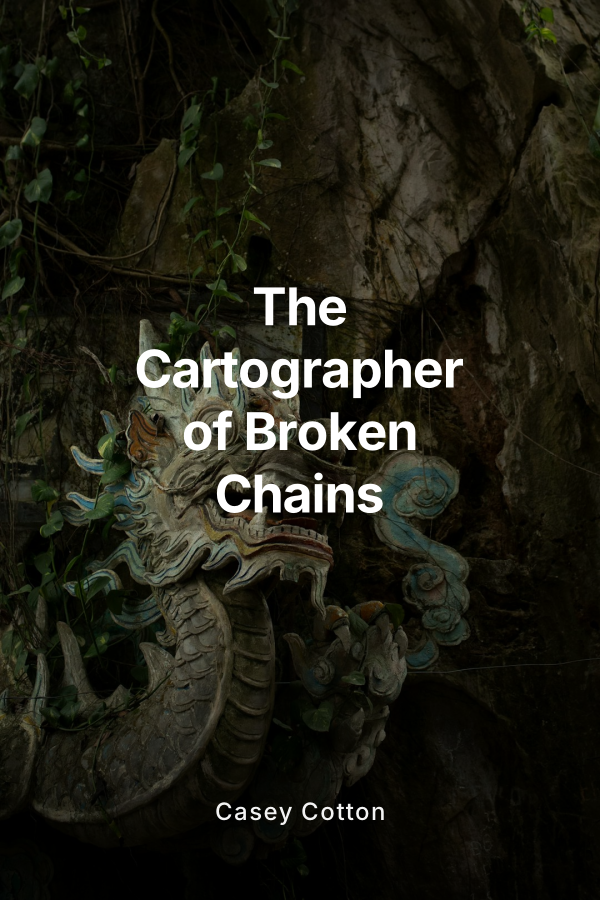
The Cartographer of Broken Chains is an epic fantasy about power, guilt, and resistance in a world where borders are drawn not only on land but inside the soul. It follows Cale, a gifted mapmaker whose precise quill strokes become instruments of conquest, and Nira, an apprentice archivist who inherits both his dangerous truths and his unfinished atonement. Through them, the story explores how records and stories can be twisted into shackles or reforged into keys.
In the storm of the first book, Cale serves the Chain Council of Amut, a rising power that claims to bring order to a fractured continent. His maps are meant to be neutral, clean, almost beautiful. He walks frontiers, takes measurements, listens to traders and shepherds, and returns to his chambers to translate the land into neat inked lines. Amut’s ministers praise him as a quiet genius. Cale tells himself that he is only recording what is, not deciding what should be.
That illusion breaks when the Council begins to use his phrasing and recommendations to justify a brutal campaign of “border adjustments.” Cale hears his own language recited in decrees that announce compulsory relocations, confiscations, and the quiet extinction of minor peoples whose villages he once sketched with loving precision. An “innocent” suggested correction to a river course becomes the rationale for driving families from ancestral lowlands. When an enforcer shrugs and tells him that “You drew the lines,” Cale is forced to see that neutrality is itself a weapon in the hands of those who claim his work.
As Amut’s secret police tighten their grip, Cale begins to hide duplicate records, marginal notes, and alternative drafts that contradict the official versions. His maps start to fracture, one face for the Council and another for himself. He toys with the idea of going to the Chain Council directly, of protesting or resigning, but every hallway is watched and the Council’s patience has limits. When he attempts to argue in the margins of his own maps, softening recommendations or noting the human cost of his lines, those comments are quietly scraped away by clerks who remind him that commentary is not part of his contract.
The turning point comes during a panicked night in the archives, when Cale realizes Amut’s agents are closing in on him. Whether it is the secret police or rival factions within the Council, the threat is real and immediate. He bursts into a dim scriptorium where Nira is working late, her hands ink-stained, her future still small and tightly circled. Without time for explanations, he thrusts a bundle of records into her arms: maps with unapproved annotations, copied decrees with his own private cross-references, and fragments of testimony he has gathered on the road.
There is a breath between them, thick with dust and terror. Cale does not deliver a careful manifesto. He gives her only urgency and a single line that will echo through the series: a desperate injunction not to let “them” write the final version of things. Then the doors slam, the raid sweeps in, and their paths diverge. What happens to Cale is left largely off the page in this first volume, his fate a shrouded absence that will shape the coming stories. Nira is left alone with the records, the questions, and the knowledge that the official story is a carefully constructed lie.
The rest of the book follows Nira as she flees the tightening circle of Amut’s control and begins to piece together what Cale tried to do. The bundle he gave her proves to be more than a hoard of incriminating documents. It contains overlapping versions of the same borders, early drafts of decrees with notes in the margins, and strange coded references to people and places that do not appear in any formal index. Through long nights of study and fragments of rumor, she realizes that Cale was not simply recording conquests. He was, in his cautious way, trying to map the machinery of oppression itself.
On the roads that run between fortified towns and censored markets, Nira encounters a world reshaped by maps she has only seen in safe lamplight. Villages that Cale annotated as “contested” lie half deserted, their wells chained or poisoned. Rivers that were redrawn on paper have been physically diverted by forced labor, leaving dry beds and improvised refugee camps. The discrepancy between what the official Atlases claim and what she sees with her own eyes becomes a personal torment. Each lie in the records now carries a face or a grave.
Slowly, she begins to hear whispers of scattered people who resist Amut’s narrative monopoly. In hidden workshops and back rooms of busy inns, there are secret reading circles where banned pages circulate, controversially copied and recopied. Some of these underground readers treat “Cale stories” as almost mythic relics, badly distorted by repeated telling. Others see his work as nothing more than a toolbox, one set of instruments among many for understanding how the Chain Council operates. Their arguments about what to do with his texts mirror the wider conflict in the series: whether to cling to pure truth, to adapt it for survival, or to let it be one voice in a rough chorus of rebellion.
Nira’s first contact with this underground is fraught. In Screegrove, a once-ordinary trade town turned transit point for the displaced, she is drawn into a quiet gathering in a lamplit workshop. There, artisans and itinerant scholars pass around smudged copies of decrees and maps, reading aloud to those who cannot read and arguing fiercely about interpretations. They test Nira’s loyalties by asking her to correct a popular but wrongful legend about Cale, a legend fashioned from half-truths and wishful thinking. To prove she is not an infiltrator or a Council apologist, she must risk revealing how much she knows and how deeply she is implicated.
Throughout the book, the central magic is subtle and grounded not in fire or lightning but in the power of inscription itself. In this world, maps, contracts, and decrees are not mere representations. Once accepted into the official Record and sealed by particular ritual inks and spoken formulas, they exert a binding force on reality. Peoples who are declared “unsettled” gradually find roads closing to them, markets rescinding their rights, their very names fading from state liturgy. Conversely, those newly inscribed into recognition gain access to protections and routes that did not previously exist. Landmarks shift, trade winds are redirected by sanctioned waystones, and even the behavior of border wards seems to tilt in obedience to the written word.
The Chain Council of Amut has learned to weaponize this inscription magic with terrifying sophistication. They commission cartographers like Cale to produce master maps that will anchor their territorial claims, then overlay those maps with an ever thickening web of laws and decrees. Each new layer tightens influence, adjusting where caravans can travel, which villages are taxed or shielded, and how rumors may flow from one province to the next. Beneath the surface, the world becomes a palimpsest of command, a landscape shackled by heavily edited text.
Cale’s great sin is not only that he lent his skill to Amut but that he believed for too long that his personal intentions insulated him from consequence. The supporting cast around him and Nira gives human shape to the vast machinery they confront. There are mid-level enforcers who insist that they simply “follow the maps,” petty officials who find ways to profit from each redrawn border, merchants who rationalize their compliance by invoking stability and safety, and minor scholars who close their eyes to contradictions in the record. None of them is a cartoon villain; each is a person who has grown used to living inside the lines someone else drew.
As Nira learns the craft of counter mapping from the underground network, she begins to understand that resistance in this world is not just a matter of open battle. It is a contest of archives. Rebels preserve testimonies that do not appear in any Council ledger, collect scraps of pre-conquest charts, and recite oral histories with the same reverence Amut grants to its stamped decrees. The more Nira delves into Cale’s scattered notes and the underground’s oral tales, the more she sees that an alternative Atlas is emerging, a shadow record of all that the Chain Council insists does not exist.
The book’s emotional core lies in the shifting relationship between Nira and the absent Cale. She moves from seeing him as a quiet mentor to hating him as a collaborator in atrocity, then to recognizing the complexity of his late defiance. Through fragmentary letters, annotations, and stories told by those who encountered him on the road, she assembles a portrait of a man who only belatedly grasped what his maps had done. His belated decision to pass her the records becomes a challenge and a burden. Is she meant to finish what he started, correct his mistakes, or burn his work entirely and begin anew?
Amid journeys through ruined provinces and dense cities, the world of the series unfolds. There are river lands where the water has been conscripted, mountain passes altered in law if not yet in stone, and coastal moors where smuggling routes now double as veins in the body of rebellion. In each region, small communities have found ways to survive the tightening grip of Amut’s inscriptions: secret folk markers that confuse official surveyors, songs that encode directions in metaphor, and shrines that refuse to acknowledge the Council’s imposed saints.
By the end of the first book, the loose network that Nira tentatively joined has begun to see her not only as a custodian of Cale’s last maps but as a rewriter in her own right. She has tampered with a minor decree and watched a checkpoint’s routines shift. She has helped preserve an outlawed place name in a local festival, blunting the Council’s attempt to erase it. These small acts of narrative sabotage hint at a larger strategy. If Amut rules through its monopoly on records, then the only real path to freedom lies in challenging that monopoly, proliferating alternate accounts faster than they can be suppressed.
The final chapters lead toward a quiet but potent climax in Screegrove. There, during a tense season of inspections, Amut sends auditors and chain-bound scribes to reconcile discrepancies between local archives and the central Record. The underground, now more coordinated than Nira suspected, chooses this moment to weave a concentrated campaign of misdirection: forged but plausible decrees, maps whose subtle inaccuracies redirect patrols, rumors seeded in taverns that cause the auditors to suspect one another rather than the populace.
Caught in the middle, Nira must decide which part of Cale’s legacy to wield. One thread of his work calls for precise truth telling, the exposure of abuse in painstaking detail. Another, more recent thread, hints at using the very tools of inscription to confuse and weaken the oppressor. In a pivotal decision, she chooses a risky middle path, preserving crucial truths in hidden archives while deliberately corrupting copies meant for Amut’s eyes. Her choice is not neat or bloodless. Some people suffer because of the misdirections, others are saved, and she cannot always tell which is which.
The book closes with Screegrove left in an uneasy stalemate. The auditors depart with records they believe are fixed, unaware of the infections Nira and her allies have planted in the central archive. Refugees still crowd the roads, but rumors circulate of a town that refused to vanish when the Council declared it dissolved. Cale remains missing or dead, his ultimate fate unresolved, but his maps live on in dozens of altered forms. Nira, now both archivist and saboteur, stands on the threshold of a broader conflict that will span the continent.
Across its five planned chapters and eventual full length, The Cartographer of Broken Chains offers readers a richly textured world where quills can be as deadly as blades and stories as liberating as open gates. It invites them to question who holds the pen in their own histories and what it might cost to take that pen back.