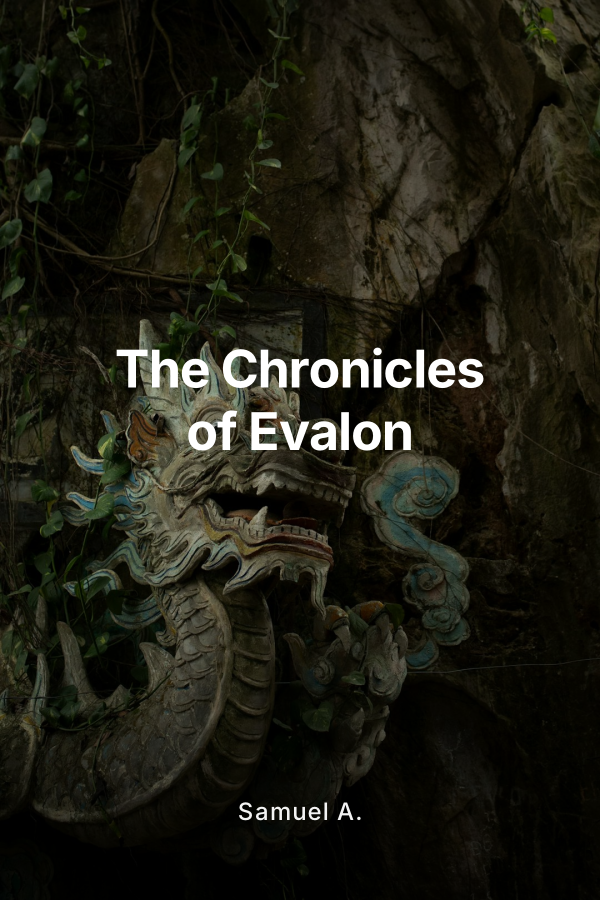
In the Realm of Evalon, the wind remembers everything. It remembers the rise of kings, the fall of cities, and the day a forgotten god first learned to speak through human hunger. It remembers a boy born between worlds who grew into a man the gods tried to forge into a weapon. And it remembers the war that began as a struggle for a single throne and ended as a reckoning for an entire age.
This book follows Halson Urgard, once Halson Lorgtarud, son of a god-touched bloodline and exile of Yeles. Marked from birth by a brand of living fire beneath his skin, Halson carries a legacy he never asked for. His older brother Edric wears the crown of their homeland and leads Evalon toward ruin, his ambition twisted by a presence older than any kingdom. That presence is Arokan, the Devourer of Suns, a godlike parasite bound beneath desert stone that has found a new way to breathe through the hearts of men.
The story begins with whispers of war and rumors of betrayal. As border raids intensify and strange sigils appear on fallen banners, Halson travels beside two companions who anchor him to the mortal world he is fated to save. Astrid of Valhein is a sharp-witted warrior haunted by the weight of every battle she survives, her loyalty a weapon as keen as her blade. Leif Thorvald, grizzled veteran and once-mercenary, fights not for glory but to make sure the young do not die as senselessly as those he has buried. With them runs Amarok, the great wolf whose fur gleams like starlight on snow, a creature bound to Halson by something deeper than simple loyalty.
Their path takes them away from the gray coasts of Valhein to Oraio’s burning deserts, where the city of Chaltha rises in limestone crescents and whale-bone gold, its people devoted to Emir, the Whale God. In streets crowded for the Festival of Emir and guarded by soldiers in whale-shaped armor, Halson learns that his brother has allied with the Brunstildian raiders he once opposed. This betrayal is not merely political. In the shadowed home of the scholar Edris and in the words of oracles who read the wind, Halson hears the older truth. The War on Ruien was once a war between gods, and Evalon’s royal bloodlines have always stood too close to that fire. The Devourer of Suns still breathes beneath the desert, feeding on greed, envy, and bloodshed, transforming kings into its vessels and crowns into its mouths.
Warned that his own brother has become one such vessel, Halson is forced to choose between blood and Realm. Edris sends him east to the Obsidian Sanctum in the Black Wastes, a ruin buried beneath Oraio’s cursed dunes. There, beyond the Dunes of Mourning where the sand is said to remember a thousand unburied dead, Halson seeks the Sword of Ashes, a god-forged blade that can cut spirit as easily as flesh. Only a scion of divine blood can wield it, and that half-god curse is his alone.
The journey across the desert becomes as much a spiritual trial as a physical one. In the ruins of forgotten Aetherian outposts, where stone columns lean like weary sentinels and veiled oracles speak in riddles, Halson is confronted with prophecies that do not promise victory but demand choice. He is told again and again that his blood holds both ruin and salvation, that the gods have chosen a side and his existence is their sharpest blade. The weight of that destiny gnaws at him, even as Astrid and Leif insist that he is more than a tool carved by unseen hands.
Beyond the dunes, the Obsidian Sanctum waits. Its doors are carved with runes that ignite at Halson’s presence, stone shuddering open as the mark on his arm burns like molten metal. Within that sanctuary of black crystal and echoing silence lies the Sword of Ashes, its night-dark steel veined with slow, living fire. The moment Halson’s hand touches the hilt, the weapon flings visions through his mind: Edric enthroned upon bone, the shadow of a serpent rising behind him, whole peoples bent in chains to a crown that no longer serves any mortal realm. He staggers away knowing the truth he had refused to face. His brother has already found the Gate through which the Devourer pours more of itself into the world, and the war they feared is already unfolding.
From desert to mountain, the story swells into open war. The Battle of Ruien becomes the trench where the future of Evalon is decided. On one side stand the Valheinians and the warriors of Aurgori, snow-born soldiers hardened by stone and storm. On the other gather the forces of the Gorl Empire, the fanatics of Dyleng, and Edric’s own corrupted legions, led by warlords like Shaka Dulda, whose steps crack stone and whose presence bends the battlefield itself.
Ruien’s outer districts are already buried in ash when Halson arrives. Streets lie choked with corpses and swirling cinders, and enemy soldiers rise from the dust like phantoms in blackened armor. The fight that follows is brutal and relentless. Halson’s arrows ignite mid-flight, Leif wades through shadows with his axe as if cutting down nightmares, and Astrid slips between armored hulks like a living blade. In the heart of this devastation, where ash skirts whirl and stone groans, Halson faces Edric in single combat.
The brothers’ duel is the emotional core of the war, a clash of steel and ideology fought on a terrace above a city that is half rubble and half grave. Edric fights with the confidence of a man cushioned by divine power, wielding the Sword of Ashes and the Devourer’s borrowed might. Halson, half-god but wholly human in his doubts and grief, fights for the right of people to live without someone else’s will carved into their fate. Each blow echoes with old memories, shared childhood, diverging roads. When Halson drives an arrow through Edric’s armor and kicks him from the burning heights, the victory tastes of ash. An older horror still moves beneath the stone.
The fall of Edric and the shattering of the armies at Ruien do not bring peace. As winter crashes down early and the winds rise without song, Halson realizes the war was never truly about territorial conquest or even thrones. Arokan is not interested in banners. It is interested in worship, in dependence, in any structure where mortals surrender their choices and call the surrender safety. Kingdoms make convenient conduits, but they are not the only ones.
In the aftermath, Evalon staggers. Snow melts from the mountain passes only to reveal scorched earth beneath. Villages rebuild their palisades beside mass graves. Yeles, Halson’s birthplace, stands diminished under black banners, its statues defaced, its fountains run dry. When he returns there, he does not find his brother on the throne. Instead he meets Vaelor, the Voice of the Devourer, wearing an obsidian crown that hovers above his brow and bleeds shadow into the air. Their duel shatters columns and windows, and though Halson manages to crack the crown and force the Devourer’s voice from Yeles, what he sees in the visions that follow changes everything. The god is no longer bound to one kingdom. It has spread its influence from desert to sea, slipping through every structure built on fear and unequal power.
Halson’s campaign turns from battlefield victories to something far stranger and more perilous: the dismantling of the very idea of rule that feeds the god. With Astrid and Leif beside him, he begins to burn the god out of the world not by killing its priests, but by teaching its worshipers to stand without it. In cities like Dornspire, where the king erupts into shadow and the citadel warps under invisible pressure, Halson arrives too late to save the old order. Instead, he helps survivors bury what is left of their rulers and walk away from the idea that they must kneel to anyone at all.
From there, the movement spreads. Caelan Vire, Warden of the Free Cities, arrives with cloaks marked by interlocking stars and a proposition that sounds like treason to every crowned head in Evalon: a pact of leaderless resistance. At a dawn council of merchants, generals, rebels, and scholars who refuse to be called kings, Halson tells them a simple truth. The Devourer feasts on hierarchy layered over fear. Tear down the pedestals, and a god masquerading as inevitability begins to starve. Reluctantly, fearfully, one symbol after another hits the ground: crowns, seals, signet rings that once opened every gate.
The Devourer adapts. Where no crowns remain, it moves into councils. Where no councils stand, it hunts for any collective that prays to be told what to do. In Rellinford, a council city with no king, Halson arrives to find its leaders kneeling as their shadows rise toward the ceiling like black roots. The battle to break those bonds leaves him and his companions nearly dead, and even in victory they must admit a bitter truth. Destroying monarchies is not enough. Arokan lives wherever people surrender their responsibility and call it fate.
The war shifts again, from armies to ideas. Astrid rides south as an envoy, carrying letters instead of lances, telling stories in markets and council halls of what happened at Ruien and Yeles. She speaks to children in Chaltha beneath the carved limestone visage of Emir, explaining that they did not fight a god’s body but the fear that made people kneel to its whispers. Leif returns to Valhein, honored as the Shield of the North, yet haunted by the boys who never grew old. He pours mead onto cold stone for the dead and makes sure his people remember why sons and daughters left their homes in the first place.
Halson becomes a rumor walking. To some, he is the Flame-Born, the half-god whose mark scorches corruption from stone. To others, he is a harbinger of ruin, a man whose presence means gods are near. In taverns and caravans, travelers tell stories of a scarred figure with a great wolf at his side, appearing at the edges of besieged cities and vanishing at dawn. They say the ground cools where he steps and the wind listens when he speaks. No one can agree on how his tale ends. Some insist he died on the glassed edge of the world, dragging Arokan down into silence. Others swear he still walks, hunting any new mask the Devourer dares to wear.
What is known is the change he leaves behind. After the War on Ruien, no king is crowned without challenge. No god, old or newly named, is worshiped without question. In places where storms gather too fast or fear spreads too easily, people remember cities turned to ash and councils turned to puppets. They remember that peace is fragile, that darkness always asks for the same thing in the end: surrender. And more often than before, they refuse. They stand. Even when it costs them. Especially then.
War on Ruien and the God that Wore Crowns is an epic fantasy of scorched deserts, haunted winds, and cities that must choose between comfort and freedom. It is a story of a man forged by divine blood but defined by mortal choice, a woman who turns from soldier to storyteller to keep hard-won truths alive, and an old warrior who measures victory not in glory, but in how many young men return home. It explores a world learning to outgrow the gods it once begged for rescue, and the terrible, beautiful cost of choosing to carry one’s own fate.
By the time the tale closes on the Black Expanse, where the earth is glass and the sky seems close enough to touch, Halson’s mark no longer burns. It waits. So does he, standing at the farthest edge of the known world and listening, not for command or prophecy, but for the memory-laden wind. When he finally turns away and walks west, he leaves behind a realm that is wounded yet wiser, unsteady yet unbound, and a legacy that no song can quite finish. The war with the god that wore crowns is over for now, but Evalon has learned a harder lesson. Peace is never permanent. Vigilance is not a gift from heaven, but a choice made again and again by those who refuse to kneel.