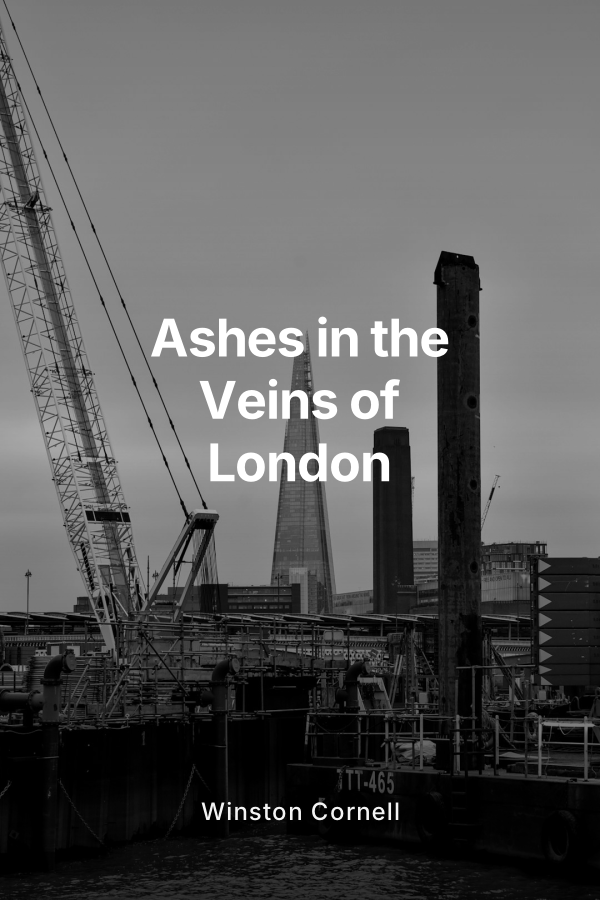
In a choking London where the air itself has become a weapon, a quiet boy from a mechanic’s garage is pushed into a war he never asked for. His father was the unassuming genius behind a revolutionary gas distribution system, a technology meant to save lives that has instead been twisted by terrorists into a lattice of invisible death. When his father dies under suspicious circumstances, the boy inherits more than a set of tools and a rusting car. He inherits secrets, blueprints, and a burden that could break nations.
At the heart of the story is a devastating gas poisoning that cripples London’s population and leaves the city staggering. Terrorists seize control of industrial sites and transport hubs, using the very infrastructure the boy’s father designed as a network for their lethal gas. As emergency services collapse under the scale of the crisis, an experimental cure appears, derived in part from his father’s obscure research. It is incomplete, untested, and localized, yet it offers the first real hope of saving the people still clinging to life in the poisoned city.
The boy becomes an unlikely lynchpin in this crisis. He alone understands the hidden quirks of his father’s car and its integrated gas system, a one of a kind machine built as both prototype and private safeguard. Its lines, valves, and vents are etched into his memory from a childhood spent under the chassis with oil on his hands. That intimate knowledge sets him on a path no one else can walk. Government agencies, fragmented and half blind amid the chaos, nudge him forward out of desperation. Terrorist cells, obsessively hunting the cure, begin to track this slight, grief stricken teenager who suddenly matters far too much.
Behind every attack lies an invisible puppeteer. Embedded high within the crisis response structure, a mole feeds intelligence to the terrorists and bends official decisions toward catastrophe. When the boy and a small circle of allies finally edge close to deploying the cure across London, the mole makes a final, monstrous move. A call comes through, direct and personal, from this hidden traitor. If the boy attempts to release the cure, the mole promises to retaliate by triggering gas dispersal systems all across the world, turning London’s nightmare into a planetary apocalypse.
The boy stands in an impossible dilemma. He can back down and leave London to suffocate slowly under a lingering poison, accepting that thousands already gasping will die so that billions elsewhere might live. Or he can defy the ultimatum, choose to save the people within his reach, and risk becoming the accidental spark of worldwide annihilation. Haunted by his father’s death and by the latent guilt that the family’s technology enabled this horror, the choice threatens to crush him.
Yet within his memories lie fragments of a different legacy. Cryptic sketches in his father’s notes, half finished equations and margin scrawls hint that the older man foresaw the possibility that his invention might be abused. Subtle safeguards and failsafes are buried in the system’s design, hidden precisely because power in the wrong hands is always a step away from abuse. The boy realizes that the mole’s threat, while terrifying, might not be as absolute as it sounds. Something in the way the gas network works globally, some asymmetry in how it was spread and licensed, could mean that the terrorists’ control is weaker than they claim.
Bolstered by that possibility and bound by a simple, stubborn conviction that he must save whoever he can now, the boy refuses to surrender. He chooses rebellion in the face of extortion. He will not allow fear of a hypothetical future massacre to become an excuse for abandoning the choking present. The call from the mole becomes the silent hinge on which his life turns. From that moment, he is no longer a frightened child caught in events. He is the one who will decide whether London breathes or dies.
To enact that decision, he must descend into the city’s poisoned underbelly. The terrorists have occupied a crucial industrial complex where the workers are held hostage and the remaining cure stock is under guard. The boy’s father had tuned the family car to interact with the gas system at a granular level. Now, that same integration becomes both a weapon and a shield. The car is more than a vehicle. Inside its frame is a compact, adjustable web of vents and reservoirs that can intake, filter, and redirect certain gas types in controlled patterns. It is the only mobile platform capable of deploying the cure in a coordinated burst across key zones of the city.
Infiltrating the complex demands a mixture of desperate ingenuity and sacrifice. The boy crafts a dangerous plan that uses his intimate knowledge of maintenance tunnels and service routes beneath the site. These forgotten passages, once used by his father and other mechanics for routine work, now become arteries for a final gambit. Slipping in with a handful of brave workers and a few hastily gained allies, he turns the very environment into a puzzle he alone can solve.
The terrorists, heavily armed and expecting conventional force, do not anticipate a mechanic’s son retooling the infrastructure under their feet. The boy reroutes valves and choke points, transforms access ducts into conduits for the cure and blind alleys for the gas, and reconfigures the car’s internal system in real time. To make this work, however, he must choose what he is willing to destroy. The car is his last tangible connection to his father, a moving archive of shared years and inherited knowledge. Yet some of its safety redundancies must be cannibalized so that it can push the cure beyond its safe operating limits.
In the crucible of that final fight, he deliberately damages the car’s core distribution lattice, overloading it to amplify the cure’s dispersal radius. It is an irreversible decision. The car will never again be what it was. This sacrifice mirrors a deeper one he faces among the hostages. At a critical moment, he allows himself to be captured, offering his life and the car as apparent prizes, to get close enough to override the terrorists’ control panels. That reckless surrender opens a narrow window of opportunity for the workers and his allies to strike. Some pay with their lives, buying heartbeats of time so he can trigger the sequence that releases the cure into London’s poisoned air.
When the release finally comes, it is not clean or perfect. Not everyone can be saved. Pockets of gas still cling to basements and sealed rooms. Some people are already too far gone. The boy’s choice quiets the city’s imminent death, but the moral toll is far from neat. Survivors stagger through streets where bodies lie in doorways. Sirens return, then fade, replaced by the muted, shell shocked silence of a population that has seen itself almost erased.
News of London’s partial salvation ripples outward, colliding with the mole’s unfulfilled threat. Around the world, gas distribution nodes remain ominously dormant. Some malfunction, not in the explosive way promised, but in a fitful, abortive flicker that reveals their limitations and the gaps in the terrorists’ reach. The boy’s gamble appears to have been right. The apocalypse the mole promised was a distorted mirror of the truth, relying on incomplete access and bluff as much as actual power. The world trembles at how close it came yet does not break. The mole vanishes, their identity still hidden, but their network is damaged and enraged.
In the aftermath, the boy’s life in the UK becomes untenable. The same ingenuity that saved the city also exposes him. Terrorists now see him as a direct enemy who spoiled their grand design. Elements within government fear the knowledge he carries, both about the cure and the vulnerabilities in global gas systems. Media narratives, hungry for symbols, twist him into a contested figure, either reckless child who risked global annihilation or savior who refused to bow to terror. In every version, anonymity is gone.
The physical toll is severe. His mind and body are wracked by accumulated stress and lingering exposure to diluted poison. Phantom pains, burning in his lungs and veins, stalk him through each waking hour. Recovery in any normal sense seems distant. It is not just London that is contaminated. His past is soaked in the gas that ruined his father’s legacy. Every familiar street smells like memory and decay. Each alley reminds him of someone he could not save.
Unable to bear the weight of both public scrutiny and private ghosts, he goes into self imposed exile, slipping quietly out of the country. He crosses borders under false identities, carried by freight ships and back road caravans, following rumors of other volatile sites where gas technologies or derivative weapons are being tested, stockpiled, or sold. The world beyond the UK is far from safe. Political factions, criminal syndicates, and corporate interests all circle these new tools of invisible warfare. They see in gas systems an efficient means of control and terror, just as the London terrorists did.
In foreign cities and remote industrial towns, the boy discovers that London was not an isolated eruption. The same design philosophies that shaped his father’s work have been copied, modified, and exported. There are forgotten facilities where gas valves stutter with age, leaking toxins into the lives of the poor and unseen. There are glittering laboratories where powerful people commission “non conventional crowd control solutions” that sound disturbingly close to weaponized air. Each encounter reveals another line of continuity, another strand tying his father’s genius to global fault lines of oppression and fear.
The boy adapts. Without the iconic car, he becomes a quieter figure. An underground mechanic with a haunted gaze, he earns his way by fixing engines in dimly lit workshops, always listening for whispers of strange accidents and unexplained respiratory deaths. When necessary, he intervenes. Sometimes that means sabotaging a facility before it becomes fully operational. Sometimes it means anonymously sending detailed warnings and design vulnerabilities back to scattered contacts in the UK, men and women who still fight from within compromised institutions.
His methods grow sharper, his conscience more scarred. Each time he acts, he must weigh immediate lives against broader consequences. Destroying one small plant may push a desperate regime to partner with an even more ruthless faction elsewhere. Leaking blueprints that expose a defect could allow untrustworthy players to patch it before ethical authorities can move. The memory of his first impossible decision in London never fades. “Save who I can now” remains his compass, but the terrain around that compass is maddeningly complex.
The mole’s specter follows him across borders. Occasionally, a local incident bears the same signature patience and precision that orchestrated London’s fall. Gas leaks that appear accidental until you note which voices in a community were silenced. Sudden policy shifts that favor aggressive expansion of gas infrastructure under the guise of “modernization.” In the shadows of these events, the boy senses a familiar intelligence at work, testing, probing, reshaping the battlefield. The unresolved conflict with this unseen enemy becomes the invisible thread stitching each new chapter of his wandering life.
In this broader world, he accumulates quiet allies. A doctor running an illegal clinic for victims of industrial exposure who recognizes his knowledge of toxins and filtration. A disillusioned engineer who once worked on a foreign adaptation of his father’s system and now lives in fear of what it might be used for. A handful of former workers from London, scattered by trauma and migration, who still remember the mechanic’s son who walked into the poisoned heart of the city. Together, they form a loose and fragile network, passing messages in coded repair notes and seemingly mundane parts orders.
The boy’s status evolves from accidental hero to covert specialist. Governments that dare not publicly acknowledge his existence nonetheless rely on anonymous tips that seem to arrive just in time. Resistance movements in gas threatened regions receive technical sketches from an unknown source showing them how to disable critical valves or rewire detectors. Officially, he is a ghost. Unofficially, he becomes a mythic figure whispered about in workyards and slums, the drifter who appears before a major “accident” and leaves behind a disabled pipeline or an evacuated block.
Yet for all these transformations, he remains fundamentally what he was at the beginning. A mechanic’s son. His understanding of the world is still rooted in practical machinery, in what can be taken apart and rebuilt. Corrupt systems that rely on the invisibility of gas are forced, by his interventions, to confront the concrete limits of their technology. He finds and exploits the misalignments between what architects designed on paper and how things actually function in rust and dust. In that gap between intent and implementation, he carves out spaces where people might live.
Ashes in the Veins of London traces this journey from a grieving teenager in a city choking on its own air to a wandering guardian of those who live under unseen threats. Every chapter deepens his conflict with the legacy of his father’s invention and the evolving designs of those who seek to turn air into a weapon. The story explores ethical tensions around technology, responsibility, and the value of an individual life against the scale of global catastrophe, without offering simple resolutions.
At its core, the book is about a young man who refuses to be paralyzed by threats that trade on hypothetical devastation. Faced with monstrous ultimatums, he keeps choosing immediate compassion over abstract fear, knowing the cost will echo through his own body and spirit. His scars and pain drive him from home, yet they also anchor his relentless determination to find and thwart new dangers wherever they arise.
The narrative will move through five sweeping chapters. The first will immerse readers in gas struck London, the death of the father, and the boy’s dawning realization of his unique role. The second will chart the tightening net of terrorism and betrayal, culminating in the mole’s chilling ultimatum and the boy’s choice to act regardless. The third will depict the infiltration of the hostage held complex, the reengineering of the car’s gas system, and the sacrificial struggle to release the cure. The fourth will follow the immediate aftermath, his physical and emotional collapse, and his painful decision to flee the UK. The fifth will open into the wider world, showing his transformation into an underground wanderer confronting new gas threats, haunted yet unbroken, with the unresolved hunt for the mole stretching into his uncertain future.
By the end of the book, readers will have walked through toxic streets and hidden tunnels, felt the heat of sacrifice as an old car is destroyed to become a city’s last hope, and breathed with the boy as he drags poisoned lungs through distant lands, still searching for ways to turn his father’s cursed gift into something that might yet save lives.