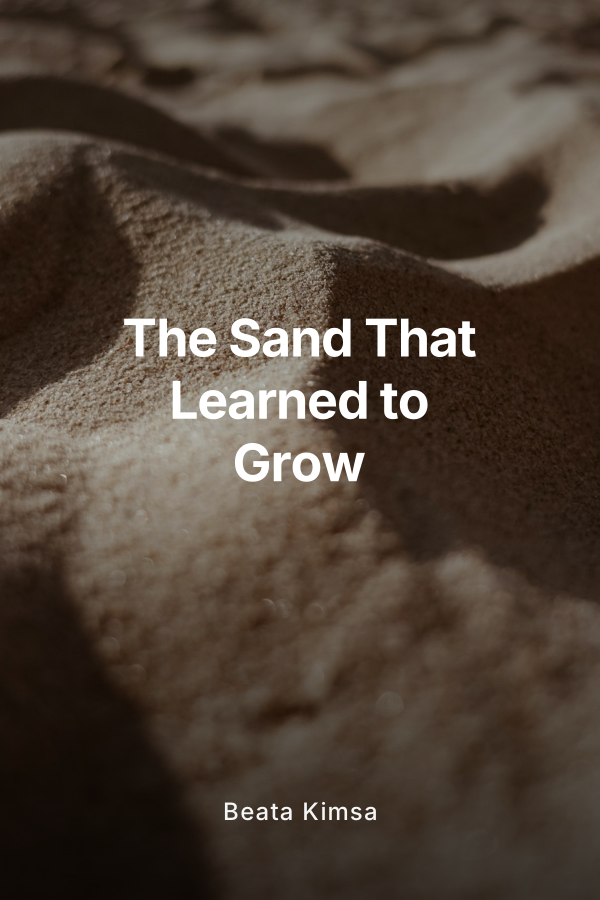
The Sand That Learned to Grow is a whimsical mystery for younger readers about a nervy little mouse in a vast desert where every plant, no matter how green it looks at dawn, crumbles into sand by sunset. It combines playful experiments gone wrong, an unknown magic that behaves like a puzzle to be solved, and a running gag of a “bravery phrase” that starts as a joke and slowly turns into real courage. The complete story unfolds over two long chapters, each structured like a step in a case file, with strange clues, misleading “fake seeds,” and a final, logical deduction that reveals why the desert refuses to stay alive .
At the heart of the mystery is Pip, a small desert mouse who is much better at talking big than feeling brave. Pip has a habit of blurting out a ridiculous bravery phrase whenever he is scared, something so silly that it makes others laugh and makes him blush. In the beginning, the phrase is just a nervous reflex that pops out in all the wrong moments. As the story deepens, the words begin to matter. The phrase is repeated at doors that should not open, on dunes that seem to shift on purpose, and in the presence of a magic Pip does not yet understand. What begins as a joke becomes a pattern, and what sounds like nonsense starts to work like a key.
The desert around Pip is dying in an oddly precise way. Pip notices that buds appear, stems grow and tiny blossoms form, only for every plant to crumble into dust before the moon rises. The regularity of this collapse feels less like bad luck and more like a rule. Why would a place that clearly remembers how to grow insist on turning its memories to sand every single day? That question is the hook of the book. It pushes Pip to investigate, even though his whiskers twitch with worry whenever he steps outside his burrow.
Pip is not a natural hero. He is a collector of odd things who prefers to inspect seeds with a magnifying shard of glass instead of leaping into danger. It is his fascination with seeds that leads him into trouble. In an effort to “fix” the desert, Pip starts experimenting with what he calls fake seeds. These are cobbled‑together contraptions and strange found objects that he plants where real seeds should go. Sometimes they are combinations of cracked beads, bits of glass and desert berries. Other times they are improvised pods made from tumbleweed fluff and secret items he finds buried in the sand. Each fake seed is an attempt to cheat the desert’s rule.
Every attempt, at least at first, goes wrong in a spectacular way. A seed that is meant to sprout shade instead bursts into a tangle of jelly thorns that wobble and then dissolve. Another fake seed erupts into bouncing cactus‑balls that chase Pip across the dunes. When one experiment turns his own whiskers strange colors for a day, Pip seriously considers quitting . The failures are comical, but they are also clues. Each disaster leaves behind traces that do not behave like ordinary matter. In the wake of the fake seeds’ short‑lived growth, Pip sees patterns in how sand falls, hears faint echoes that sound almost like a distant song, and notices that certain shapes in the dunes reappear in different places.
These details shape the central riddle of the book. There is some “unknown magic” at work that makes plants revert to sand, a force that feels older than Pip’s village and more delicate than the loud accidents he keeps causing. The story carefully avoids treating this magic as a simple spell or a quick explanation. Instead it behaves like a law of the desert that has to be observed, tested and understood. Pip’s investigations slowly turn scientific in their care, even as the results stay wild and funny. He begins to draw maps of where plants crumble fastest, sketch the shadow of each experiment, and mark every spot where his bravery phrase slips out of his mouth during the day.
The book is structured as a two‑chapter mystery in which each chapter has its own sub‑case. The first chapter is devoted to the chaos of the fake seeds. It introduces Pip’s world, his bravery phrase, and the stubborn daily death of the plants. Each new trial with a different fake seed creates a fresh twist that seems to promise a solution, only to reveal another limit, another rule the desert refuses to bend. What looks like progress turns out to be a red herring. A seed that appears to grow all the way to twilight still fractures into sand on the stroke of sunset. A patch of ground that keeps its green for an extra heartbeat seems promising, but Pip later realizes he misread the time. Little mistakes in his thinking lead him temporarily astray, mirroring how a detective might follow a false lead.
Even the people around Pip become part of the puzzle. Some neighbors laugh at his fake seeds. Others quietly collect the harmless leftovers because they find them pretty or useful. Their comments send Pip in the wrong direction more than once. He spends a full day convinced that the desert is cursed by color because the only plants that linger a bit longer are pale ones, only to discover that his sample was too small and his conclusion flimsy. Each misstep teaches him what careful observation really means.
The “unknown magic” is developed as a mystery that can be felt before it can be named. Pip often wakes in the middle of the night to a sound that he can never quite locate, a low hum buried under the whisper of the wind. He wonders if there is an invisible “sand wind” spirit or perhaps an ancient symbol buried under the desert that orders the grains into their dry obedience. The book plays with these possibilities without resolving them too quickly, allowing readers to test theories along with Pip. Subtle hints are scattered through ordinary scenes. A pattern in the cracks of a dried water basin appears again in the way fallen seeds crumble. Pip’s bravery phrase causes a faint vibration in the air in one scene and a tiny tremble in a dune in another.
The second chapter shifts from noisy experiments toward quieter deduction. After one especially dangerous fake seed misfires and almost buries Pip under collapsing jelly thorns, he realizes he cannot simply force the desert to change through clever gadgets. He has to understand what the desert is already doing. This chapter becomes a slow unraveling of the rules that govern the sand. Pip begins by retracing his steps, mapping every failure in a circle around his home. When he overlays all his observations, he sees that the plants are not crumbling randomly. They succumb in tidy rings that ripple outward from a central invisible point, as if something in the desert is sending out a daily pulse.
Clues from chapter one that once seemed like jokes click into place. Pip remembers that his bravery phrase always slips out of his mouth when that odd hum in the wind grows loudest. He recalls that one fake seed continued to glow faintly in the twilight, not because it resisted the desert’s magic, but because he had planted it slightly away from the unseen center of the daily pulse. Slowly, he concludes that the desert’s unknown magic is not hatred of life, but a kind of defensive rhythm, a heartbeat turned outward that keeps growth from spreading too fast or too wildly.
The bravery phrase becomes the final piece of the puzzle. Throughout the story, Pip’s phrase has been comic relief, a silly sequence of words that make him feel braver than he actually is. What he has not realized is that he has always spoken it with a particular rhythm. Young readers see this rhythm play out on the page repeatedly, even as Pip is too distracted by his fear to notice. When he finally decides to stop planting fake seeds and instead listen, truly listen, to the desert’s nightly hum, he hears the same rhythm mirrored in its pattern.
The mystery’s solution is not that the phrase itself is magical in a shallow sense, but that Pip’s own heartbeat, his fear and courage tangled together, has been resonating with the desert’s old pattern the entire time. The words, said often enough and with enough feeling, have taught him to align with something he could not name. In a quiet scene that forms the emotional core of the book, Pip stands alone at dusk in the most stubborn patch of sand, watches the last struggling plant droop, and softly says his bravery phrase on purpose, not because he is scared, but because he wants to speak to the desert.
What follows is not a sudden explosion of greenery. The book resists offering an easy reward. Instead, a single stem holds its shape just a moment longer after night falls. Pip notes the delay. The next day he refines the timing of his phrase, observing where in the pulse of the desert he places his words. Each small success is measured and fragile, but it is real. The unknown magic begins to feel less like a wall and more like a door that must be knocked on with the right rhythm. The last pages hint that with patience, the sand might not exactly “learn to grow,” but rather might remember how to cooperate with those who understand its limits.
Throughout, the narrative is laced with cleverly placed hints about what truly lies under the desert. Ancient marks that Pip initially mistakes for scratches appear on rocks in patterns matching his seed explosions. The sound that troubles his sleep grows louder near one forgotten dune. A series of wind‑carved symbols that Pip passes again and again are never fully explained, but they point attentive readers toward the idea of an old, protective magic established long before any mouse arrived. These hints are never spelled out as a single correct answer. The book respects the reader’s ability to infer and imagine, framing Pip’s solution as one logical possibility built on his observations rather than as a final word.
Red herrings keep the mystery playful. Pip briefly suspects that his fake seeds themselves are the cause of the desert’s breakage, only to discover that the crumbling preceded his birth. At another point, an oddly shaped rock that looks like an enormous seed convinces him that a giant underground tree is draining life from the surface. Careful description leads readers to share his suspicion, but the rock is eventually revealed to be ordinary. Instead of being wasted, these misinterpretations become part of Pip’s growth as a careful thinker who learns to distinguish between wishful stories and evidence.
The tone of The Sand That Learned to Grow balances humor and wonder. Pip’s repeated bravery phrase functions like a refrain, something children can shout along with, while his fake seed mishaps deliver slapstick delights. At the same time, the structure of the story invites readers to ask questions, track patterns, and test their own theories about what is happening beneath the dunes. It is a mystery that can be enjoyed for its antics by younger children and revisited later for its layered clues and themes.
Underneath the playfulness, the book quietly explores ideas about courage, failure and listening. Pip’s most impressive quality is not his noisy experiments, but his decision to admit when he is wrong and begin again more carefully. The unknown magic of the desert, viewed first as a cruel curse, gradually becomes something worthy of respect. By the final pages, Pip has not conquered his home, but entered into a shaky, hopeful truce with it. His bravery phrase, once a shield against fear, becomes a shared language with the land he lives in.
As a two‑chapter work of about four thousand words, the book offers young readers a satisfying, self‑contained adventure that still leaves room for imagination. The first chapter provides a rush of comic disaster and hard‑earned clues. The second chapter rewards attention with a calm, reasoned untangling of those clues into a gentle revelation. Together they create a story in which a tiny mouse solves a big mystery not by finding a spell to overpower an old magic, but by listening long enough to hear how his own small heartbeat might fit inside the larger rhythm of the desert itself.