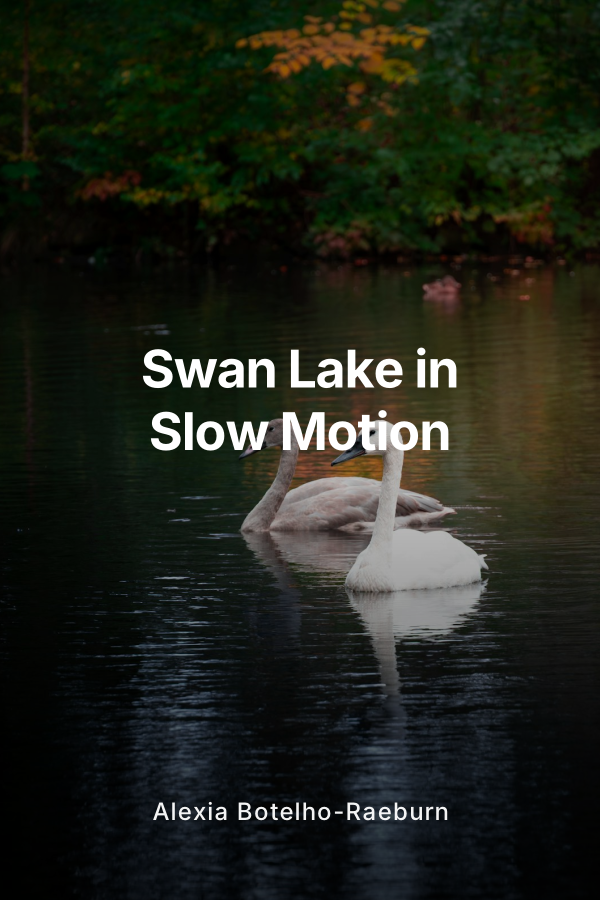
This slow burn high school romance follows a quiet, anxious girl who is used to dissolving into the background and a sharp tongued volleyball captain who notices what everyone else overlooks. At its heart, the story is about the aching beauty of being truly seen for the first time and the fragile courage it takes to step into the light.
The unnamed heroine is an introverted honors student who moves through school corridors like a shadow. Classmates know her grades, not her face. What no one at school knows is that she is a devoted ballet dancer, pouring everything she cannot say into rehearsals and performances. On stage she becomes someone else entirely, yet the thought of her classmates seeing that side of her fills her with dread. She keeps her worlds rigorously separate, guarding ballet like a secret heartbeat.
Everything begins to unravel the night of a Swan Lake performance when a handful of students from her school attend by coincidence. On stage, costumed as a swan, she performs under the hot brightness of the spotlight, her movements drenched in all the emotion she never allows herself to voice. Afterward, scrubbed of stage makeup but still carrying the vulnerability of having been seen, she hurries to the station, nerves frayed and body exhausted.
Waiting there is Kuroo, a familiar figure from school with a reputation for clever sarcasm and easy confidence. He is on his way home from a team event, hair ruffled, posture loose, eyes amused. He recognizes her from the performance and casually falls into step beside her on the walk to the station. The world narrows to the echo of their footsteps and the electric awareness of being near someone who has just seen her at her most exposed.
He asks, lightly, “I didn’t know you danced,” his tone a blend of genuine surprise and subtle teasing. He mentions the Swan Lake outfit, makes an offhand joke about not having pegged her for the ballerina type, perhaps suggesting that she looked like she was about to whirl right off the stage. His words are playful rather than cruel, but to her, they land like a small shock. No one at school ever notices her, much less enough to connect the anonymous girl in class with the swan on stage.
Flushed and flustered, she becomes even quieter than usual. Her responses are short, almost brittle, but grateful. She manages a shy confirmation that yes, she dances, that it was “just a show,” brushing it off while her cheeks heat with embarrassed color. Inside, there is a storm: mortification that someone from school saw her, relief that he did not mock her effort, gratitude that he noticed at all. She is nervous, but also deeply, quietly thankful that he not only saw her but chose to speak to her without turning the performance into gossip bait. The air between them is threaded with a nascent tenderness she does not yet know how to name.
Their conversation on that walk is simple, almost mundane, yet it becomes the invisible hinge on which the entire story will turn. He asks a few soft questions about ballet and she gives him only the bare minimum, keeping the deeper reasons for her anxiety to herself. Still, there is a fragile sense of being acknowledged. He does not push when she retreats. He lets silence sit comfortably between them, occasionally puncturing it with small, almost throwaway jokes that are gentle enough not to sting.
In the weeks that follow, they encounter each other in a more ordinary context when he begins to tutor her in chemistry. Their tutoring sessions form the spine of the book’s slow burn. At first they are awkward meetings filled with formulas, notes, and the safe neutrality of schoolwork. Yet Kuroo cannot resist calling back to their shared secret. He might glance across the table and quip that at least solving equations is less terrifying than dancing in front of people, or that today’s session is easier than performing Swan Lake in full stage makeup. Each low key joke is a soft tap on the invisible thread connecting them, an invitation to remember the intimacy of that walk without forcing her to relive its vulnerability.
The heroine, who has grown used to existing unnoticed, begins to realize that Kuroo sees more than she wants to show. He notices when her hands tremble before a presentation, when her gaze flickers to exits in crowded rooms, when she curls slightly inward in group settings. He covers for her with offhand remarks, redirects attention when she looks overwhelmed, and never calls her out in front of others. His teasing remains light and infrequent, careful not to corner her. Slowly, she comes to anticipate those moments instead of dreading them.
Over five chapters, the book traces the delicate evolution of their relationship from tentative acquaintances to something richer and deeper. Each chapter centers on a different kind of intimacy.
The first chapter captures their initial collision: the Swan Lake performance, the charged walk to the station, the inner turmoil of being recognized. The focus is on her internal world, rich with self consciousness and unspoken yearning, and on the unexpected gentleness hidden beneath Kuroo’s teasing.
The second chapter shifts into the rhythm of tutoring sessions. The narrative lingers on small domestic details: the scratch of pens, the clink of glass beakers in the lab, the way their knees nearly touch beneath the desk. Their relationship deepens through small callbacks and inside jokes related to ballet and chemistry, slowly building a private language between them. She starts to open up in tiny increments, letting slip that performing terrifies her only when she knows people from school might be in the audience, hinting at how fragile she feels when the two halves of her life collide.
The third chapter explores the space outside structured meetings as they encounter one another in hallways, at practice, and in moments of accidental solitude. Here, the emotional stakes rise. Kuroo becomes a quiet witness to her anxiety, and she becomes a steady, listening presence when his own pressures as a captain weigh on him. He drifts from making jokes about Swan Lake to genuinely asking what ballet means to her. She begins to trust him enough to describe the feeling of dancing as the only time she does not feel like she might disappear. The chemistry between them shifts from careful to charged.
In the fourth chapter, the dual worlds of school and ballet converge again in a new performance. This time, Kuroo attends intentionally. The heroine knows he is somewhere in the audience and her anxiety spikes, but so does a strange thrill. On stage, every movement carries the knowledge that he is watching, not as a stranger but as someone who has seen the frightened, embarrassed girl behind the costume. After the show, their interaction is deeper and more honest. He offers a mix of teasing and reverence, praising her control and artistry while still tossing out a light remark to anchor them in their familiar dynamic. She finally confesses how afraid she is of being seen, and he quietly admits that seeing her is what first drew him in.
The fifth and final chapter brings their slow burn to a tender culmination. A crisis shatters the fragile balance she has kept, perhaps a rumor at school about her ballet life or the possibility that she might have to choose between her academic priorities and dance. Overwhelmed, she pulls away, fearing that her feelings for Kuroo and the vulnerability he represents will only complicate everything. He refuses to chase her loudly or dramatically, instead waiting for moments when he can offer quiet reassurance. He reminds her that being seen does not have to be a wound, that sometimes it is the first step toward being loved.
In a soft, intimate climax far removed from grand declarations, they finally confront their feelings. Perhaps it happens during another walk to the station, or in the dim calm of an empty classroom after a tutoring session. The echo of their first shared moment lingers in the air. She thanks him, truly and fully, for noticing her that night in her Swan Lake costume, for not turning away from the girl who could not speak. He admits that from that night on, he could not unsee her and did not want to.
Their confession is almost ordinary in its simplicity, built from everything unsaid over months of small jokes, shy glances, and shared silences. There is a first touch that feels like a promise, a brush of fingers that finally lingers, perhaps a hesitant kiss that tastes of relief. The narrative does not end with a perfect future mapped out, but with a sense that together they can learn to live in the complicated overlapping of school, ballet, and young love.
Throughout the book, the emotional core lies in the contrast between how invisible the heroine feels and how intensely Kuroo sees her. Their romance is not built on dramatic gestures but on gentle persistence, subtle protectiveness, and the slow, careful unveiling of their inner selves. The story lingers in soft, intimate moments: his half smile when he references Swan Lake in a tutoring session, the way her eyes brighten when he understands a ballet metaphor, the warmth that settles between them when they share a joke nobody else would understand.
Swan Lake in Slow Motion is a quiet, heartfelt love story about an anxious girl and the boy who makes it safe for her to step into the spotlight of her own life. It is about the alchemy of being noticed, the slow chemistry of trust, and the tentative yet powerful realization that sometimes, the bravest thing you can do is let someone see you exactly as you are.