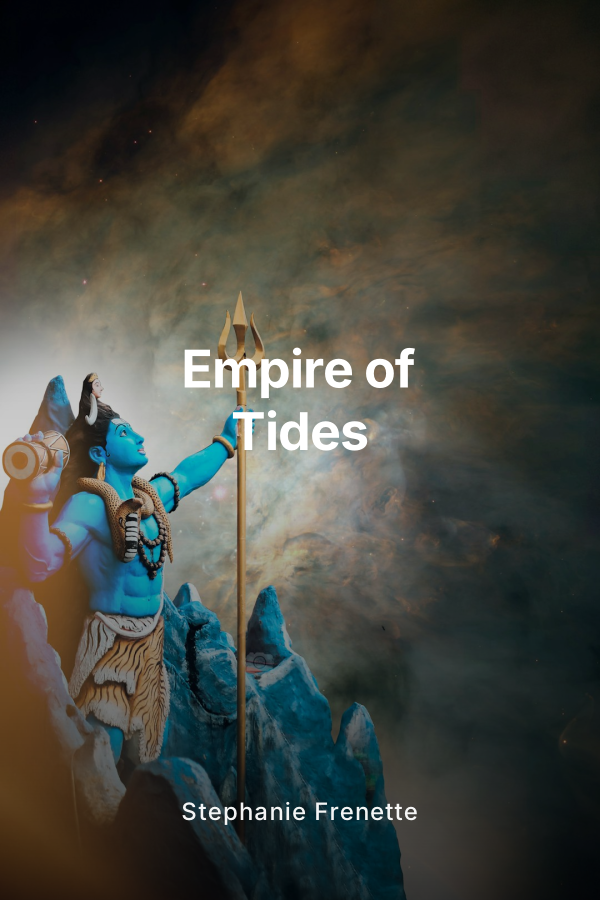
In a North America reshaped by gods and legions rather than ballots and bureaucrats, “Empire of Tides” follows the relentless ascent of Percy and Apollo as they forge a Roman dominion across a fractured continent. The story immerses readers in a world where demigods are taken and trained young for war, where service is glory, obedience is survival, and resistance is ground beneath the disciplined tread of imperial legions.
The book centers on the intertwined arcs of Percy and Apollo as they shift from champions of a besieged Rome to architects of an unforgiving new order. Percy becomes the living spearhead of conquest, a commander who wields oceans, storms, and disciplined cohorts with equal ease. Apollo, once radiant and frivolous, becomes a cold strategist and cultural engineer, crafting propaganda, rituals, and legal codes that sanctify Rome’s expanding power and recast submission as honor. Through their eyes, the reader experiences not only colossal battles and divine politics but also the quiet, intimate processes through which empire infiltrates the soul.
Across five chapters, the book traces the evolution of this imperial project. The opening chapter establishes the fall of old democratic America and the rise of a Roman successor state that promises order in place of chaos. Through the clash of modern armies and myth-forged legions, readers witness the first brutal proofs that Roman discipline combined with godly might can shatter contemporary military doctrine. Percy’s raw power on the battlefield is contrasted with his private conviction that he is preserving the world from anarchy, not recognizing how his victories gradually normalize ruthless methods and irreversible sacrifices.
The second chapter dives into the demigod system that sustains Rome’s war machine. Children marked by the gods are identified, taken, and raised within the legion’s austere barracks and training grounds. From within Percy’s and Apollo’s close perspectives, the narrative explores academy-style drills, initiation rites, and the shaping of teenagers into weapons who view battlefield death as the highest possible fulfillment. Moments of parental grief are seen at a distance, filtered through imperial logic that frames such loss as the natural price of greatness. The reforms Percy and Apollo enact to make the system harsher and more efficient are portrayed not as sadism, but as “protection” against a dangerous world, revealing how authoritarian institutions dress their cruelty in the language of care.
The third chapter follows the expansion across North America, where state and non-state forces try to resist Rome’s march. Percy’s legions, supported by monsters and divine blessings, slam into armies that still believe numbers, technology, and democratic ideals can hold back ancient power. The narrative showcases large-scale set pieces in which Roman formations advance through artillery fire, break mechanized lines, and then turn victory into spectacle through parades, oaths, and carefully staged celebrations. Apollo crafts songs, triumphal arches, and legal proclamations that ensure each conquest is remembered not as a tragedy of lost sovereignty but as a step in humanity’s “return to greatness.”
The fourth chapter explores the intimate, morally complex terrain of consent, reverence, and divine entitlement. In a culture where no one can meaningfully say no to Percy or the gods, personal relationships, alliances, and even subtle acts of coercive intimacy are wrapped in an aura of honor. The book does not linger on graphic scenes, but it examines the manipulative dynamics through which powerful beings secure what they want while maintaining a veneer of voluntary devotion. Young demigods, courtiers, and provincial elites alike come to view proximity to Percy and Apollo as the highest form of blessing, even when that closeness strips them of true agency. This chapter asks how far a society can go in sanctifying obedience before it loses any real concept of choice.
The final chapter turns inward as rumblings of doubt, quiet dissent, and unintended consequences begin to surface. Percy and Apollo remain committed to Rome and to one another, yet fractures appear in the edifice they have built. Traumatized veterans, disillusioned officers, and conquered subjects begin to see the cost that has been hidden behind victory banners. Without openly condemning its protagonists, the narrative allows readers to sense alternate moral horizons: could there have been another path, one that preserved strength without demanding such total submission? Percy’s and Apollo’s attempts to tighten control and refine their system only deepen the paradox at the heart of the empire they forged.
Throughout, “Empire of Tides” maintains an emotionally close but tonally restrained perspective. The narration stays tightly aligned with Percy and Apollo, inviting the reader to understand and at times even sympathize with their beliefs, while never fully endorsing the imperial lens through which they view the world. The result is a story that feels both grand and disturbingly intimate, as the reader lives inside an empire that sees itself as the only bulwark against chaos and gradually learns to question that claim without ever being given easy answers.
Planned at approximately 10,000 words across five chapters, the book will balance sweeping political and military developments with character-driven moments of introspection, loyalty, and private compromise. It is written for readers who enjoy morally complex power fantasies, who are fascinated by the psychology of empire, and who are willing to inhabit the minds of characters whose choices are both compelling and deeply unsettling. “Empire of Tides” offers not a simple tale of heroes and villains, but a sustained exploration of what happens when those who can reshape the world decide that conquest and control are the surest path to peace.