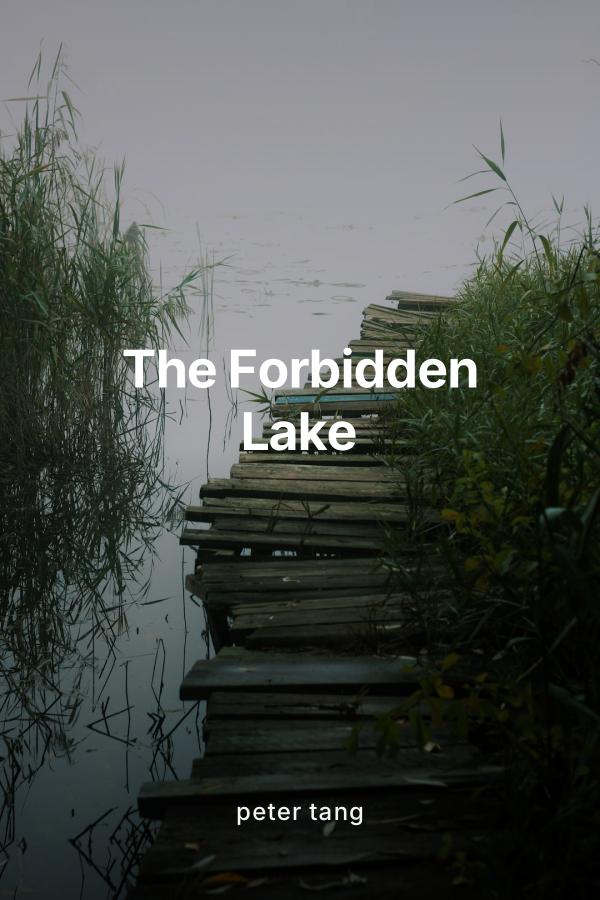
Set high in the volcanic highlands of Cameroon's North West Region, Lake Oku is more than a landscape. It is a sanctuary, a warning, and a mirror that remembers everything it has ever swallowed. The Forbidden Lake invites readers into this charged space where geology, ecology, myth, and lived faith are inseparable, revealing how a community has protected a sacred lake for centuries while the modern world circles closer every year .
Blending fiction and fact, the book follows Dr. Nformi, a Cameroonian scientist trained abroad who returns home determined to separate verifiable data from village legend. He comes to Oku as a researcher of African folklore and crater lakes, armed with sampling bottles, sensors, and a belief in objective truth. The local stories he heard as a child about a dangerous, watching lake now feel like material to analyze rather than a power to fear .
At the crater rim he meets Bah Nteck Yosembom, an aging guardian of the lake's traditions who has inherited stories and responsibilities passed from ancestor to ancestor. Where Nformi sees a research site, Bah Nteck sees a covenant that must not be broken. Their early conversations frame the central tension of the book. One man trusts instruments and peer review. The other trusts memory, taboos, and the conviction that some mysteries protect themselves by punishing intruders .
Despite Bah Nteck's warnings about "forbidden weeks" when no one should go near the water, Nformi insists on descending to the shore with his younger cousin and research assistant, Silas Wamey. The path is steep and treacherous, the forest unusually hushed, the air heavy with moisture and something that feels like attention. When they finally reach the lake, they find a surface as black and still as polished stone, a silence so complete that the fall of a single drop sounds like a bell. What should be a neutral field site presses on them like a presence .
As Nformi disturbs a stone and prepares to collect his first samples, the ripples on the surface behave in ways no physics textbook can easily explain. When Silas dips his container into the water, the temperature plummets and the sample begins to emit an otherworldly glow. In that eerie light, Nformi is pulled into a vision that compresses centuries into moments. He sees fire and eruption, a flourishing village, pride and neglect, then a catastrophic night when the ground opens and water pours in. The village disappears, yet its memory remains suspended in the depths. The lake, he realizes, is not simply water in a crater. It is an archive of consciousness that sometimes chooses to show itself .
Shaken and disoriented, Nformi wakes on the rocks with words in the Oku language on his lips. Bah Nteck has followed them down and quietly understands what has happened. In the guardian's view, the lake has "spoken" and selected Nformi as a new kind of keeper. Not a traditional priest, and not a detached academic, but a bridge between the tools of science and the older grammar of ritual, story, and taboo. Whether Nformi believes in spirits is suddenly irrelevant. The lake's choice is presented as a responsibility rather than a privilege .
From this turning point, the narrative traces Nformi's gradual transformation. He continues to test pH levels and identify organisms, yet he now studies the calendar of forbidden days, the protocols for who may approach the water, and the meaning of the Fon of Oku's annual visits. He learns how, every year, the community gathers at the lakeshore, drinks from its waters, and presents sacrifices to Ma, the goddess associated with fertility, continuity, and protection of the land. The ritual in which a newly crowned Fon must be symbolically tested and accepted by the ancestral forces of the lake becomes a key emblem of how political authority and sacred ecology intertwine in Oku life .
The book does not reveal every sacred detail. Instead, it gestures respectfully at rites whose precise steps remain with the community, while explaining enough for outside readers to understand that these practices are sophisticated systems of governance, environmental management, and moral education. Taboos about when to fish or bathe, who may cross certain thresholds, and what kind of speech is acceptable near the shore are presented as living law that has protected both people and habitat for generations, long before formal conservation frameworks existed .
Alongside the story, readers learn about the lake's real-world ecological uniqueness. Lake Oku is depicted as a high-altitude crater lake nestled within the Kilum-Ijim forest, harboring species found nowhere else and threatened by deforestation, pollution, and climate change. Through Nformi's evolving research, the book shows how local reports of lights on the water can correspond to unusual microorganisms, yet also how some phenomena, such as water that appears to respond to human intention or recurring prophetic dreams among researchers, resist clean explanation. Rather than dismissing one side or the other, the narrative insists that rational inquiry and indigenous cosmology can enrich each other when approached with humility .
Structurally, the planned two-chapter book mirrors this duality. The first chapter reads as a compact mystical adventure. It follows Nformi's first season at Lake Oku, his confrontation with the limits of scientific certainty, his initiation into the lake's deeper history through visions, and his uneasy acceptance of a role that ties his personal destiny to a place he once considered only a research topic. Suspense builds around whether he will overstep the boundaries that Bah Nteck has set, and what the lake might do in response.
The second chapter widens the lens. Here the narrative voice shifts between story, reflection, and carefully framed exposition. Myths about the drowned village, the origins of the goddess Ma, and the ancestral spirits that dwell in the water are set beside explanations of Oku chieftaincy, the Fon's ceremonial obligations, and the region's environmental challenges. In this chapter, Nformi becomes not just a protagonist but also a guide, interpreting both the data from his fieldwork and the teachings of elders such as Bah Nteck for a broader world audience. The reader is invited to see how a "forbidden" lake can function as a teacher, confronting modern societies with questions about extraction, reverence, and limits .
Throughout, The Forbidden Lake speaks to several kinds of readers at once. For Oku and other Cameroonian readers, it is a gesture of honor toward a sacred landscape and the people who have guarded it, acknowledging their knowledge as something other than superstition. For international readers, it is an entrance into a part of Africa too often reduced to headlines, portraying instead a place where climate, culture, and cosmology collaborate in complex ways. For students, tourists, and general readers, it offers an accessible path into understanding how myth, ceremony, and science can be woven into one coherent story of a lake that refuses to be simplified .
The central insight that emerges is that some places do not want to be conquered. They want to be listened to. Lake Oku is portrayed as such a place, a living archive that has preserved both a drowned village and a thriving culture through water, silence, and taboo. By the end of the book, Nformi has become less certain of many things, yet more convinced that genuine knowledge always requires relationship and responsibility.
The Forbidden Lake is therefore not only a tale of one man's encounter with a mysterious lake. It is a persuasive meditation on what it means to live in right relationship with land and water in a century of environmental crisis. It suggests that myths carry truths that cannot always be captured in tables and graphs, and that respecting "forbidden" spaces may be the wisest science of all.