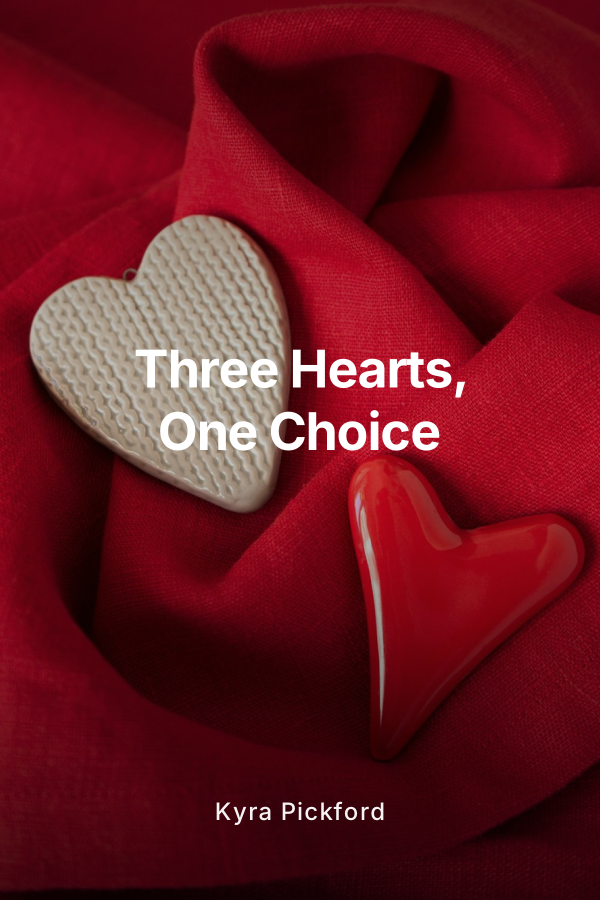
This book is a sweeping, intimate romance about a young woman caught between three very different kinds of love. Built around the core question hinted at in the original concept "Three choices, one girl, who will she pick, long story" the novel follows her emotional journey as she learns that the most important choice is not about which man wins her heart, but about the woman she becomes along the way.
At its heart, the story is about the tension between safety and adventure, loyalty and desire, expectation and authenticity. Each of the three men represents not just a potential partner, but a different possible life. The girl stands at a crossroads where every step forward means letting go of another version of herself. This is not a simple love triangle; it is a love constellation, a slow unfolding of feelings, missteps, tenderness, and heartbreak that stretches over years.
The girl, who begins the story uncertain of her worth and fearful of disappointing others, gradually discovers the quiet bravery required to choose a life that is truly her own. Her journey is surrounded by small, vivid moments: the warmth of late night talks, the ache of unsent messages, the charged silence of almost-kisses, and the sting of realizing that timing can be as cruel as it is kind.
The first man is her best friend, the familiar constant who has known her since childhood. With him, love looks like safety and shared history. He is the one who remembers her favorite snacks, the exact shade of her laughter, the stories behind every scar. With him, she can breathe. Yet that very comfort leaves her wondering whether what they share is deep romantic love or the tender, cousinlike affection of two people who have grown up side by side. He represents a life where things remain recognizable, where they stay close to home, surrounded by the same streets and faces they have always known.
The second man is the newcomer, mysterious and magnetic. He arrives in her life like a storm, bringing with him a sense of possibility she has never felt before. With him, love feels like standing on the edge of a cliff, terrified and exhilarated at once. He asks questions no one else thinks to ask, challenges the beliefs she has carried unquestioned for years, and awakens long buried dreams. He is the embodiment of adventure, risk, and leaving everything familiar behind. With him she can imagine a future in unknown cities, chasing ambitions that seemed impossible before he looked at her as if she was capable of anything.
The third man is the rival turned reluctant ally, a person she once disliked, perhaps even resented, before circumstances forced them into the same orbit. Their connection begins with friction and impatience. Slowly, that tension melts into a surprising intimacy built on honesty, shared struggles, and mutual respect. He sees her contradictions and does not look away. With him, love looks like being fully seen and still chosen. He offers a life that is not easy, but profoundly real, built on partnership and growth instead of illusion.
As the story unfolds, the girl wavers among these three, pulled by different parts of herself. With her best friend, she wrestles with the question of whether lasting love must always be tied to intensity, or if it can be found in quiet, consistent presence. With the mysterious newcomer, she confronts her fear of change and the possibility that she might outgrow the life everyone expects her to live. With the former enemy now confidant, she learns that conflict can be a path to closeness, and that imperfect people can still love each other perfectly in small, essential ways.
The book traces how her relationships with each man evolve in parallel with her own self understanding. Early chapters dwell in softer, more innocent moments. There are scenes of long walks home under fading streetlights, whispered phone calls that stretch until dawn, and shared jokes that build their own private language. The girl clings to the belief that she can find a path where no one gets hurt, where she does not have to make an irreversible choice.
But as time passes, the gaps between what she feels and what she says widen. She begins to live in the space between her heart and her lips, torn between the urge to confess and the terror of ruining what she already has. Each man, in his own way, senses that she is not fully with him, and this quiet fracture creates a web of misunderstandings, small jealousies, and abrupt silences that echo louder than any fight.
The pressure intensifies when an external turning point arrives: an opportunity that forces her to decide not only who she wants beside her, but what kind of life she is willing to build. This could be a chance to study or work far from home, a family crisis, or a life event that makes time suddenly feel finite instead of endless. Whatever the form, it clarifies a painful truth. Staying indecisive is also a choice, and it too has consequences.
Each man responds differently. The best friend, terrified of losing her, finally lets his deepest feelings slip in an unguarded moment, turning years of unspoken affection into raw confession. The newcomer, instinctively drawn to movement, pushes her toward pursuing her dreams even if it means risking their future. The rival turned ally refuses to beg or bargain, instead asking her one unwavering question: "What do you actually want, when no one else is watching?"
The girl realizes that love is not just about who makes her heart race. It is about who she becomes around them. With one, she feels safe but small, unsure whether staying would mean forever living within the expectations that have always held her back. With another, she feels on fire, but suspects that the flame might consume them both if they are not careful. With the third, she feels stretched and challenged, sometimes to the point of discomfort, yet also deeply, almost frighteningly, herself.
What makes this story so emotionally rich is that none of the men are villains. Each cares for her in his own flawed, human way. The book refuses to reduce them to simple archetypes, instead showing their insecurities, their jealousies, their quiet gestures of love. It allows readers to understand why she is so torn, why each potential future is both tempting and terrifying.
The climax does not arrive in the form of a grand, public declaration. It blooms in a quieter, more intimate realization: that her life cannot be shaped solely by whom she loves, but by what she chooses to stand for. She recognizes that unless she knows what kind of woman she wants to be, every relationship will feel like a temporary shelter instead of a home. This turning point is not about rejecting love, but about stepping into it with both feet on the ground, aware of the cost and committed to the path.
In the end, she does make a choice. The narrative builds to this decision through a series of layered, emotionally charged scenes: a final conversation under rain stained skies, a letter written and rewritten until the ink smudges, a last lingering glance that says goodbye more clearly than words ever could. The man she chooses is less important than the woman who chooses. She no longer drifts between other people’s needs; she stands in the center of her own life, willing to accept the joy and the heartbreak that come with choosing one heart and letting the others go.
The resolution balances sweetness and ache. The man she chooses is not perfect, and neither is she, but together they embody a love that feels earned rather than handed to them. Their connection is shaped by every misstep that came before, every moment she almost walked away, every time he waited instead of pushing. The final scenes linger on the small, intimate details of their shared life, offering readers the sense that real love is not measured in dramatic gestures, but in the quiet consistency of choosing each other again and again.
At the same time, the story does not abandon the other two men. The narrative honors the roles they played in her growth. One might find his own path, finally free from waiting in the wings. The other might carry a gentle scar, a tender reminder of what might have been, and eventually turn that pain into a deeper understanding of himself. Their arcs underline the theme that unchosen love is not wasted; it shapes the people we become, even when it does not lead to forever.
Throughout the book, settings mirror the girl’s inner landscape. Familiar streets and childhood haunts represent the comfort she must partially leave behind. New cafés, train stations, or city skylines suggest the lives she might inhabit if she dares to step beyond the border of her fears. Shifting seasons mark her emotional evolution: warm summers of denial and possibility, muted autumns of slow realization, cold winters of loneliness and clarity, and eventual springs of cautious hope.
The prose dwells on feeling. The way a single touch can silence a room. The way someone's name can sit like a stone or a prayer in the back of her throat. The way love can feel like both a gift and a burden when three hands are held out and she knows she can only take one. Intimate conversations are interwoven with internal monologues, revealing the depth of her confusion and the slow, steady birth of her self trust.
More than a story about choosing between three men, this novel is about learning to hear the sound of one’s own heart under the noise of family expectations, social pressure, and the fear of hurting those we care about. It offers an emotionally resonant reflection on how we make the hardest choices of our lives not in a single moment, but through a thousand small decisions, half truths, and brave confessions.
"Three Hearts, One Choice" invites readers into a long, immersive love story that feels both deeply romantic and painfully real. It asks them to remember the times they stood between what was safe and what was true, between the person they were supposed to love and the person they actually did, and perhaps most importantly, between the life they were handed and the life they secretly longed for.
By the final page, the girl is no longer simply the one who must pick. She has learned to be the one who chooses. And in that transformation, readers are left with a lingering feeling of hope: that even in the messiest, most tangled corners of the heart, there is a way forward that honors both love and self.