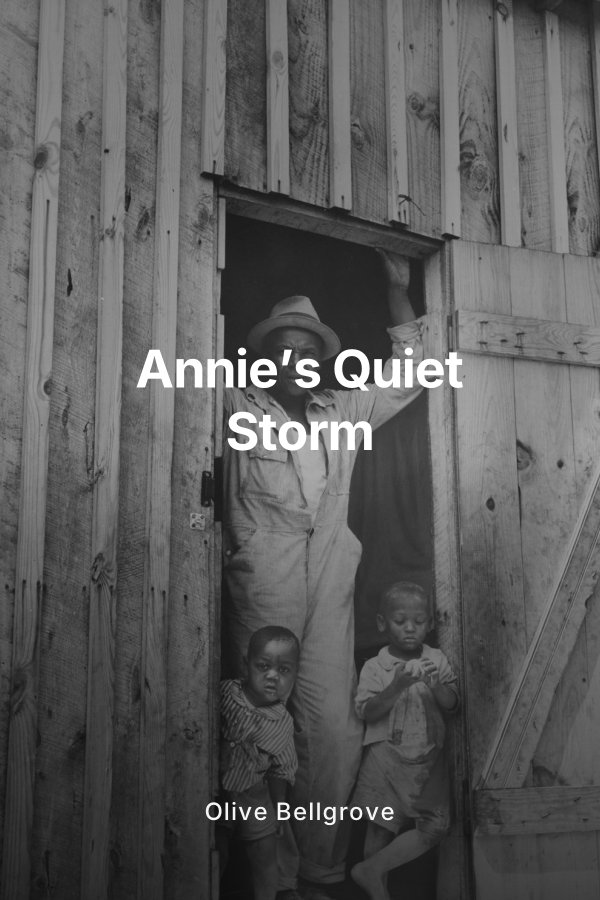
Annie’s Quiet Storm is a tender, emotionally rich story written for children under ten as well as younger teens, crafted to feel simple and safe on the surface while carrying deeper feelings and reflections underneath. At its heart stands Annie, a thoughtful girl who feels quietly pushed aside as her family’s attention turns more and more toward her baby brother and the busyness of everyday life. The story explores gentle but real sadness rooted in family and jealousy, without heavy themes such as illness, death, or cruelty, making it suitable for sensitive readers who still want a book that truly understands how big their feelings can be .
Across two carefully structured chapters, the book traces how Annie’s quiet hurt slowly grows into a small inner storm, how misunderstandings build between her and the people she loves most, and how honest words and listening hearts begin to heal what has been aching for so long. Although written in clear, accessible language for younger readers, the story makes room for more complex inner thoughts and subtle emotional shifts that older children and teens can recognize in themselves. It aims to validate jealousy and loneliness without judgment, guiding readers toward empathy, communication, and the comforting realization that being upset does not make them bad or unlovable.
The book’s sadness is soft rather than overwhelming. There are no sudden tragedies, only the ordinary pains that can nonetheless feel enormous: a parent too busy to look up from an email, a little brother who always seems to get the last piece of attention, a best friend who drifts closer to someone else. Moments of hurt are carefully balanced with scenes of warmth, humor, and comfort. A neighbor’s kind word, a teacher’s quiet check‑in, or a shared cookie with a friend show that small gestures can matter more than grand speeches, especially to a child who is waiting for someone to notice her feelings.
One of the book’s central promises is that “understanding” will arrive in a way that feels earned and believable. This understanding unfolds in three directions . First, Annie begins to understand her parents better, seeing that their distracted moments come not from a lack of love but from stress, exhaustion, and the complicated demands of adulthood. Second, her parents learn to see more clearly what has been going on beneath Annie’s calm surface, finally recognizing how often she has quietly stepped aside without complaint and how lonely that has made her feel. Third, Annie and her best friend Zoe talk honestly about jealousy, hurt feelings, and the fear of being replaced, discovering that friendship can stretch to hold more than one person.
The story is especially mindful of readers who have younger siblings or who feel overshadowed in some way by family circumstances. Annie’s relationship with her little brother is not one of harsh rivalry but of mixed, changing feelings. She sometimes resents the constant noise, mess, and attention he brings, yet she also worries about him, protects him instinctively, and feels bursts of pride when he copies her or calls her name. The book never asks Annie to pretend she is always happy for him; instead, it shows her learning how to hold more than one feeling at a time, how love and jealousy can sit side by side without canceling each other out.
To serve both younger children and teens, the narrative voice walks a careful line. Scenes unfold in simple, concrete language accessible to readers under ten, with short sections and clear actions that keep the plot moving. At the same time, the story frequently pauses inside Annie’s thoughts, capturing the kind of quiet, reflective questions that older readers are already asking themselves but may not speak aloud. How much attention is “fair”? Is it selfish to want more? Does being mad at your family mean you love them less? These questions are woven gently into the narrative rather than posed as lessons, inviting readers to think and feel alongside Annie rather than being told what to believe .
The emotional arc of the book centers on three turning points. First, Annie hits a private low point when a special moment she has been waiting for is unexpectedly overshadowed by yet another small crisis involving her brother. She does not explode in a dramatic scene; instead, she grows quieter, then quieter still, until someone finally realizes that her silence is not the same as being fine. Second, a heart‑to‑heart conversation with Zoe cracks open things Annie has tried to hide, including her jealousy over Zoe’s new friendship and her shame about feeling so jealous in the first place. Third, a family conversation at home allows both Annie and her parents to speak openly, apologize, and make specific plans for change, including new traditions that give Annie more time, voice, and space in the family.
Throughout, the book avoids easy fixes. Understanding does not arrive through a single perfect speech. Her parents do not become flawless overnight, and Annie herself continues to feel twinges of jealousy even after their talk. What changes is that her feelings are now seen and named instead of ignored, and she has been given words to explain them, plus a sense of safety in doing so. That shift, from invisible hurt to shared understanding, forms the emotional core of the book and the hopeful note it ends on.
Annie’s Quiet Storm ultimately speaks to children who sense that their sadness is “too small” to matter in a world that often pays more attention to big disasters than to quiet disappointments. The book gently insists that these smaller aches are still real and worthy of care. It reassures readers that wanting to be noticed and valued is not selfish, that even the kindest child can feel jealousy, and that there is courage in telling the truth about what hurts. For parents, teachers, and caregivers reading alongside children, the story offers a soft mirror, inviting them to look again at the quiet kids in their lives and ask what might be living behind tired smiles.
The result is a brief yet layered novel that welcomes young readers into Annie’s inner world, then guides them back out with a little more understanding of themselves and the people they love. It is meant to be read in cozy corners, bedtime nooks, or quiet classrooms and remembered later, whenever a child feels overshadowed, unheard, or unsure whether their feelings are allowed to take up space. Annie’s story whispers that even the quietest storm can be seen, named, and slowly, gently, understood.