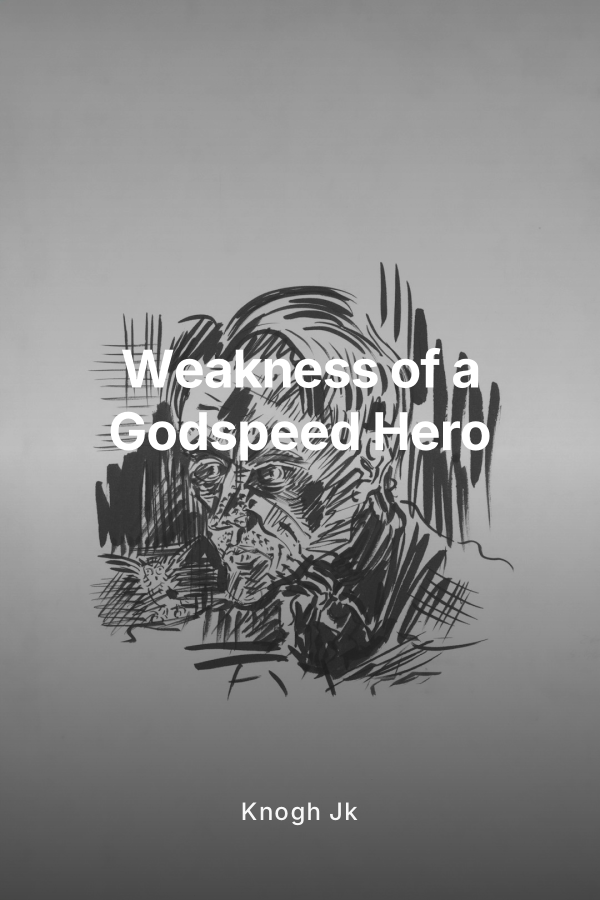
This book is an over‑the‑top superhero comedy for mature readers that blends multiverse scale stakes with irreverent fetish humor, fast paced action, and a surprisingly heartfelt arc about turning humiliation into strength. Drawing from a mashup style of familiar comic and animated universes without copying any single one, it imagines a reality crafted by a near omnipotent cosmic mind where one hero’s vulnerability becomes both the running gag of the galaxy and the key to saving it.
At the center stands Godspeed, a speedster whose body can rapidly regenerate but whose enemies all know one thing. His most sensitive weak point lies below the belt, and for reasons rooted in the very design of this universe nearly every powerful woman he meets lives to exploit it. His own teammates love him, rely on him, and routinely drop him to his knees. Their playful sadism is a feature, not a bug, baked into the physics and psychology of their world.
The story unfolds over three escalating acts told through ten to fifteen mission based chapters, each structured like an episode. Every chapter balances tactical briefings, snappy banter, and cinematic battles with locker room comedy and intimate character moments, always culminating in a low blow twist that reinforces the central running joke. The tone stays mostly comedic with fetish elements, treating pain, arousal, and embarrassment as the fuel for both slapstick and character development, while keeping the violence stylized and unreal enough to avoid grimness.
Act One introduces the core team, the scale of the threat, and the rules of this bizarre universe. Godspeed joins forces with a lineup of powerful women and a future world detective figure, all operating under the distant gaze of the Celestialsapian creator who fashioned this cosmos and the galaxy around it. The looming crisis is a joint invasion plotted by two tyrants, each representing nihilistic control and obsessive conquest. They dispatch waves of female lieutenants, agents, and warriors to scour Earth and beyond for twin cosmic keys: a mind shattering equation of domination and a scattered set of reality bending stones.
Against this backdrop, the book introduces the lead heroines and defines their sharply different dynamics with Godspeed. Power Girl emerges as his dominant, playful tormentor. Confident, physically imposing, and utterly unembarrassed by her tastes, she delights in using her strength on his weakness, often barefoot, treating his resilience as a toy and their training sessions as her favorite sport. Miss Martian occupies a more conflicted role, genuinely caring for him yet drawn into the team’s culture of targeted attacks, her telepathic sensitivity making her uncomfortably aware of his mix of dread and reluctant arousal. Yara Flor approaches their interactions as warrior discipline, convinced that attacking his weakness is a brutal but necessary method to sharpen his focus and control, often provoking visible reactions only to double down in the name of “training.” Alongside them stands a future era vigilante ally who offers tactical mind and moral commentary, half appalled and half amused by what passes for camaraderie on this team.
Early missions in Act One follow a pattern. Briefings lay out clues about the equation and stones, the team deploys against intimidating foes drawn from savage empires and exotic alien species, and just when Godspeed seems poised to turn the tide with his incredible velocity, a well aimed strike from a female opponent neutralizes him in spectacular fashion. Each defeat underscores his predicament. He is indispensable to the team but cannot escape being their perennial punchline. These episodes also reveal the cosmic joke at the heart of their reality. The Celestialsapian creator has tilted probabilities and desires so that women, consciously or not, gravitate toward exploiting this particular vulnerability.
Act Two raises the stakes both emotionally and physically through the introduction of Bianca, a non powered but frighteningly skilled human rival whose entire combat style revolves around precision, timing, and his most fragile spot. Bianca is a professional footballer with a fighter’s mindset and a performer’s flair, usually clad in minimal, athletic gear that highlights her agility and control. Her moves read like a catalogue of targeted techniques. Close range knees that rob him of breath and speed, perfectly judged long range strikes that drop him out of superspeed mid run, surprise attacks from behind that coil her leg between his, trapping and crushing him in ways that his regeneration can mend but never let him forget.
Bianca appears repeatedly across the middle of the book, first as a mercenary working for the invaders and later as a volatile temporary ally. Her love hate dynamic with Godspeed becomes the emotional core of Act Two. He is terrified of her yet unable to ignore his attraction. She is fascinated by his durability and by the knowledge that he can recover from anything she inflicts, which frees her to indulge her competitive and teasing instincts with few restraints. Their clashes are framed as duels in which she uses football techniques as martial art, stringing together combinations of feints, sweeps, and finishing blows that always seem to find their mark.
Between battles, Bianca intrudes into Godspeed’s routine, ambushing him during training or downtime, testing new angles and tactics, and occasionally offering him real insight into his powers and his psychology right before flooring him again. The team’s own women study her methods and, with varying degrees of guilt and glee, integrate aspects of her approach into their own roughhousing. This is where the running “no popping right before the mission” rule arises, a safety guideline that everyone openly states and casually bends, turning it into an ongoing joke about how far they can push him without jeopardizing the next operation.
As the invasion escalates, the heroes suffer a serious setback. The combined forces of ruthless warrior empires and adaptive alien technology push them into defensive retreat. Bianca and a cadre of fanatically loyal female furies deliver Godspeed his worst defeat yet, a prolonged tactical humiliation that leaves him sidelined for a crucial window. The plot focuses here less on gore and more on the surreal experience of a man whose body can regrow from almost anything while his mind still processes the shock, the echo of pain, and the memory of being reduced to helplessness at the hands of enemies who treat him as both threat and toy.
From this crisis emerges the turning point of the book. During recovery, Godspeed reflects on the pattern that has defined his entire heroic career. He is always fast enough, strong enough, brave enough, yet always predictable in one crucial respect. Everyone knows where to strike, and he always reacts the same way. This realization, combined with hints buried in mission lore about why the Celestialsapian designed him and his world this way, nudges him toward a radical idea. What if his weakness is not a flaw to be hidden but a resource to be controlled, even deliberately provoked?
Act Three delivers the final stand against the invading tyrants and their armadas. By now the villains have collected several stones and pieced together fragments of the dominating equation, twisting reality and minds on a planetary scale. The heroes must fight on multiple fronts: in physical space, in abstract mathematical dimensions shaped by the equation, and in the psychological battlefield that the omnipotent creator seems to enjoy watching. The structure remains episodic, but the missions connect more tightly, culminating in one sustained campaign that leads to the ultimate confrontation.
Here, Godspeed unveils his “weaponized weakness” plan. He orchestrates scenarios where enemies, conditioned to target his vulnerable spot, are lured into carefully set traps. By timing their attacks and his own regenerative surges, he converts impact into bursts of speed or localized temporal distortions, briefly freezing or slowing the battlefield at the exact moment his team needs an opening. He trains his mind and body to endure longer before collapsing, coordinating with teammates who, for once, learn to synchronize their teasing with tactical necessity. Sometimes he charges ahead as a gleeful “nut tank,” deliberately absorbing punishment that would otherwise be scattered across the team, buying precious seconds at the cost of personal agony that his powers can eventually undo.
Bianca plays a crucial role here. Having spent most of Act Two as his fiercest tormentor, she now becomes the only person who understands exactly how to trigger and modulate his pain response for strategic gain. Their partnership balances on a razor edge between flirtation and cruelty as she drills him through choreographed sequences that culminate in him unleashing unprecedented bursts of speed and reality bending maneuvers in the final battle. The moments where she almost shows genuine affection, only to undercut it with a perfectly placed strike, give the climax a charged, comedic tension.
The culminating showdown with the twin tyrants intercuts large scale spectacle with intimate, absurdly personal beats. On one side, cosmic weapons, algebraic horrors, and army level clashes. On the other, the repeated image of the universe’s fastest man bracing for yet another blow from allies and enemies alike, each impact fueling the gambit that could save all existence. This interplay crystallizes the book’s central theme. In a universe engineered by a capricious creator, where even desires and fetishes may be scripted, genuine agency emerges when a character embraces what he cannot change and chooses how to use it.
By the end, Godspeed has not outgrown his weakness. Women still delight in taking him down a peg, and the team’s locker room culture shifts only slightly. What changes is the framing. He is no longer simply the butt of the universe’s joke. He is the one who figured out how to turn that joke on its authors, leveraging the very pattern that defined his humiliation into the mechanism that defeats would be gods. His relationships with Power Girl, Miss Martian, Yara Flor, Bianca, and the future vigilante are still full of teasing, ambushes, and comic suffering, but now tinged with a shared awareness that beneath all the antics lies genuine trust and interdependence.
Across its five chapters, this book will deepen each phase of the arc.
Chapter One will establish the world, the Celestialsapian’s role as cosmic architect, and the founding missions of the team, ending with Godspeed’s first humiliating defeat that sets the tone.
Chapter Two will expand the threat and explore each heroine’s distinctive style and motives, from Power Girl’s gleeful dominance to Miss Martian’s conflicted empathy and Yara Flor’s ruthless concept of discipline, while layering in lore about the stones and the equation.
Chapter Three will focus on Bianca’s arrival, her signature techniques, and the temporary victories she wins over both hero and villains, culminating in the crushing setback that forces Godspeed into self reflection.
Chapter Four will chronicle his recovery, the refinement of his “weaponized weakness” strategies, and the uneasy training alliance with Bianca and his teammates as they prepare for the final campaign.
Chapter Five will deliver the sprawling, multi layered climax followed by a coda that leaves room for future episodic volumes in the same universe, with the war averted for now but the creator still watching and the running gag very much alive.
“Weakness of a Godspeed Hero” ultimately invites readers who enjoy irreverent superhero parody, fetish tinged humor, and multiverse storytelling to witness how one very specific vulnerability can redefine courage. It treats the body as battlefield and punchline, yet never forgets that the real victory lies in the choice to stand back up, again and again, and weaponize the very thing that was supposed to break you.