Ori is eighteen, a new college student trying to balance classes, a dorm full of strangers, and his part time job at a gas station. On the surface he looks like any other overwhelmed freshman, but under the long sleeves and tired smiles lives a history he never speaks about. His father’s abuse still lives in his reflexes, in the way he flinches at raised voices and apologizes for taking up space. When the story begins, Ori believes that survival means staying small, staying useful, and never needing anyone too much.
Then there is Fin. Laid back, unemployed for now, and somehow both chaotic and deeply gentle, Fin becomes Ori’s first real friend on campus. They share similar interests and fall quickly into a comfortable rhythm: shared playlists drifting through their dorm room, late night gaming sessions, inside jokes about bad cafeteria food, and the quiet ritual of studying side by side until one of them falls asleep at the desk. Their connection forms easily because they are so alike in what they enjoy, but it becomes meaningful because Fin sees Ori’s fear and never looks away.
When Ori is attacked at work by a drunk customer, everything he has tried to bury rips to the surface at once. The incident leaves him physically hurt and emotionally shaken. He cannot go back to the gas station. He falls behind in classes. Most of all, the attack echoes his father’s violence in ways he cannot control. Nightmares return. Old memories sharpen. The story traces how this new trauma cracks open the old, turning Ori’s day to day life into a minefield of triggers and exhaustion.
During Ori’s recovery, Fin quietly restructures his entire world around being there. He makes sure Ori eats, handles small tasks around the dorm, and subtly protects his friend’s dignity when Ori cannot manage basic routines on his own. At first, Ori interprets this care as simple kindness, a favor he will someday repay. Yet as days turn into weeks, the weight of Fin’s presence begins to feel like something else. He notices the way Fin always asks before touching him, offering a hand on the shoulder or a blanket within reach instead of assuming contact. He notices how Fin somehow knows when to fill the silence with jokes and when to simply sit and listen to Ori’s ragged breathing.
Their friendship, built on shared interests and easy laughter, slowly becomes the safest space Ori has ever known. Healing, however, is not simple. As Ori’s body knits itself back together, his inner landscape grows more complicated. There are good days when he can study for an hour and even tease Fin about his lazy job search. There are bad days when panic closes his throat and he cannot leave the dorm. Through it all, the story focuses on the small, human details of recovery: a half eaten sandwich left untouched during a flashback, a class email left unread, a game controller abandoned mid match when the world tilts sideways.
Fin, for his part, is changing too. Being so close to Ori’s pain makes him confront his own fears of inadequacy and failure. Without a job, without clear direction, he worries that he is not enough, that his support is temporary and fragile. Yet the more he shows up, the more he realizes that care is not measured in grand gestures but in consistency. He is there at three in the morning when Ori wakes from a nightmare, there at the nurse’s office, there when Ori cannot walk into the lecture hall. Over time, Fin begins to understand that he is not just helping Ori heal. Being needed gives his own life shape and purpose.
Both boys begin to feel an undercurrent running beneath their routines, but neither is ready to name it. They fear risking the safety of what they already have. The story leans into this slow burn, capturing the glances that linger a little too long, the way their knees brush on the dorm couch and neither of them moves away, the fond annoyance in Fin’s voice when he drags Ori out of bed for a late class. Romance grows not in dramatic declarations, but in the soft accumulation of moments where they choose each other over and over again.
The turning point arrives in the form of something deceptively small and light: a local café with a promotion that offers free food to couples. Money is tight, and Ori’s lost income from the gas station only makes things worse. Fin suggests, half joking and half hopeful, that they could pretend to be a couple for one afternoon and share a real meal without counting every coin.
At the café, what starts as a game begins to unravel their carefully maintained distance. Holding hands to convince the staff, sitting pressed together in a booth, sharing food across the small table, they are forced into the performance of what they have secretly wanted. The act feels too natural. Every time Ori’s fingers tighten around Fin’s, his heartbeat stutters not with fear but with a shocking sense of rightness. Fin, usually easygoing, finds himself studying every flicker of expression on Ori’s face, torn between enjoying the closeness and worrying that he is crossing a line.
This pretend date plants a seed they cannot ignore. In the days afterward, their shared routines feel different. A silence falls between them that is not empty but charged. Both are embarrassed, each assuming the other did not feel the same spark. Yet while they hesitate, life does not. A new crisis builds, heavier and more complicated than the playful tension of the café. Ori’s unresolved trauma, combined with the pressure of missed work and classes, reaches a breaking point. Perhaps it is a severe panic attack in a public space or a frightening confrontation related to the original attack. Whatever shape it takes, this crisis exposes how fragile Ori’s sense of safety still is and how deeply Fin has already become part of that safety.
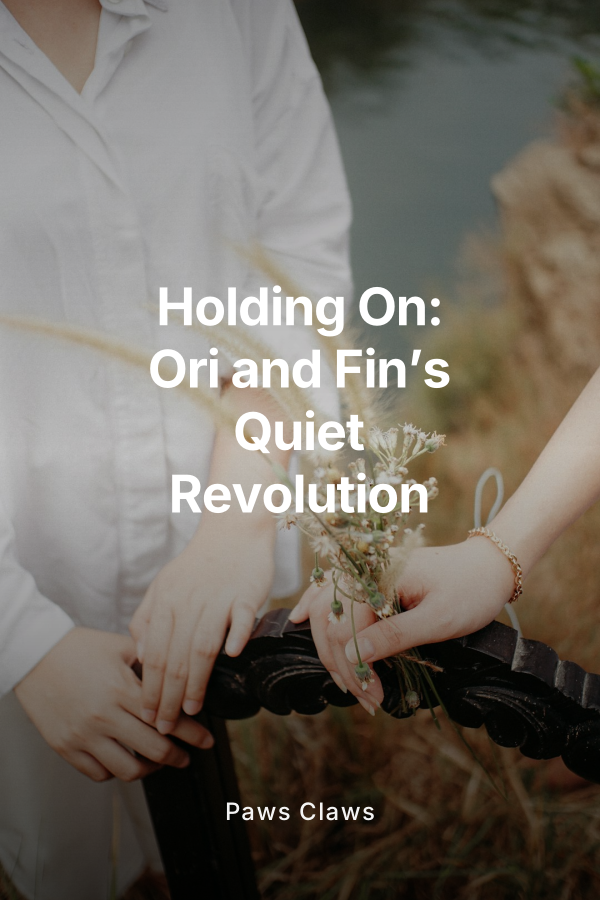
When everything falls apart, the boys can no longer pretend that their connection is only friendship. Fin must decide whether to step fully into Ori’s life, accepting the weight of his fears and history, or to pull back out of self doubt. Ori must choose whether to risk needing someone to that degree again, after a childhood that taught him that dependence always hurts. In the heart of this crisis, a simple act becomes the most important moment in the book: Ori reaching for Fin’s hand, not out of social obligation, not to play a part in a café, but because he wants to. Their fingers interlace, and the noise of the world recedes.
The story treats hand holding as a central symbol of both healing and love. Early in the narrative, Ori recoils from touch or endures it stiffly. Over time, he begins to tolerate small, respectful gestures from Fin. By the end, hand holding becomes a conscious choice, a wordless confession, and a coping tool when anxiety threatens to drown him. One of the most powerful scenes shows a flashback interrupted not by a therapist’s technique but by Fin quietly asking, “Can I hold your hand?” and waiting for Ori to say yes.
Throughout the book, physical intimacy remains gentle and limited, in keeping with the boundaries the reader has set. There are no explicit scenes, no rushed escalation. Affection is shown through shoulders resting together, shared blankets during late night movies, and those pivotal moments of interlocked fingers. This careful handling of their physical relationship mirrors Ori’s slow reclaiming of his body from fear and Fin’s growing understanding of how to support a partner with trauma.
The final chapters focus on the quiet revolution the title promises. There is no miraculous cure, no sudden erasure of Ori’s past. He still has bad days. Classes remain challenging. The memory of his father’s abuse does not vanish. What changes is the way he faces these realities. With Fin’s constant, compassionate presence and his own growing willingness to be vulnerable, Ori learns that healing is not a straight line but a series of choices to keep moving. Together, they form new routines that are deliberately kind: scheduled study sessions so Ori does not fall behind, budget friendly rituals that make their tiny dorm feel like home, small celebrations of each step forward.
The book closes with an image that carries the emotional weight of everything that has come before. Ori and Fin walk across campus, fingers threaded together openly for the first time, the afternoon light stretching long across the path. Students pass around them without much notice, but for Ori the moment is monumental. Once, being seen was terrifying. Now, being seen this way, beside Fin, feels like a promise. It is not a fairy tale ending. It is something better: a realistic, hopeful future where love is both anchor and catalyst, where two boys who started as shy freshmen become each other’s safest place.
“Holding On: Ori and Fin’s Quiet Revolution” is a story about the tender intersection of trauma and first love, about how friendship can become the ground from which a different life grows, and about the courage it takes to reach out a hand and hold on.