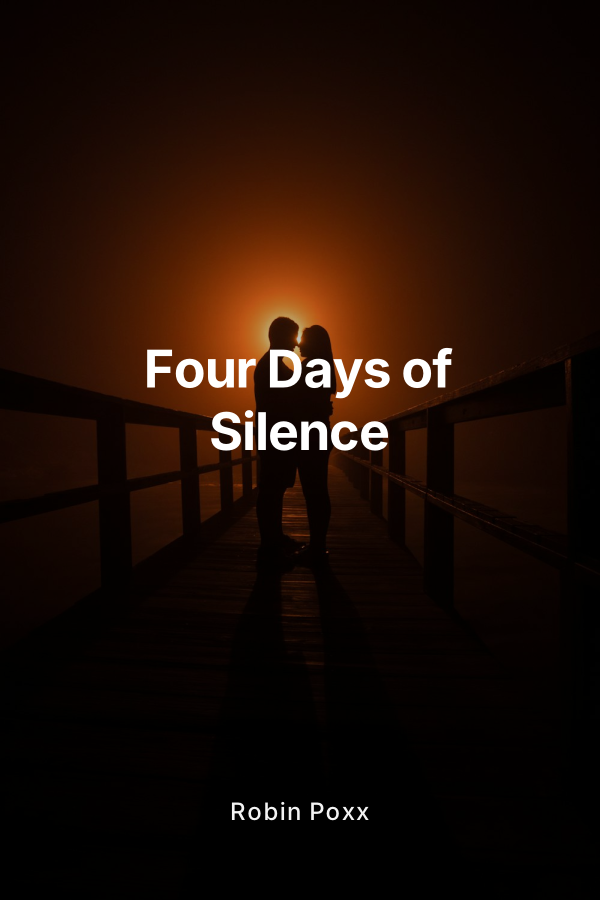
This book is a character driven, E rated modern AU romance that follows Levi Ackerman and Hanji Zoë, along with their tight knit circle of friends, as they navigate the brutal realities of chronic mental illness, institutional betrayal, and the fragile, stubborn hope of building a life that is livable on Hanji’s terms. It centers autism, BPD, and severe depression as ongoing conditions to be managed rather than problems to be fixed, and treats boundaries and consent as the core love language rather than an afterthought.
At its heart is Hanji, a brilliant lab scientist whose life runs on routines, dark curtained corners, and the calming weight of water around her shoulders. She is autistic, has BPD and severe depression, and moves through the world with an arsenal of coping mechanisms and a history of institutionalisation that the group only half understands. She has good weeks in bursts of intense productivity and social presence that almost always fracture into worse weeks, when the BPD spiral hits, she pushes everyone away, and the best they usually manage is a text reply every few days to prove she is still alive.
Levi, a fellow teacher and the only person besides Nanaba who knows Hanji’s precise sensory and touch terms, is the first to sense that this time is different. He maintains his rule of one simple, noninvasive check in text a day and never pushes if she does not answer. But when four full days pass in absolute silence, he breaks their usual distance, uses the spare key he knows she keeps, and walks into her two story house to find the reality that had only existed in the group’s collective fear.
The inciting incident of the book is a seemingly small, bureaucratic conflict at work, when a long standing lab rule that Hanji herself helped write is suddenly reversed. The change makes no sense to her and scrambles the structured logic her job depends on, triggering a sharp BPD spiral. Instead of masking, she goes fully off the radar. She self harms in places no one would see unless she was undressed, and spends four days submerged in a private hell of shame, overstimulation, and suicidal ideation.
The balcony scene is the story’s first major anchor. Levi finds her on the edge, quite literally, and has to talk her down not with grand declarations but with the only language she can process in that state: calm rules, clear options, solid facts spoken in a low voice while he keeps his distance from her body and his focus on her choices. She regresses into a scared child near him instead of a suicidal adult, listens more to structure than to comfort, and the scene becomes less about saving her and more about convincing her that she is allowed to come back inside without being dragged back to the place she fears most.
From there the book splits its structure between the immediate crisis arc and threaded flashbacks to previous rehab stays. Those flashbacks gradually reveal why the group’s default solution of “send Hanji back to rehab and visit every day” has been both a lifeline and a slow moving disaster. Inside rehab, staff overstep constantly. Forced physical contact, physical restraint, verbal belittling, and calculated sensory overload are framed as “treatment.” Workers abuse their power to touch her, ignore her clearly communicated sensory needs, and treat her not as a disabled adult with specific requirements but as a difficult, “crazy” patient to be managed.
Hanji cannot speak about any of it. Her autism turns words into an impossible hill whenever she is pushed on the subject, and just hearing rehab mentioned can send her into another episode. She shuts down, dissociates, and the group learns to skirt the topic, even as they keep signing the forms that send her back there in every serious crisis because they think there is no other viable choice. They see only fragments of the truth in the way she flinches when touched on the ward, in the way she clings to dark corners during visits, in the way she begs to go home and promises never to do anything “stupid” again, promises that never hold.
The present timeline after the balcony is where that pattern finally breaks. Levi’s instinct is to call the ambulance and follow the old script, but when he signals the SOS groupchat and everyone converges on her house, they hesitantly choose something different. Nanaba and Levi, who know her sensory profile best, put together an emergency at home crisis plan on the fly. Hanji will not be sent back. Not tonight. Maybe not ever again if they can help it.
The at home crisis plan becomes the skeleton of the rest of the book. Levi and Nanaba stay with her most of the time, rotating sleep but almost always making sure that at least one of them is physically present in the house. They reduce sensory overload by darkening rooms, limiting noise, and preserving her favourite dark curtained corner. They manage her medications closely but allow her to retain control where she can: she cooks when she feels able, they supervise but do not take over, and they set loose times to start winding down and trying to sleep. Hanji accepts their help and rules, yet still needs to feel autonomous in certain rituals, and the plan becomes an ongoing negotiation of where care ends and coercion begins.
Outside that intensive core, each member of the group takes on a different support role that respects her autism and BPD rather than working against them. Miche and Nanaba, both teachers, handle structured messaging and consistent routines, turning check in texts into predictable, low pressure pings that never demand answers. Nifa and Moblit, who works with Hanji in the lab, handle low sensory hangouts, visits that only happen when she explicitly agrees and is fully informed. Erwin, a lawyer, and his wife Marie orbit the group more distantly, with Marie’s well intentioned but misinformed suggestion about “just using rehab again” providing the only real conflict over Hanji’s boundaries. Hanji shuts the question down, and Erwin later explains to Marie that rehab is off limits as a topic even though none of them really know why in full.
Running underneath the crisis and the logistics is the slow, delicate love story between Levi and Hanji. They already share a private, rigorously negotiated touch language before the book opens. She can link arms with him and with Nanaba, but cannot bear hand holding. They offer their forearm and say her name softly to signal the option and never comment on it if she declines. In public she shows affection through acts of service, movie nights, and simply allowing herself to be seen alongside them. No one gets into her darkest mental spaces, but she lets Levi sit in the bathroom while she submerges in the tub, a swimsuit on if he is there, her head always above water. That small permission is more intimate to her than any kiss.
As crisis care stabilises into an uneasy routine, their intimacy changes almost imperceptibly. She links arms with him more often. On very rare days she rests her head on his shoulder for a heartbeat, something she does with no one else except, on equally rare occasions, Nanaba. She never becomes fluent in the language of declarations. Her conditions are persistent, her mood swings sharp, and the story refuses to offer a miraculous cure. Instead, the emotional climax comes in a quiet scene when, after a day that is merely survivable instead of catastrophic, Hanji takes Levi’s hand without warning and presses a kiss to his knuckles. There is no speech, no label, just the deliberate choice to step a single inch outside her comfort zone under her own rules. That becomes their shared understanding that they are together now.
Sexual and near sexual content in the book follows the same framework of explicit consent, accommodations, and control. Any E rated scenes grow out of carefully negotiated rules around lighting, touch, and pacing, with Levi treating every step as opt in and Hanji reserving the right to halt at any moment. Intimacy often takes the form of shared baths with her swimsuit on, or simply sleeping in the same room while he reads quietly and lets her exist without pressure. The focus remains on how desire and disability can coexist when both are filtered through patient communication and respect for sensory limits.
Thematically, the book interrogates the difference between safety and control. Rehab presents itself as a safe, controlled environment yet repeatedly violates Hanji’s autonomy and makes her worse. Home is messy, inconsistent, and held together by exhausted friends who are making it up as they go, but it is the only place that adapts around her instead of forcing her to adapt to it. The group’s gradual decision to build an alternative crisis plan is shaped by accumulating evidence of harm and by their recognition that loving someone with chronic, high risk mental illness means learning to hold responsibility without sliding into paternalism.
By the end, nothing is neatly resolved. Hanji’s conditions remain, and the narrative is honest about the likelihood of future spirals and scares. What changes is the infrastructure around her. The friends have a written yet flexible crisis plan. They know who moves in when, which topics are forbidden, how to communicate with her when she is nonverbal, and how to guard her from institutions that mistake coercion for care. Levi and Hanji never trade formal “I love you”s in a climactic scene. Instead, their love surfaces in the way he keeps texting once a day no matter what, the way she keeps opening the door when he knocks, and the way she learns, over time, that she can survive nights on the balcony without having to jump or be locked away.
“Four Days of Silence” is ultimately a story about choosing the hard, unglamorous work of staying. It refuses easy redemption and instead celebrates small victories, like answering a text, eating a meal, or letting someone sit outside the bathroom door while you breathe underwater. It is written for readers who want an unflinching yet tender look at mental illness, who crave romance that blooms not from grand gestures but from mutually honoured boundaries, and who understand that for some people, survival itself is the boldest kind of love story there is.