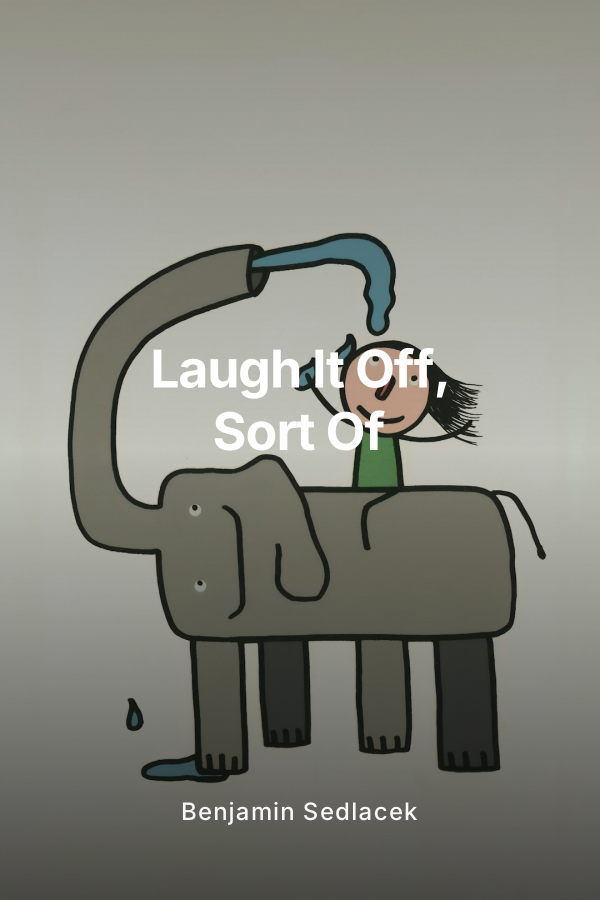
This book is a humorous middle grade story about a seventh grade kid who feels very small in a world of very tall eighth graders, and somehow learns to feel just a little bigger by the end. The tone mixes comedy with real feelings, so readers can laugh at the disasters and still care about the bruises and worries underneath. It focuses on three main threads identified in the original concept: a funny angle on daily school life, the pressure of getting bullied by older kids, and the slow, realistic way things “get a little better” instead of magically perfect overnight .
The protagonist copes with school by turning everything into a running joke in his head. Tests become “brain gladiator battles,” the cafeteria is “the zoo where the pizza slices go to die,” and the principal feels less like an authority figure and more like a sitcom character who wandered into the wrong show. His sense of humor is his armor: he narrates his own life as if a live studio audience is watching. This lets readers experience humiliation, fear, and awkwardness through a filter that is always, somehow, funny.
Unfortunately, the laugh track cuts out when the eighth graders show up. They are not horror-movie villains or truly dangerous, but they make life reliably awful. They specialize in embarrassing pranks, cruel nicknames, and the kind of teasing that feels small on the outside and enormous on the inside. A “harmless” food-tray incident in the cafeteria becomes a legendary story at school and a private nightmare at home. Rumors float down the hallways faster than the protagonist can walk. The book makes clear that what adults might call “just teasing” can feel like a daily storm to a kid who has to walk through it.
Instead of turning the story into something dark, the book uses humor to show the weird logic of middle school cruelty. The eighth graders are ridiculous as often as they are scary. Their insults sometimes backfire. Their pranks sometimes take too much planning and go wrong in absurd ways. The protagonist notices these cracks and begins to use them, very slowly, as leverage. The comic voice becomes a secret weapon, not just a shield. Readers see how noticing the ridiculous side of a bully can chip away at his power.
At the same time, home is not exactly a safe, quiet place. The protagonist has an older brother who lives in the strange borderland between being part of the problem and part of the solution. At first, the brother seems like another bully, just one that the protagonist is stuck with. They argue, trade insults, and fight over tiny things. Yet the brother also knows the eighth graders’ social rules and survival tricks. He understands the way hallways really work, how group chats explode into drama, and what teachers actually see. The book explores how an older sibling can be both annoying and secretly loyal, and how that messy relationship can slowly tilt toward something more supportive by the end.
The heart of the story is not a big, dramatic showdown. Instead, several smaller moments add up. There might be a school event where the social order temporarily flips, a disastrous prank that accidentally exposes how insecure the eighth graders really are, or a moment when the protagonist blurts out a joke in front of everyone and realizes that people are laughing with him, not at him. The older brother might step in once, publicly, in a way that changes the unwritten rules. The protagonist might try out one brave sentence in the hallway and discover the world does not collapse.
By the final chapters, things are only “a little better,” which is exactly the point. The eighth graders still exist. Some teasing still happens. But the protagonist no longer feels completely helpless. He has learned a few clever, realistic ways to stand up for himself without pretending to become a superhero overnight. The brother relationship has shifted to include more quiet advice and fewer cheap shots. The protagonist’s internal monologue grows from pure self-defense comedy to something that includes pride, small victories, and real hope.
Readers who have ever felt too short, too awkward, or too scared to move through school hallways will recognize themselves in this story. They will find jokes that let them laugh at the weirdness of middle school, but they will also see how courage can look small from the outside and huge from the inside. Instead of promising a fantasy solution where bullies vanish forever, the book offers something truer: sometimes the bravest thing you do is simply walk back into the cafeteria the next day, with one new joke, one new ally, and one new idea about who you are.