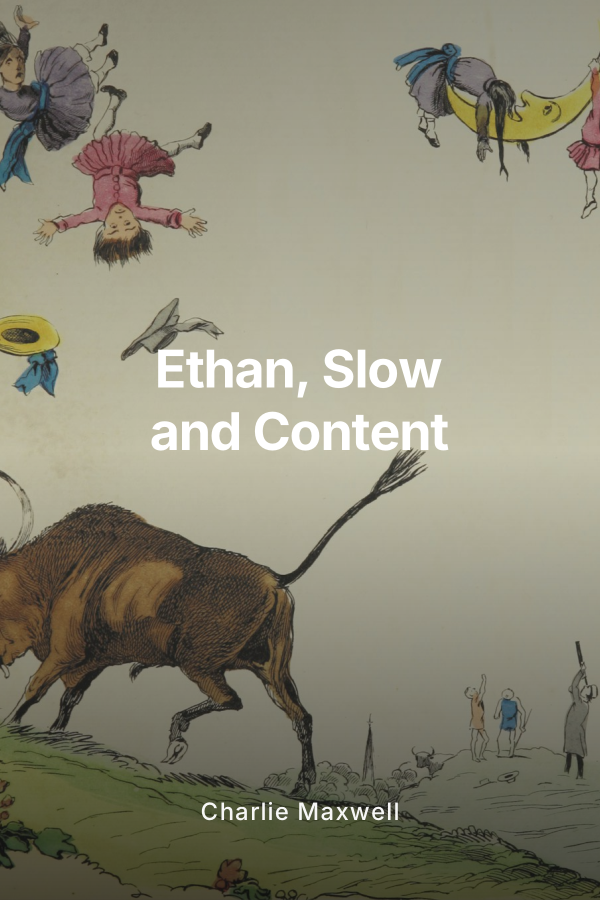
This book follows Ethan, a quiet, unhurried boy in a world that always seems to be in a race. Every chapter uses simple, rhythmic storytelling and playful, kid friendly situations to gently question the idea that faster is always better, while affirming the worth of children who like to move at their own pace. At the same time, it offers adults a soft mirror for their own busyness, without blame or lectures, and leaves room for warm family conversations about rest, priorities, and what truly matters.
Across the full text, Ethan remains recognisably “slow and content,” yet not lazy, broken, or in need of fixing. His small but meaningful arc shows that slowness can hold its own kind of strength. He stays himself, yet finds one thing he chooses to care about just a little more, and he discovers that “going slow” can include thoughtful action and quiet responsibility. The story ends with a feeling of balance instead of pressure, and with a tone that is more tender than preachy, so both children and adults feel seen and comforted instead of corrected.
The audience is primarily children aged 4 to 8 and the adults who read to them. For kids, Ethan is funny, cozy, and reassuring, a character who makes it okay to be dreamy, slow, or different. For parents and teachers, the book carries a secondary layer of meaning, inviting them to notice how often they demand speed without really needing it. This double focus allows the story to be enjoyed simply as a bedtime read while still planting deeper questions about stress, schedules, and expectations in the grown up heart.
Below is a chapter by chapter overview of the planned 2 chapter, roughly 4000 word picture book text. Each chapter is structured as a sequence of scenes rather than formal sections, to match the flow and page turns of an illustrated picture book.
Chapter 1: A Boy Who Refuses to Hurry
Chapter 1 introduces Ethan and his world. It sets the emotional tone, lets children relax into the rhythm of his slowness, and gently sketches the tension between Ethan’s contentment and the hurry around him. The goal is not to make Ethan change, but to let readers fall in love with him as he already is.
The opening scene presents Ethan at home on a typical morning. The house is buzzing with movement. A sibling might be clattering bowls, a parent might be hunting for lost keys, clocks might be everywhere, all quietly measuring time. In the middle of this, Ethan sits at the breakfast table, half focused on his cereal and half watching a line of sunlight creep across the floor. He moves slowly, not to annoy anyone, but because he honestly does not see the point of rushing into the day. The language highlights small sensory details: the swirl of milk in his bowl, the warmth of toast, the soft hush of his thoughts. From the start, Ethan is framed as content rather than defiant. He does not argue with adults, he simply experiences life in a slower key.
From breakfast, the chapter moves to a series of domestic and everyday moments that repeat the same pattern in varied ways, so each scene feels fresh instead of repetitive. On one page, a parent might call, “Shoes on, Ethan,” while he is still feeling the weave of his socks between his toes. On another, his sibling might race down the path to school, while Ethan lingers to trace a crack in the pavement or count snails after it rains. Each time, the people around him urge him forward, not unkindly, but with the familiar, constant nudge to go faster. The text makes it clear that Ethan hears them, cares about them, and tries a little, yet his natural pace often wins out.
This chapter also explores how Ethan comes across in public spaces. At school, he takes a long time to hang up his coat, to open his lunchbox, to choose a crayon. In the classroom, his teacher might call on him and find that he is still turning the question over in his head, building an answer grain by grain. Other children may fidget or whisper, waiting for him to finish. Adults do not ridicule him, but the small sighs, the ticking clock, the lines like “Let’s hurry along” create an invisible pressure around Ethan’s stillness. He is not in trouble, yet he is almost always slightly out of step.
The narrative lens stays close to Ethan’s inner world. Rather than labelling him as “slow” in a negative sense, the book lets readers feel what his pace is like from the inside. When everyone else sees a hallway to sprint through, Ethan might see a river of shoes, each pair different, each worth looking at. When recess ends, he needs one more moment to watch a cloud finish its slow journey past the edge of the school roof. Children who share his temperament will recognise themselves here and feel less alone. More energetic children will still be drawn in by the humor of Ethan quietly drifting while others zoom around him.
Humor is woven gently through his actions. For instance, while others finish a worksheet, Ethan might still be carefully printing his name, adjusting each letter until it feels just right, leading to a funny visual where his page holds only his name in huge, careful letters while his classmates’ papers are filled with answers. Another moment could show Ethan trying to speed up because an adult asks him to, only to get distracted by a tiny detail that matters to him alone, such as the reflection on a window or the sound of a pencil rolling. His attempts to be quick are sincere but often undone by curiosity, reinforcing that his slowness is not stubbornness, but attention.
Toward the middle of the chapter, the book shifts slightly to show how adults interpret Ethan. At home, a parent might chat with a teacher or another adult and wonder if they should “push him” more. The conversation is warm, not harsh, acknowledging that Ethan is kind, gentle, and easy to be around, but puzzling over whether his pace will cause problems later. This layer is subtle and child friendly, often conveyed through tone, expression, and simple lines of dialogue rather than long explanations. It offers adult readers a moment of self recognition, inviting them to see how concern for the future can sometimes overshadow acceptance of who a child is today.
Yet the text carefully avoids turning Ethan into a lesson or a project. Each time someone thinks about how to change him, the narrative returns to Ethan himself, peacefully engaged in something small and immediate. Perhaps while adults discuss him, he is on the floor lining up toy cars, not to race them, but to make sure they all face the same way. Or he might lie in the grass, watching ants travel around his shoe. These quiet cutaways insist on his full personhood, reminding readers that he exists beyond others’ plans and worries.
Alongside this, Ethan’s contentment is clearly shown. He does not long to be different. He does not envy those who race ahead, though he sometimes feels puzzled that speed matters so much to them. The story might share a passing moment where a friend zooms by shouting, “Last one there is a rotten egg,” and Ethan simply wonders what the hurry is, since everyone will be there in a minute anyway. He is comfortable in his own skin, even when the world tugs at his sleeve.
By the end of Chapter 1, a gentle pattern has been established. Ethan is consistently slow and consistently at peace with that slowness. The world around him continually leans on the gas, nudging him to keep up. There is minor social friction, but no cruelty. The final scenes of the chapter hint that something new is coming, some situation in which Ethan’s pace will meet a fresh kind of pressure.
This hint arrives in the form of a coming event. Perhaps a school project fair is announced, or a class performance, or a simple “special day” where everyone is expected to be on time, prepared, and enthusiastic. Adults might look at Ethan a bit more closely than usual. Friends might tease him lightly about “not being late this time.” He hears their words but does not fully grasp the worry behind them. The chapter closes with Ethan at home that evening, moving as slowly as ever, while a calendar on the wall quietly marks the days until this event. That visual foreshadowing sets the stage without raising anxiety, keeping the tone soft and inviting as the story turns toward its small, central conflict.
Chapter 2: One Thing Ethan Chooses to Care About
Chapter 2 brings Ethan’s inner pace into contact with a specific challenge, revealing a new dimension of his character while preserving his steady core. It explores how “slow and content” can coexist with commitment and follow through, and how adults can shift from pushing toward speed to trusting a child’s own way of engaging with the world.
The chapter opens in the classroom as preparations for the special event begin. The teacher explains what is expected. Perhaps each child must choose a small project, song, or presentation to share. There is a clear deadline, simple steps, and an excited buzz in the room. Many children immediately start planning. They talk fast, scribble notes, grab supplies. In contrast, Ethan gazes at the blank paper in front of him, feeling no rush to choose. The teacher might gently urge, “You can pick anything you like, Ethan, but we need your idea today.” This is new for him, because his usual approach of “I will think about it later” will not quite work.
As his classmates chatter, something small catches Ethan’s eye or imagination. It might be a topic that lines up perfectly with his quiet way of seeing the world: snails and how they move, clouds and how they drift, or the comfort of bedtime routines. Whatever it is, it feels true to him, not borrowed from others’ excitement. For the first time, readers see Ethan lean forward with a touch of interest, not quickly or dramatically, but clearly. He chooses his idea slowly yet decisively, in a way that feels like an extension of his usual thoughtfulness rather than a sudden change of personality.
Once he has chosen, the story follows Ethan through the days of preparation. On the surface, not much looks different. He still moves slowly. He still gets distracted by light, sound, and texture. Yet there is a subtle shift. At home, when a parent suggests starting early for once, Ethan does not resist or drift away. Instead, he pads to the table, opens his notebook, and begins to work in his own measured rhythm. His effort is unhurried but steady. The narrative pays attention to small, repeated acts: the way he draws one careful picture each night instead of rushing to finish everything at once, the way he practices saying his lines softly to himself as he walks down the hallway, the way he pauses often but always returns to the task.
This is the heart of his “tiny turning point.” He does not become fast. He does not become a different child. Instead, he discovers that he can align his natural pace with a clear intention. He chooses to care about something specific, not because others tell him to, but because the topic feels important to his inner world. His slowness now supports the depth of his work, helping him notice things his classmates might skip. For instance, if his project is about snails, he might observe details that only someone willing to sit still for a long time would ever see. The text makes space for these discoveries, showing that time spent is not wasted when it springs from genuine interest.
Adults around Ethan begin to notice. At first they are cautious, unsure whether his attention will last. A parent may quietly watch from the doorway as Ethan arranges his materials, resisting the urge to step in and speed the process. The teacher might look surprised to see him volunteer a small thought during group planning. These reactions are written with warmth and humility, not “at last he is normal” triumph. Instead, the emphasis is on their growing trust that Ethan has his own way of getting things done.
The chapter then moves through the milestone moments leading up to the event: a practice run at school, a minor setback, a long evening when Ethan feels tired and almost sets his project aside. In that moment of wobble, the book offers a key message about balance. Rather than scolding him or reminding him of deadlines, an adult might sit beside him and simply ask, “Do you still care about this?” The question puts the focus back on Ethan’s own choice instead of external pressure. After a pause, he nods. He still cares. He picks up his work again, slowly, and moves forward with quiet determination.
This scene helps children distinguish between doing something because they are chased and doing something because they have decided it matters to them. It invites adults to consider how different those two paths feel. The arc remains small and believable for a young child. Ethan does not suddenly love all responsibilities. He does not become a universal high achiever. He learns that his contentment can include moments of effort when they are rooted in his own values.
The day of the event arrives, bringing a natural rise in energy. The school is bright, crowded, full of noise. Ethan feels the swirl around him but does not get swept away. He may move more slowly than others as he sets up his project, but he is ready. There is a quiet confidence in his manner, different from usual but still recognisably his. When his turn comes, the story lingers on the little details that would matter in a picture book: the feel of the floor under his shoes as he walks to the front, the sound of paper in his hands, the faces in the audience.
His presentation is simple, not flashy. He speaks in his own unhurried way, which at first may make some listeners restless. Then something in his calm steadiness begins to draw them in. Because he has spent so much time observing, he can share one or two surprisingly deep or tender insights about his chosen topic that others have never noticed. Children and adults both feel the truth of what he says, even if they cannot quite explain why. By the time he finishes, the room is quietly attentive. Applause may be gentle rather than wild, yet it carries genuine respect.
In this moment, the story offers its core message without stating it outright. Ethan’s value does not lie in how quickly he moves, but in how deeply he sees. His slowness, which often seemed like a problem, has allowed him to notice and cherish details that everyone else raced past. He has contributed something only he could give.
The reaction of others after his presentation deepens the theme. A friend might say, “I never knew snails did that,” or “I never noticed that cloud shape before.” The teacher might thank him for helping the class see in a new way. A parent might simply hug him for who he is, without tying their affection to performance. None of them declare him “fixed” or “improved.” Instead, they appreciate what his true self brings to their shared life.
In the final scenes, life returns to normal. Ethan is once again slow at breakfast, slow at putting on shoes, slow at leaving the house. Adults still occasionally say, “Come on, we need to go,” because real families remain imperfect. However, something subtle has shifted. The urgency in their voices is softer. Sometimes they pause and match his pace instead of always pulling him forward. Sometimes they build in a little extra time rather than expecting him to compress himself into their schedule.
Most importantly, Ethan now carries a small inner memory of having chosen to care and seeing it through. That memory does not make him permanently busier. Instead, it sits quietly inside him as proof that his way of moving through the world can hold both rest and responsibility. He knows that when something truly matters to him, he can lean into it without betraying his nature. Children reading the book are left with a sense that they too can be fully themselves and still rise to meet what they care about.
The book closes with an image that echoes the beginning yet reframes it. Perhaps Ethan once again sits at a table, dawdling over a meal or daydreaming in a sunbeam. The calendar hangs in the background, now blank after the event. This time, instead of hurrying him, a parent might sit in the adjacent chair for a moment, noticing the same beam of light. No long speech is needed. The shared pause itself is the resolution. It shows that the family has made a small adjustment, leaving more room for stillness in their days.
In its final lines, the text gently affirms that there are many ways to move through a day. Some people run, some people stroll, some people stop to look at every little thing. Ethan remains, as he was from the start, a slow and content child. Yet now, readers can see that his slowness is not absence, but presence: a way of being deeply here. The story invites children to take pride in their own tempo and invites adults to consider, with kindness toward themselves, where they might loosen their grip on hurry.
Overall, “Ethan, Slow and Content” is designed as a warm, rhythmic picture book that children will ask for again and again, not because it preaches, but because it feels like a soft blanket laid over a rushed world. It validates young readers who are dreamy, observant, or easily overwhelmed, and it gently challenges the culture of constant speed by showing, in one small boy’s life, how much beauty becomes visible when we move just a little bit slower.