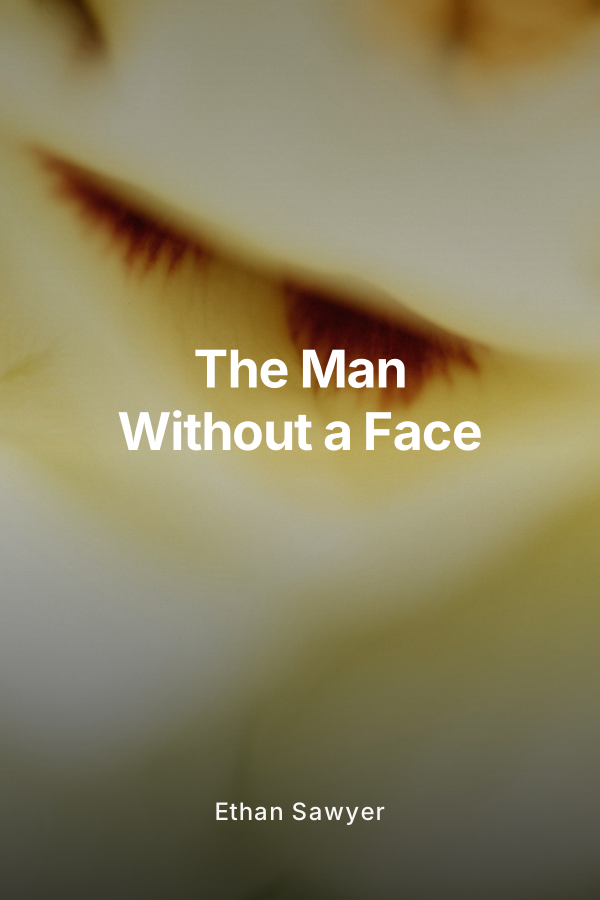
This book follows a man who spends his life moving through ordinary American spaces that never quite feel safe. A water park in Pennsylvania, a suburban mall, a college house party, a cookie-cutter neighborhood at dusk. In each of these places he is marked by the same sensation that has shadowed him since childhood: that something about him invites cruelty, that he carries an invisible sign naming him an acceptable target. Underneath that lifelong humiliation runs another, stranger current. Whenever his fear and shame crest into something unbearable, he notices a figure at the edges of the scene. A man whose face he can never see.
At twelve, he is almost drowned in the lazy river while babysitting his friend’s little brother, Danny. Two older boys pin him under the shadowed bridge, pushing his head beneath the chlorinated surface in a slow, casual rhythm that feels more like an experiment than an attack. As his lungs burn and the steel drum music loops on as if nothing is wrong, he breaks the surface and sees a man standing a few yards away on the concrete, watching him struggle and choke. Everything about the man is sharply in focus, from the navy swim trunks to the posture, but where his face should be there is only a smear of color, as if someone has dragged a thumb through fresh paint. The man does nothing. A chaperone mother eventually intervenes, the bullies are chased off, and the story that travels home on the bus is simple and clean. A boy almost drowned in the lazy river. What he actually remembers is the blur that stared back and did not help.
The incident brands him in more ways than the gossip that follows. It fuses humiliation and danger in his mind, stitches public spaces to a new understanding of himself as someone singled out and exposed. In the years that follow, he learns how quickly a mood can turn, how rapidly a crowd can become an audience. As a freshman in high school, after months of AIM conversations, he finally meets Diane, a girl he has built an entire fantasy life around. He arrives at the mall with braces, a shaking voice, and the desperate hope that the funny, fluently edited boy on the screen will translate to real life. Instead he stammers, floods the silence with nervous energy, and recruits two semi-friends as human shields, pretending at confidence while Diane and her sharper, prettier friend Cara glance away and check their phones.
It is during this fragile, overexposed evening that two older boys step directly into their path and begin to perform cruelty in public. They ask why Diane is wasting time with “these losers,” speak loudly enough to draw attention, and wait for someone to protest. No one does. The girls freeze, his friends study the floor, and he laughs weakly as if the moment can still be played as a joke. Inside his chest, though, the old panic returns, the same bodily confusion from the lazy river, except now there is no water and nowhere to hide. When he looks up, searching instinctively for an exit, he sees the figure again. The man is leaning against the second-floor railing near the Gap, hunched over a pretzel, posture unmistakable, details clear down to individual salt crystals. The face is once again impossible, a deliberate blur inside an otherwise precise memory. This time, the man is not a bystander to literal drowning but to its social equivalent, and the connection between terror, humiliation, and this faceless witness tightens.
In college his world is larger and no kinder. He spends weekends in sticky basements soaked with cheap beer and expectations, half-believing that if he can perform the right type of casual confidence he might finally graduate from the role he has always played. At one crowded party he wears a band shirt as a small, stubborn expression of taste and self. It becomes an easy handle for the kind of men who ghost through his life as antagonists. They call out to him not by his name but by the logo on his chest, barking it across the room as if summoning a dog. At first he tries to ignore it. Then the old heat rises in him, except this time it is not pure fear. He feels a new, volatile anger: an urge to hit something, to rewrite the script that has kept him compliant and embarrassed since he was a child. Friends guide him outside, tell him to let it go, but the insult keeps circling his mind as if the room itself is chanting.
Hours later, when he spots one of the hecklers outside, the fury finally finds a body. Without thinking, he walks up and punches the man hard enough to feel bone shift under his knuckles. For a moment the world goes still. His victim writhes on the pavement with blood leaking through his fingers, and the crowd stares, not sure yet if this is comedy or crisis. Then his friend Egor pulls him away, apologizing loudly, hustling them both to the car while the heckler’s friends give chase. The flight through the neighborhood is reckless, tires squealing, their laughter sharpened by fear. He looks back at the group they are leaving behind and feels more alive than he has in years, drenched in relief and horror at his own capacity for violence. It is exactly then that he sees the man again, standing on a sidewalk after midnight with a dachshund on a leash, watching their car speed past. The same blurred face. The same fixed attention. For a second it seems as if the dog is staring too. When he urges Egor to look, the figure has already vanished, leaving behind only the adrenaline and a deepening suspicion that his life is being watched according to rules he does not understand.
The book opens in the present, long after he has filed these scenes away as bad stories from younger, softer versions of himself. He is now married to Sarah, a woman who loves him but has grown used to the odd blind spots that structure his life. He avoids malls whenever possible, declines amusement parks with easy excuses about motion sickness, and builds routines that keep him away from crowded thresholds and overheard laughter. Their relationship is affectionate, lightly barbed, full of shorthand and interruptions. She has learned to be patient with his detours and his need to narrate everything from the beginning, even when she cannot see why an old online flirtation or a middle-school field trip could matter to whatever is bothering him now.
When a family visit pulls them back toward the old water park, though, his careful avoidance strategy fails. The smell of chlorine and sunscreen, the absurdly themed rock formations, the lazy river curving under a fake rustic bridge; all of it drags the old sensory memory to the surface. Watching a cluster of children wrestling on an inner tube, he notices how quickly play can tip toward danger. One boy slips underwater for a fraction too long and the air around him sharpens. His body remembers the weight of hands on his shoulders, the warped steel drum music, the sick realization that by the time adults notice, it may already be too late. When they leave the park, he is brittle and distant. In the car, Sarah pushes gently and then insists. The simple explanation that he “doesn’t like water parks” fractures into the real story: the drowning, the faceless onlooker, the way that blur followed him to the mall and then to college.
The middle of the book unfolds as a long, uneasy confession. Sitting on their couch that night, Oscar the dachshund nudging his way between them for affection, he traces his life along the fault lines the figure seems to have marked. He tells Sarah about Diane, about the scripted seizure excuse that bought him one more chance, about the way his own self-hatred infected every moment of that long awaited meeting. He revisits the water park in all its humiliating detail, not as a cheap origin story but as a place where he first understood that some witnesses choose not to act. Each time the man appeared, it coincided with some peak of social exposure and helpless rage: an audience gathering under the bridge, a crowd of teenagers silently watching bullying in a mall corridor, a ring of college boys surrounding a victim at a party. From her side of the couch, Sarah offers reasonable hypotheses. Trauma, she suggests, can distort and repeat itself. The mind finds patterns where there are none, associates new situations with old fear. He refuses simple explanations not because he is certain of a supernatural answer but because the experiences feel too precise to dismiss as cognitive noise.
Sarah eventually urges him toward therapy, calls what he is describing “not normal” in the careful tone of someone trying not to sound dismissive. What unsettles her most is not the possibility that he hallucinated a stranger’s face in moments of distress. It is the way these scenes have silently shaped the architecture of their life together: the places he will not go, the arguments that never fully make sense, the way he startles at certain casual cruelties directed at others. She recognizes that his avoidance has been controlling them both, that what he calls discomfort is in fact a fear that has calcified into habit. For him, the idea of opening these memories to a stranger feels both obvious and threatening. The stories are the closest thing he has to a private mythology, the secret explanation for his sense that the world’s meanness is somehow particularly interested in him. To have them reduced to diagnostic language would be another form of humiliation.
As they argue and circle the question of what to do, reality itself begins to fray at the edges in ways the book treats with deliberate ambiguity. On an evening walk with Oscar, he nearly loses the dog to a speeding car that blows through a residential stop sign. He yanks the leash and swears after the vehicle, more angry at the repetition of casual disregard than at the near accident. In the brief instant when the car passes, though, he glimpses something impossible. Egor appears to be behind the wheel. In the passenger seat sits a younger version of himself in the same band shirt from that long ago party, turning to look out the back window with a face twisted in exhilarated fear. The driver’s face is blurred, not his own, as if the old figure has stepped into their history and taken the wheel. The car disappears around the bend, leaving him on the sidewalk with a trembling hand and a dog tugging him toward the next smell. It is as if he has just watched himself fleeing the night he thinks of as his turning point, only from the outside this time, occupying the role that the faceless man used to occupy in his memories.
The book’s final chapters do not resolve this event into a neat system of rules or a solved mystery. Instead they deepen its emotional reverberations. If the man without a face has always appeared when he is most vulnerable, what does it mean that he now seems to be that man for himself, standing a few steps removed from his own worst nights, bearing witness without intervening? Is he being haunted by an external presence that has finally shown its hand, or is his perception of time folding so that his future self is bleeding back into his past, trapped in the same powerlessness he has always feared? The story refuses to confirm any single reading. What matters is that he is finally forced to see his life not as a string of isolated humiliations but as a continuous experience of being watched, judged, and sometimes abandoned.
Throughout the book, familiar spaces accrue an almost metaphysical weight. Bridges, railings, escalators, the lips of swimming pools and curbs: these are the thresholds where he becomes most aware of his own visibility, where strangers cluster and choose whether to help or to hurt. Food recurs as a minor but telling motif. The pretzel at the mall that flicks salt into his eye just as the figure appears again. The cookies and beer and grill smoke of suburban adulthood masking older hungers. Each detail grounds the narrative in ordinary sensory life even as reality tilts, suggesting that the truly uncanny element is not the blurred face but the way cruelty is tolerated as normal background noise.
At its core, The Man Without a Face is an exploration of how shame mutates across years, how unprocessed humiliation can feel like a haunting, and how difficult it is to convince someone you love that your experience of the world is fundamentally different from theirs. The protagonist is not pursuing heroism or redemption so much as clarity. He wants to know whether the pattern tormenting him is real, whether the man he keeps seeing is an external force, a symptom, or some rough future self trying and failing to intervene. The book’s tension resides not in jump scares or revelations about a secret society, but in intimate scenes of conversation, silence, and misrecognition.
By the time the story ends, no one has been exorcised or neatly healed. Sarah has not become a true believer, but she has listened, and her understanding of him has shifted. He has not rid himself of the man without a face, but he has claimed, in language, the events that once lived in him only as sensations and images. The closing image echoes the first: a body at the edge of water, a crowd nearby, a single witness watching. Only now the perspective has changed. He can feel his own gaze from somewhere further down the river of time, and for the first time the question is not why no one is doing anything. It is whether watching himself with compassion can ever be enough to break the loop.