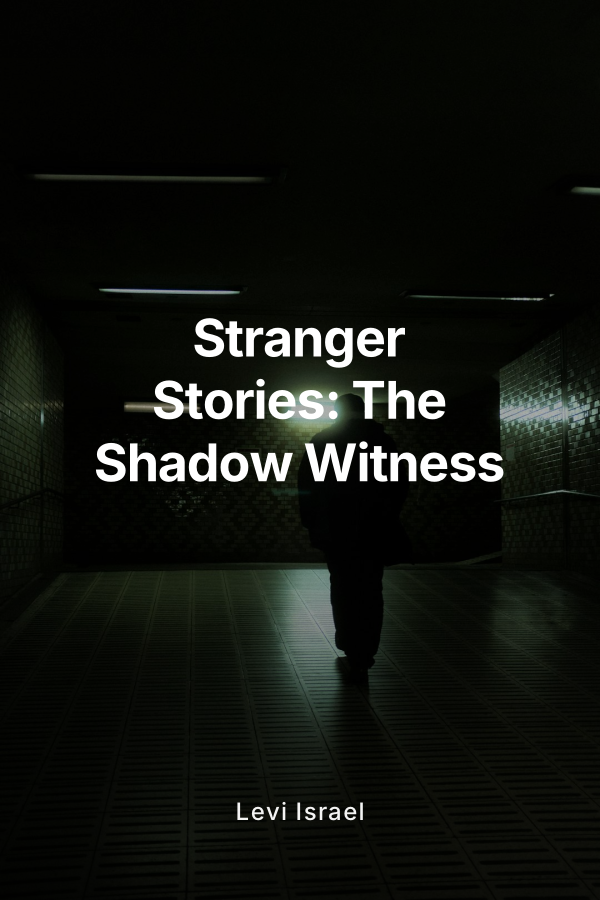
This book is a fast, relentless thriller that runs in parallel to a familiar saga but from a new, terrifying angle. It follows a single unknown man who sees what everyone else misses. He tracks the spreading horror across all five seasons of the original story, always on the edge of canon events, never changing them in any major way, but brushing so close that the monsters, portals, and shadows begin to recognize him. You asked for suspense, terror, and sharp flashes of dark, nervous humor, all while keeping the core storyline intact and only adding subtle “butterfly effect” moments and eerie connections.
The series is structured as five interconnected seasons inside one book, with each of the five chapters mapping to a season of the original show. Every chapter is its own contained nightmare, yet each one pushes the man deeper into a secret war no one knows he is fighting. Throughout, the tone stays tight and cinematic. Scenes come in sharp bursts. Tension never fully releases. When humor appears, it is the shaky, involuntary laugh that slips out right after you almost die.
Core Premise
In a quiet town, a nameless man lives an ordinary, forgettable life. He is lonely but observant. He walks at night because he cannot sleep. That habit dooms him. One night, he is in the woods when he sees a boy on a bicycle vanish into thin air. A gate closes on empty air. Reality seals over something that was never supposed to exist. The boy is gone. The man is still there. He becomes the sole witness to a new kind of nightmare.
From that moment, the story never lets him go. He shadows the town’s descent into horror from the margins. He trails the sheriff. He creeps behind emergency lights and military cordons. He follows the echo of screams into places no one should enter. He never fully steps into the spotlight, but his presence starts to leave traces. Gates shiver when he passes. Creatures hesitate. Lights flicker around him. The Upside Down notices. And it does not forget.
Across all five seasons, this man does not become a superhero or a chosen one. He stays what he was at the start. A nobody. An observer. A shadow on the edge of someone else’s story. That is what makes his fate so frightening. The darkness targets not the champions, but the witness.
Chapter One – The First Gate
Season 1 becomes a ground-level horror tale about a man who should have stayed home that night.
The book opens on his sleepless routine. Night walks. Cheap coffee. Half-finished thoughts. He wanders the woods outside town and watches life from a distance because he is too tired, too uncertain, or too damaged to step into it. That distance keeps him safe right up until the moment it kills his sense of reality.
He sees a boy, a flash of fear, a scream that does not quite have time to escape. He sees a shape that is wrong. Then the boy is gone and the air ripples, sealing shut like a wound. The bicycle falls. The gate closes. He is the only one there to see the border between worlds twitch and lock.
Shocked and desperate to make sense of what happened, he follows the ripples. They lead him toward the investigation, toward the sheriff who storms government gates and does not care who gets in his way. Our man keeps his distance but cannot help trailing behind, drawn by the raw, stubborn anger of someone who refuses to accept a child’s disappearance. When the sheriff grabs his hand and sees a faint residue, a thin trace that looks like the edge of a burned-in portal, a silent alarm goes off. The man lies. He says he saw nothing. He lets the authorities keep their version of reality.
But he does not stop.
He sneaks in behind the sheriff’s raid on the laboratory. The prose stays tight and breathless here, cutting between what the audience remembers from the original story and the new angles that only this man can see. While the sheriff pushes deeper into forbidden corridors, the man veers off and stumbles straight into the living border of the other world. He slips in and out behind them, chased by a predator that smells not just his fear but something else on him, something the first gate rubbed into his bones.
He hides for a full day in the twisted mirror of the town, hungry, shivering, and trying not to breathe as monstrosities hunt nearby. He witnesses a horde of creatures racing after another demon that drags a small figure through the dark. He cannot save the boy. He barely saves himself.
Back in the real town, he thinks he can finally report what he knows, but every time he tries, something stops him. A power outage. A sudden chill. A sense that speaking about the other side will invite it in. He instead becomes a stalker of the weird. He stands outside a house as its lights flicker in impossible patterns. He watches a monster claw through a wall while a girl screams inside, fleeing with her friends. He runs again, because that is what he does best. Survive, barely.
His escape turns worse. He falls through a hidden opening, dragged by winged things that look like diseased bats. They haul him through multiple unstable gates, dropping him finally into an abyss that exists between all worlds. Time slips. He wanders the void for days, finding memory fragments and spectral echoes. The abyss becomes the first hint that what is happening in Hawkins is only one symptom of a much bigger infection.
He claws his way back through a stray gate and crashes into the woods again, changed. The air feels wrong now. Lights stutter when he passes. In the final pages of Chapter One, he stumbles on a cabin in the woods and peers through a window. Inside, a girl with shaved hair and haunted eyes is using a power that bends the world. He feels the Upside Down strain, react, recoil. The season ends on a cliffhanger image. The girl’s nose bleeding. The cabin shaking. The man outside, unseen, with one thought burning through his mind.
He did not just see a gate. He was seen by whatever lives behind it.
Chapter Two – What Came Back
Chapter Two tracks with the second season, but now the man is no longer just a spectator. He is marked.
The story opens after the events of the first book. The man survives, but his life is shattered. He suffers brutal cold flashes that come without warning. Electricity malfunctions when he walks into a room. Streetlights pop. Radios hiss with broken whispers. A single image dominates his sleep. Red lightning over Hawkins. Something huge watching the town from a storm of ash. He does not know it, but this is the same looming intelligence that now circles a boy who made it back from the first season’s nightmare.
On Halloween, he is drawn toward the outskirts of town as if pulled on invisible strings. There, he witnesses reality twist. He sees the sky overlay the Upside Down for a heartbeat. A colossal outline stretches across the clouds, tendrils curling down toward a boy in the field. Everyone else sees a seizure. The man sees a test. The entity does not just hurt the boy. It passes through him and marks him. The same icy brush slips across the man’s mind, brief and probing, as if running a hand over glass to see how thick it is.
The book shifts into cat and mouse. The mouse is not the boy. The mouse is the man.
He hunts anomalies across town. Dead vegetation. Animals fleeing. Frozen breath on warm nights. Through windows and from alleys, he watches a family crumble under the weight of something they cannot name. He sees a second silhouette overlapping the boy’s body during an attack. For the first time, he understands a hard truth that the others will only fully face later. The boy did not just see the monster. The monster got inside.
Curiosity drives him underground. He sneaks near the reactivated lab and catches glimpses of terrified scientists speaking about tunnels that do not obey gravity, geology, or logic. He follows a maintenance crew and discovers one of those tunnels himself. It beats like a heart. Breathes like lungs. The walls are sticky and pulsing. He is stuck between panic and fascination, whispering grim, nervous jokes to himself because if he does not, he will start screaming and never stop.
In the tunnels, he meets new predators. Smaller, faster, but working together. Demo-dogs. They rush past him without attacking, as if he is not meat, not target, but tagged as something else. The realization hits him like a physical blow. The creatures recognize him. Not as ally. Not as friend. As familiar.
He endures shared visions when the boy’s possession peaks. The entity touches the boy’s mind and brushes his at the same time, using the boy as a primary host and the man as backup, test subject, contingency. He sees the Upside Down from above. Storms of red. A massive shape moving, turning once to look straight at him across impossible distance. He wakes with blood pouring from his nose and his ears roaring. Something tested his limits and backed off. He is not viable for full takeover. That does not mean he is safe.
As the lab falls and the tunnels erupt, he nearly dies underground, trapped in collapsing corridors of living matter while soldiers are ripped apart in the distance. He crawls free only to be caught in the psychic aftershock when the girl from the cabin closes the gate. He falls into the space between.
There, in a zone of memory fragments and drifting shadows, he watches the gate seal from the wrong side. For the rest of the town, this is a victory. For him, it is a door slamming on the wrong person. Months later, he finds himself unstuck, existing like a ghost near Hawkins. He can see the kids dance at a school event. He can see the looming shadow form above the building. He understands, with sick clarity, that the enemy did not lose. It learned. And it learned about him.
Chapter Three – Echoes in the Neon
The third chapter drags the man back into a town that thinks the worst is over.
He reappears in his own life like a missing person who simply walks home. No one asks where he went. No one notices how thin he has become. Reality adjusts around him because the true violence of what happened occurred in his mind, his perceptions, his connection to the in-between.
Now the infection spreads more quietly. He feels flickers of the Upside Down around static-filled televisions, neon lights, and radio towers. The town busies itself with malls and fireworks, but he sees mold on the underside of the dream. This chapter leans hard into paranoia thriller energy. While the familiar story escalates in the background, he tracks a more invisible danger. Subtle experiments. Strange shipments. People whose eyes do not quite focus right, as if listening to a faraway voice.
His sensitivity is now a curse and a tool. The entities cannot fully control him, but their influence leaks around the edges. He hears distant screams no one else reacts to. He catches reflections of things behind him that vanish when he turns. The book uses these moments for razor-edged humor at times. A muttered “nope” at a bathroom mirror that will not stop fogging in cold patterns. A panicked sprint away from a mannequin that seemed to breathe. The laughter is tight and bitter, but it breaks the most suffocating dread just enough to keep the reader going.
He crosses paths with new players. Foreign agents. Ruthless officials. People who see Hawkins as a battlefield or a laboratory rather than a home. To them he looks like a paranoid drifter, but something in his eyes makes them uneasy. He knows too much and cannot prove any of it.
At the same time, the deeper intelligence on the other side uses the chaos of the season’s events to run more experiments on him. Dreams intensify. He sees himself from an outside angle, as if the Upside Down is rehearsing how to wear his shape if it ever finds a way to hollow him out.
By the end of Chapter Three, the town survives another round of horror, but the man understands a crucial evolution. The threat is learning subtlety. It is moving from brute-force monsters toward psychological warfare and precision. And it keeps circling him as a test case.
Chapter Four – Songs in the Dark
Chapter Four mirrors the fourth season, pushing the threat into the realm of memory and guilt.
Here, the man’s long history of watching without interfering comes back to haunt him. The enemy that emerges now preys on trauma, regret, and unresolved pain. That makes him perfect prey. He has stood by, half-hidden, as children were taken, people were hurt, and worlds were ripped open. He told himself he was just trying to survive. Now the new presence digs its claws into that excuse.
This chapter unfolds as a psychological siege. Nightmares become more intricate and personal. The man sees the people he could not save. The kid on the bike. The screaming girl at the wall. Strangers pulled under by the tunnels. They accuse him without words. The book uses sharp, rapid scenes of surreal horror. Limbs twisting at wrong angles. Gravity shifting. Rooms stretching into endless hallways lined with televisions all replaying his worst moments.
Through it all, the humor nearly dies out, which is intentional. When it does appear, it is broken and raw. A gasped, half-mad comment to a hallucinated monster. A desperate joke about therapy as he flees visions that want to crush his mind. The reader feels how thin his control has become.
He learns that the mind behind the Upside Down and this new tormentor are connected. They have been watching him since that first night in the woods, cataloging his reactions, filing away his weak points. He is no longer just a bystander to someone else’s war. He is being tailored into something. Not a soldier. Not a hero. A bridge.
The known events of this season blaze in the background like a house fire. Bodies levitate. Bones snap. A song becomes a lifeline for other characters. For the man, sound works differently. Snatches of radio static, broken songs, humming fluorescent lights become tools he uses to drown out the whispers drilling into his skull. This chapter leans hard into claustrophobic tension, as both the enemy and the man claw through the same mental battlefield.
By the end of this section, he has not defeated anything. But he has done something the enemy did not expect. He resists. Not because he is strong, but because he is stubborn, tired, and furious at being used. That resistance leaves scars on both sides. The enemy knows now that brute pressure will not crack him alone. It must change tactics one last time.
Chapter Five – The Last Witness
The final chapter aligns with the fifth and biggest confrontation. Everything the man has seen, endured, and half-understood comes to a head. The town prepares for a war it can barely name. He prepares for something worse. A reckoning with the simple truth that witness has a cost.
The scale explodes. Gates tear open like wounds across Hawkins. Reality buckles. The Upside Down is no longer a hidden dimension but an invading landscape. The man walks streets split between two worlds, seeing every layered horror in full color. Ash falls where others see snow. Tendrils brush his shoulders as he pushes past people who do not feel a thing.
He is no leader. No one gathers behind him. He does not stand at the front lines. Instead, he does what he has always done. He moves through the cracks, the blind spots, the unguarded corridors no one thinks to watch. That is exactly why he matters. In those cracks, the enemy has been setting its most delicate traps. He sees them. He sees the places where reality is thinnest, where another town might collapse without anyone even knowing why.
The suspense in this chapter comes from constant near-collisions. He narrowly avoids crossing paths with the main heroes at key moments, always a room away, a street away, a heartbeat away from finally being seen. Each time, something diverts him. Falling debris. A shifting gate. A creature steering him away. The reader knows these are not accidents. The enemy is curating his route, keeping him in the shadows until the right moment.
At the climax, when the last major battle rages and the town’s fate hangs in the balance, the man is pulled into a deeper confrontation. The intelligence behind the Upside Down, the architect of the mind-storms and psychic tortures, finally reveals its full attention. It shows him a world where he never walked into the woods. Where he never saw the bike fall. Where he never became a factor. In that world, different people die. Different victories are won and lost.
The enemy makes an offer that is not spoken aloud but felt. Step out of the pattern. Let reality reconfigure without him. Erase the witness. In return, the storm may break a little softer.
The man refuses. Not with a speech, not with a grand gesture, but with a simple, terrified choice. He keeps watching. He keeps remembering. He stays. That act, small on the surface, has consequences in the in-between. The enemy’s calculations depend on erasing anomalies. He has become the biggest one.
The closing pages keep the tension sharp until the very end. The known heroes win or lose their battles in familiar ways, but threaded through those outcomes is the subtle influence of all the times the man’s presence made a gate tremble or a creature hesitate without knowing why. The book never breaks canon. It only fills the negative space with a single stubborn life.
In the final scene, after the dust has settled, he walks through a town that will never understand what he gave up. Lights still flicker around him, but less violently. The air still chills now and then, but the cold does not reach his bones the way it once did. The Upside Down is not gone. It never will be. It has retreated, wounded, rethinking.
He stands at the edge of the woods where it all started and looks into the dark. For once, the dark does not look back. Not openly.
He laughs, short and humorless, at the thought that he spent five seasons as a ghost in someone else’s legend. Then he turns and walks away, not toward peace, but toward a fragile normal life he knows will never fully feel real again.
The book ends with a single, unsettling certainty.
The world survived because its heroes fought.
It stayed honest because one man watched.