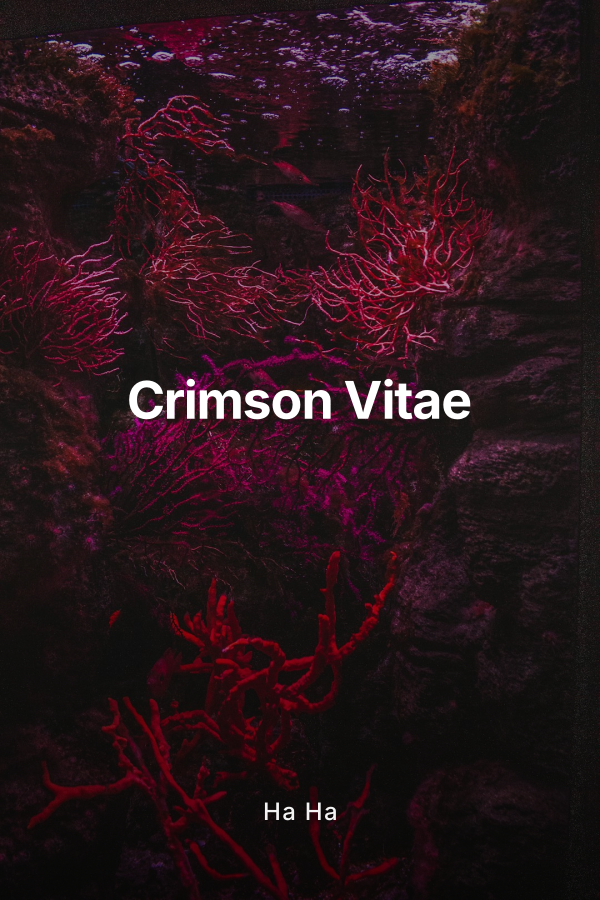
This standalone adult dark urban fantasy follows Eirwen, a former top-tier trainee hero turned living weapon, and Cassian, the wealthy, foul-mouthed “prince” of the city whose life she is hired to protect. It blends superhuman action, brutal emotional stakes, graphic attraction mostly through Cassian’s perspective, and a morally fraught world where the same power that saves a city nearly destroys it.
The city itself is a modern, slightly futuristic metropolis scarred by past superhuman conflicts and ruled, on paper, by Aegis Concord, a centralized hero organization whose mandate is public safety at any cost. Its branches specialize in elite protection, frontline combat, and surveillance plus containment, using runic technology and high‑security cells to cage unstable or rogue powered individuals like Eirwen becomes. Yet in the shadows, Vaelor, a failed hero and embittered ex-classmate, rises as a crime lord with a hidden bunker and a personal militia known as the Fangs, tightening his grip on the underworld through fear, calculated brutality, and a dry, mocking sense of humor.
At the core of the book is Eirwen’s transformation from disciplined trainee into the feared “Crimson Predator,” and then into a controversial public hero whose existence forces the city to confront what it truly believes about power, monstrosity, and redemption. Alongside her stands Cassian, who begins as a privileged client shielded by Aegis’s Crown Guard and ends as the one person willing to stake his life, reputation, and sanity on the belief that Eirwen is more than the monster everyone claims she is. Their relationship, driven by sharp banter, gallows humor, and Cassian’s increasingly graphic inner life, threads through the entire narrative as a counterweight to the story’s violence, political maneuvering, and psychological tension.
The story opens with a city already on edge. Civilians live under constant surveillance and rumor, aware that a single uncontrolled powered incident could level a block. Aegis Concord’s officers are trained to choose tactics over sentiment, and the public reveres branded heroes while quietly fearing what happens when they lose control. Into this fraught climate steps Eirwen, serving in her old identity as Shard: a masked, rigidly disciplined bodyguard assigned to Cassian, the charming, infuriating heir who masks trauma and responsibility behind jokes, arrogance, and music gigs in dim city bars. At first, Cassian views her as a professional asset, a faceless weapon he pays to keep him alive, while privately resenting how much he relies on someone who never even reacts to his presence.
Everything shifts the night an assassin ambushes Cassian in a park. Eirwen intercepts with clinical precision, but the fight is fierce enough that her helmet is knocked off. For the first time, Cassian sees the woman behind the mask: silver hair, sharp eyes, and a presence that hits him in the chest like a physical blow. That glimpse is enough to flip his perception from distant admiration to visceral, bewildered interest. When she quietly tells him her real name, “Eirwen,” that single moment seeds the attraction and obsession that will shape much of the novel’s emotional core.
In the shadows, Vaelor watches. Once Eirwen’s classmate and rival at the hero academy, he has rewritten every moment she outperformed or refused him into a personal narrative of betrayal. In his mind, she stole the future that should have been his. Her emergence as something more than human confirms his worst fears and deepest cravings. He begins to see her not as a person but as a force he is entitled to claim and control, a living rebuttal to the system that cast him aside. His fixation is about ownership and domination, not sexuality, laced with sardonic humor and the brittle pride of a man who still insists he was meant to be a hero.
As Cassian and Eirwen settle into a tense routine under the same roof, cracks form in her armor. Inside the privacy of Cassian’s mansion, she slowly begins removing her helmet, allowing herself, for the first time in years, to exist as Eirwen instead of Shard. Cassian responds with an uneasy mix of teasing banter, clumsy attempts at respect, and an increasingly filthy imagination he never lets reach the surface. Domestic quiet becomes dangerous: a knee brushing his leg on the couch, the way she stretches after patrol, or the casual intimacy of her watching him play music in a bar. Outwardly, he stays careful; inwardly, his thoughts veer into detailed fantasies of pinning her, holding her down, and claiming what he wants, fantasies that terrify him precisely because they feel too easy to act on.
The first real breach between desire and control arrives in a dream. Cassian, half asleep, finds himself in a graphic, confusing scenario where Eirwen approaches without armor, touches him with an ease and hunger that matches his darkest wants, and lets him take control in a way he has never allowed himself in waking life. He pins her wrists, feels her yield under him, and rides a wave of pure, greedy possessiveness before jerking awake, sweating and ashamed. The dream contaminates his perception: every glance at Eirwen the next morning overlays fantasy on reality, turning casual contact into torture and making him hyperaware of how much power he would have if he ever stopped holding himself back.
Before either can address the tension, Vaelor makes his first decisive move. A faked message lures Eirwen to an abandoned warehouse, where he has built an ice-rimmed trap designed specifically for her mind and training. Surrounded by creeping frost and illusions, she is restrained, frozen into a helpless tableau of power denied. Vaelor’s parting act is a cold, possessive kiss meant to brand her as his even as he leaves her broken. Cassian arrives too late, forced to carry her shattered body through empty streets while screaming for help in a city that no longer trusts its heroes. It is there he meets Silas Morvane, a dangerous, clinical figure who offers a solution none of them fully understand: infusing Eirwen with the Crimson Vitae, a volatile source of power that can save her life at the cost of turning her into something new. Cassian consents, barely conscious, his last awareness the sound of her screaming as the Vitae takes hold.
Eirwen’s awakening marks the true beginning of the book’s monster arc. She rises from the hospital bed with red eyes that pulse, wounds that seal in seconds, and reflexes that blur her into near invisibility. Every motion carries predatory grace and coiled potential, yet her voice remains calm, her posture deceptively human. The Crimson Vitae amplifies her confidence and playfulness, loosening the restraint that once defined her. She tests her new edge in small ways at first: stopping a street assault with horrifying efficiency while Cassian watches, stunned, as her blood disappears and her strength borders on brutal.
At home, this new Eirwen begins to tease Cassian about how much he watches her, and she initiates physically charged moments that walk the line between mutual desire and dangerous loss of control. One night she climbs onto him, eyes glowing, testing both his restraint and her own. Cassian’s fantasies roar to life. He wants to flip her, pin her, and take exactly what his dream promised, but the sight of her sharpened teeth and the volatile red in her gaze forces him to confront just how far he might go and what that could unleash in her. In a conscious act of self-preservation and respect, he breaks her hold, pushes her away, and steps back from the brink, even as his entire body protests.
Neither of them gets a chance to fully process the encounter before disaster strikes in public. During a routine protection detail, Eirwen intercepts a skilled attacker, only to have her helmet knocked off in front of a crowd. The Crimson Vitae surges. Her eyes blaze, her teeth lengthen, and she kills the assailant with shocking, efficient violence. Civilians scream. Someone films it. Within hours, the city knows the name “Crimson Predator,” and Eirwen becomes a symbol of everything people fear about uncontained power.
Aegis Concord reacts with ruthless predictability. Eirwen is restrained and locked in a harsh, chaotic containment facility designed to suppress powered individuals. There, surrounded by unstable inmates and constant conditioning, her thoughts begin to fracture. She questions why she is caged while weaker, more reckless people walk free, and the Crimson Vitae whispers that she should break the world that dared imprison her. The organization’s scientists warn Cassian that her control may never return, and that loving her may mean accepting that she is more weapon than woman.
Years pass. Seven of them. Eirwen becomes an urban legend from inside her cell, and Vaelor ascends, building his Fangs into a force that terrorizes neighborhoods and erodes Aegis’s grip on the city. When a high-level Fangs raid finally forces Aegis to deploy their most dangerous asset, they release Eirwen from containment under strict runic restraint crafted by Silas. She obliterates Vaelor’s men with terrifying ease, then hunts down a fleeing target and kills him before the control rune can fully settle. In the aftermath, Cassian recognizes her in the chaos, calling her name across a battlefield that has forgotten she ever existed.
That encounter fractures both their lives. Cassian returns to his mansion shaken, confessing to his confidante Lysandra that Eirwen is alive but altered beyond recognition. Lysandra becomes a quiet support, understanding that his grief and loyalty are far from resolved. Eirwen, unable to reconcile her confinement with the raw power crackling inside her, shatters her restraints, pockets the damaged rune, and escapes into the city. Wanted posters go up. Drones comb the rooftops. She disappears into an abandoned warehouse that becomes both hideout and emotional sanctuary, a symbol of the life she might have had if she had not been turned into a weapon.
From here, the book intensifies its alternating-perspective structure. Each major emotional beat shifts into the mind of whoever owns the moment: Eirwen when the Crimson Vitae claws at her self-control, Cassian when desire and fear collide, Vaelor when the illusion of heroic entitlement curdles into vindictive obsession. Short, clearly signaled POV segments let readers feel the same scene’s impact from radically different interiors: Cassian’s shame after a fantasy, Eirwen’s horror at realizing how close she came to killing him in bed, Vaelor’s satisfaction at orchestrating public panic around the Crimson Predator.
Vaelor’s rise culminates in his boldest act: kidnapping Cassian to drag Eirwen out of hiding. He positions himself as the architect of the city’s terror, taunting both Cassian’s “Prince” status and the myth of noble heroism while treating Eirwen as the apex predator he believes he helped create. The confrontation forces Aegis to work with the very woman they once locked away. They restore Eirwen’s full Shard suit and helmet, assemble heroes from all branches, and treat her less as a colleague and more as a barely controlled missile they can aim at Vaelor’s heart.
On a rooftop above a public square, Eirwen prepares for the final battle. Helmet in hand, rune in her pocket, she remembers training drills, containment nights, Cassian’s hesitant confessions, and the moments she almost surrendered fully to the Crimson Vitae. Below, Cassian waits, bound but defiant, trusting that if anyone can cut through the city’s terror and Vaelor’s schemes, it is the same woman he once watched sip coffee so carefully in his kitchen.
The ensuing clash erupts into a citywide war. Eirwen drops into the square, engaging Vaelor with surgical restraint at first, gauging his enhanced frost powers while trying not to lose control. He responds with escalating force, unleashing both his own abilities and waves of Fangs soldiers into the crowd. Aegis heroes join, turning the plaza into a battlefield watched from apartments, street corners, and news drones. Cassian slips free in the chaos and fights beside her, but every second she spends protecting him, civilians, and herself from Aegis’s triggers stretches her to the limit.
At a breaking point, Eirwen realizes the rune she carries is holding her back more than it is keeping her safe. Destroying it would let the Crimson Vitae off its chain and make her strong enough to end Vaelor once and for all, but it could also turn her into the uncontrollable monster everyone already believes she is. In a conscious, terrifying act of agency, she crushes the rune and unleashes her full power. Time seems to tilt. She moves too fast for eyes or cameras to track, strikes hard enough to shatter reinforced walls, and anticipates attacks before they begin. Her teeth and eyes blaze, her instincts flare, and for a moment she becomes the very image of the Crimson Predator people fear.
Vaelor, cornered and outmatched, triggers a last-resort explosion meant to annihilate them both and leave nothing but a crater where the city’s terror once stood. Fire and shockwaves consume the square. From a distance, citizens watch as both figures vanish in light. No bodies are found. The official line is clear: Eirwen and Vaelor are gone, destroyed together. Aegis, the media, and the public rush to memorialize the event, building statues and planning ceremonies that simultaneously mourn a lost hero and close the book on an uncomfortable chapter of superhuman history.
Three months later, at a grand memorial, the city gathers to grieve and mythologize. A towering statue of Shard dominates the plaza, recasting Eirwen as a sanitized heroic figure. Cassian stands among dignitaries, outwardly composed, inwardly hollowed by unresolved grief, guilt, and all the words he never spoke. As speeches end and the crowd quiets, a familiar figure appears: hood down, a streak of red in her hair, eyes no longer blazing but still unmistakably hers. Eirwen has survived. She steps into the light, rune now permanently anchored to her arm in a configuration that suppresses catastrophic loss of control without erasing her abilities.
Cassian’s reaction is instinctive. He reaches her in front of everyone and kisses her, not as a bodyguard, not as a weapon, but as the woman he has chosen again and again despite every rational reason to walk away. The crowd gasps, then surges into applause. In that public, unscripted moment, the city finally chooses acceptance over fear. The Crimson Predator story gives way to that of Eirwen, the hero who survived being caged, weaponized, and vilified, and still chose to stand between civilians and destruction.
By the end, Vaelor is dead, his Fangs dismantled, and Aegis forced to reckon with its treatment of those it labels unstable. Eirwen is no longer hunted or imprisoned. The city knows her full history and, for the first time, sees her humanity alongside her monstrosity. Cassian and Eirwen walk away together into a future that is uncertain, still haunted by trauma, but finally theirs to define. Memorials and statues remain, yet the real legacy of the Crimson Vitae resides in the uneasy but genuine trust that begins to grow between superhumans and civilians, and in the understanding that the line between hero and monster was never about power alone.
Across five chapters and roughly ten thousand words, the book will trace this full arc: from professional distance to incendiary intimacy, from hidden obsessions in a bunker to public battles under a thousand cameras, from containment cells to rooftop choices, and ultimately from the myth of the Crimson Predator to the reality of a flawed, frightening, fiercely human woman who saves a city even as it tries to decide what she deserves. The tone remains unapologetically adult, with foul language, crude but character-grounded humor, and graphic sexual tension seen primarily through Cassian’s conflicted eyes, all framed by a world that treats power as both salvation and threat.