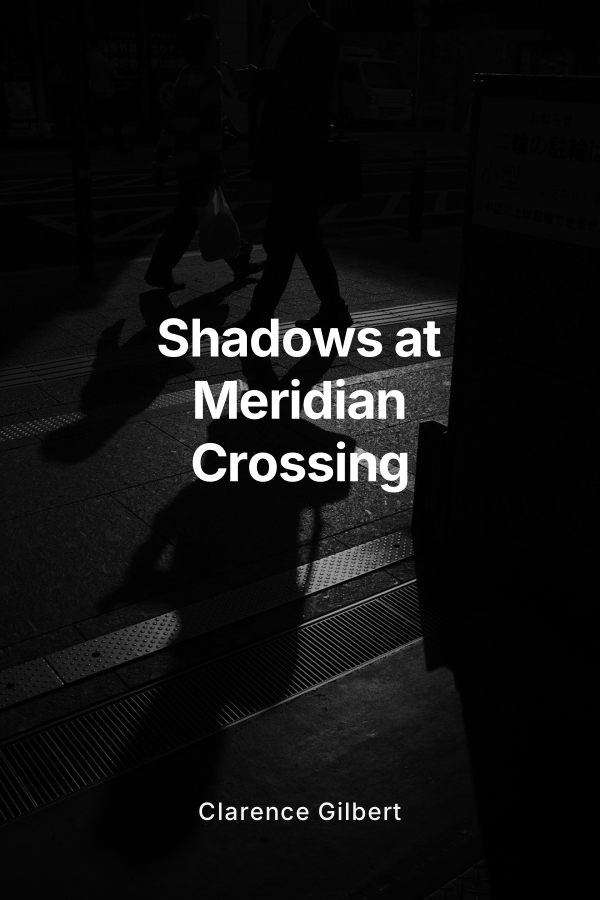
This book is a character driven mystery about the invisible grief, unspoken loyalties, and quietly desperate bargains that hold a small community together long after a crime is forgotten by everyone except those who were marked by it. Set in the aging river town of Meridian Crossing, the story explores the fracture lines between memory and denial, justice and survival, and the thin line between protecting the people you love and becoming the very danger you fear.
Told over two tightly woven chapters, the book follows a single pivotal week in which a long dormant case is abruptly pulled back into the light, forcing each of the main characters to choose which truth they are willing to live with.
At the center is Mara Ellison, a thirty something archivist who has quietly returned to Meridian Crossing after a public career failure she refuses to explain. She takes a job in the municipal records office on the assumption that paper cannot hurt her, only to discover that the town’s past has been misfiled on purpose. In the course of digitizing old reports, she uncovers a misnumbered box that contains fragments of an investigation everyone claims never existed: witness statements that trail off mid sentence, photographs with missing timestamps, and the partial case file of a teenager who vanished fifteen years earlier on a rain swept night near the riverfront rail yard.
That teenager, Jonah Rios, is not a stranger to her. He was the first person who ever taught her how to leave Meridian Crossing in her mind. He is also the only person whose last known conversation with him belongs to her alone. Mara has spent her adult life carefully not thinking about that night or the fight they had in the arcade behind the old laundromat. Confronted with the incomplete file, she realizes that whatever everyone else decided to forget, her name should be somewhere in those papers and is not.
The missing file cracks open the first of several silences that structure the town. Meridian Crossing is portrayed as a place that learned, slowly and painfully, to keep secrets as a survival strategy. The river redirected, the factories closed, and each economic blow was answered with another round of polite denial in which everyone agreed that nothing important had changed. Now, the same older generation insists that Jonah ran away, that teenagers will do what teenagers do, and that dredging up the past is a cruelty to those who have chosen to heal.
Mara’s decision to quietly reconstruct the case in private pulls the story forward. She disassembles the archive like a puzzle, cross checking utility logs against school attendance records, reading between the lines of budget meetings and noise complaints. This investigative work is quiet and methodical rather than sensational, and it mirrors the larger theme of how ordinary documents, casual habits, and half remembered conversations create the real record a town lives by.
Other key figures orbit her search. Chief Aaron Kline, who took over the police department years after Jonah’s disappearance, carries the slow burn frustration of someone who inherited broken systems he did not design. He has built a career on incremental reform rather than heroic gestures, cultivating the trust of people who never used to call the police at all. When Mara privately confronts him with the broken chain of evidence and questions about who signed off on closing the investigation, he must decide if reopening a case his department technically never handled is worth the risk of destroying what little faith the community has begun to place in him.
Alongside him is Lila Rios, Jonah’s younger sister, whose life has narrowed into quiet routines and the lingering conviction that she is the only one still paying attention. She works at the town’s only twenty four hour grocery, tracks the names of every teenager who comes in after midnight, and maintains a dog eared notebook of weather patterns and anniversaries. To Lila, the idea that Mara has found something substantial is both vindication and a new wound. She is wary of Mara’s return, suspicious of her motives, and yet drawn to the possibility that this time someone will not leave when the answers turn ugly.
The book’s atmosphere leans into the understated tension of small town familiarity, where everyone knows pieces of everyone else’s history but has silently agreed to let crucial details slide out of view. Each scene introduces small, concrete signals of this culture of selective memory: a street that locals still refuse to walk after dark, a mural depicting a community event that never actually happened, a diner that keeps a table permanently “out of order” where an old crowd used to sit.
As Mara follows the paper trail, she notices a recurring pattern in the documents. Certain names appear again and again at key points in budget allocations, property transfers, and enforcement decisions. One of those names belongs to Elias Ward, an influential council member whose public persona is built on pragmatic optimism and who quietly controls which subjects are acceptable to raise at town meetings. Another belongs to a retired rail supervisor, Mr. Chambers, who is living alone near the defunct yard. To everyone else he is a relic of the town’s industrial past, difficult but harmless. The documents suggest that his reports and complaints from the time of Jonah’s disappearance were noted, then consistently sidelined.
Chapter 1 traces how Mara’s private curiosity becomes a collective strain. She begins with the pragmatic hope that she can quietly hand over what she has found, let the right authorities act, and return to her neutral life in the stacks. Each conversation she has with current and former town officials makes that hope less realistic. Some are polite and dismissive. Others are sympathetic but constrained by obligations, family ties, or debts that were never written down. A pattern of accidental negligence slowly begins to look more deliberate.
Part of the book’s power lies in its refusal to offer a single villain. Instead, it portrays a network of small concessions and rationalizations that culminated in a choice: to label Jonah as a runaway rather than a victim because the town already felt too fragile to survive another public crisis. People convinced themselves that they had no influence, that the system would not change anyway, or that someone else would step forward if real harm had been done. Over time, that belief solidified into a story that everyone could live with, even if it meant excluding certain voices, including Mara’s, from the official record.
Mara herself is not written as a flawless investigator. Her own reasons for returning to town and for initially avoiding Lila are gradually revealed as part of the larger theme of what it costs to see yourself clearly within a community that remembers your childhood, your worst decisions, and your most desperate moments. Her relationship to Jonah, once a mixture of admiration, rivalry, and an unspoken possibility of more, is revisited not in idealized flashbacks but in sharp, embarrassing moments of teenage pride and fear.
Chapter 2 escalates the internal and external conflicts rather than merely resolving the questions raised. The discovery of a single missing file triggers a cascade of consequences. Someone begins leaving anonymous notes in the records office suggesting that Mara has misinterpreted what she has found. A locked cabinet she was told held duplicate forms instead contains audio tapes with no labels, each holding brief, muffled segments of conversations that seem to be from around the same year Jonah disappeared. The tapes introduce new names and suggest that the night he vanished intersected with a minor industrial accident that was officially reported as non injurious.
As Mara, Kline, and Lila begin to cross reference the old tapes with the incomplete written record, they find discrepancies that cannot be explained as clerical error. Certain timestamps conflict, and details remembered by a few older residents do not appear anywhere in the public file. It becomes clear that someone at the time made a choice about which narrative would be allowed to enter the permanent record.
The emotional core of the book shifts from “What happened to Jonah?” to “What do we do now that we know how we failed him?” That shift is what gives the story its resonance. Rather than a clean detective arc in which facts alone provide closure, the characters must confront what accountability looks like years after the moment for decisive action has passed.
Mara must decide whether to risk destroying what is left of her relationship with her parents, who are entangled in the story in quieter ways than she suspected. Kline, faced with the limits of institutional reform, must choose between preserving his hard won legitimacy or publicly acknowledging that his department stands on a foundation of manipulated history. Lila, finally armed with something more than intuition, must decide whether exposing the past will give her back a piece of her brother or fix him permanently in the most painful version of his story.
The town itself is treated almost as a character, with its rhythms, rumors, and rituals shaping how people respond. A hastily assembled public meeting about “archival discrepancies” becomes the stage for long deferred confrontations. Neighbors who shared casseroles and church pews during the original search quietly confess what they saw and chose to forget. Elderly residents who are not on social media and rarely attend official events arrive anyway, as if pulled by the realization that this might be the last chance to redirect how the story of Meridian Crossing will be told.
Throughout, the book keeps its focus on subtle, human scale choices. There is no dramatic unmasking in a storm or final confession shouted across a barricade. Instead, the truth emerges as overlapping narratives that contradict and partially confirm one another. The final picture is complicated and uncomfortable: an accident that might have been prevented, a chain of authority more concerned with liability than safety, a group of teenagers whose loyalty to each other did not extend to trusting any adult with the worst of what they knew.
By the time the central mystery is clarified, the story has already shifted to its deeper concern: how people learn to live with knowledge that damages the myths that once held them together. The conclusion leans into pragmatic consequences. Old zoning decisions are revisited. The rail yard, long an eyesore, is finally fenced properly and slated for conversion into a public space with a memorial that acknowledges what happened without reducing Jonah to a symbol. Some officials resign quietly rather than face a drawn out inquiry. Others stay, now openly tied to a scandal that will mark their legacies.
For the main characters, the ending offers a form of earned ambiguity rather than simple catharsis. Mara accepts that returning to Meridian Crossing has changed her permanently. Her failure in her previous career, once the defining shame of her identity, now feels smaller in the shadow of what she has helped uncover. She understands that the skills that made her effective elsewhere, her obsession with record keeping and pattern recognition, are both gifts and burdens in a place that has preferred not to look too closely at itself.
Lila is given space to be more than the sister of the missing boy. She is portrayed in the final pages as someone negotiating her own future, weighing the prospect of leaving Meridian Crossing against the pull of the only place where people understand her grief without explanation. Her bond with Mara, once brittle and suspicious, becomes a fragile alliance grounded in shared anger and reluctant hope.
Kline finishes the book neither vindicated nor ruined. He is shown sitting alone in his office after the last official statement has been given, re reading the original incomplete report and the newly reconstructed file side by side. He understands that his legacy will be judged by what he chooses to do after the cameras leave, in the months and years when attention has shifted elsewhere. The book leaves him at the threshold of that long term work rather than awarding him a quick redemption.
Throughout both chapters, the narrative voice remains clear and restrained, allowing the reader to feel the slow accretion of pressure rather than pushing toward spectacle. The town’s physical spaces, from the echoing stacks of the records office to the neglected rail yard and the fluorescent hum of the grocery store at 3 a.m., serve as constant reminders that the past is not an abstraction but something built into walls, routines, and local habits of speech.
The intended audience for this book includes readers who appreciate literary mysteries that dwell more on motive, consequence, and communal responsibility than on twist heavy plotting. It is for those interested in how institutions quietly fail particular people, how those failures are rationalized, and what it takes to name them without resorting to easy moral binaries. The tone remains grounded and contemplative, treating its characters with empathy even when they make choices that are hard to forgive.
Ultimately, "Shadows at Meridian Crossing" is about what happens when a community is finally forced to see itself as it truly is, stripped of the comforting fictions that allowed it to endure. It argues that the real turning point in any old case is not when the last fact is uncovered, but when someone decides that knowing obligates them to act differently, even when it is too late to save the person they failed. The book ends not with certainty, but with a fragile new honesty, suggesting that this, and not perfect resolution, is the most meaningful form of justice the living can offer the dead.