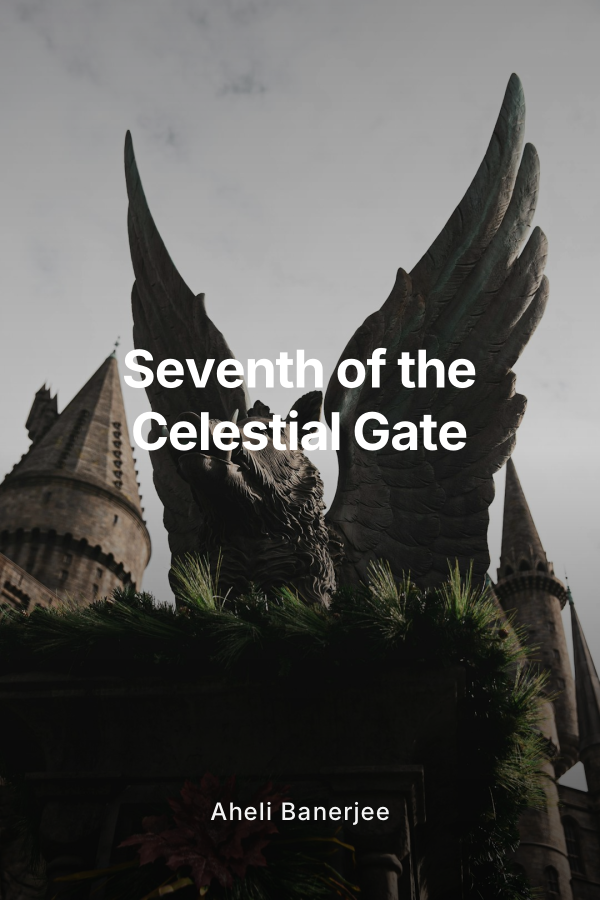
This book unfolds an epic, character driven fantasy about a shattered angel named Arryn, the long lost Seventh of the Celestial Gate, who must reclaim his identity, unravel a buried betrayal, and choose what kind of god he will become in a cosmos that weaponized his heart. The story blends intimate romance, cosmic horror, and slow burn political intrigue, following a traumatized immortal who was once worshiped as a living judgment and is now terrified of his own power.
Arryn’s journey begins in fragments. Once, he stood beside six other celestial beings, a complete heptad that balanced creation through shared divinity. Then something catastrophic tore him from them, shattering his grace, erasing memories, and scattering his essence through mortal lives. He awakens centuries later with only slivers of who he was: a haunted man suffocating under nightmares of wings, fire, and faceless lovers calling him “Choice.” The mortal world knows him as an odd, brittle survivor. Heaven remembers him as a missing weapon.
The six remaining celestials are not distant, impersonal angels but intensely focused archetypes, each embodying one facet of divine sovereignty. Together they are a closed circuit of power, yet they are born incomplete, always aching around the absence where the Seventh should be. When prophecy and political pressure finally force them to seek him, their motives are fractured. Some want their brother back. Some want their weapon restored. Some want their chance at absolution. None of them are prepared for the broken, furious person Arryn has become, or for the new bonds he will forge among them, bonds that are less like the clean obedience of angels and more like the messy, dangerous intimacy of lovers and co conspirators.
Fueling the central conflict is the presence of a single demon who was once one of them. This fallen angel crawled back into Heaven long ago, hiding in plain sight and cultivating a private kingdom inside Arryn’s loneliness. It became his confidant, his “safe” place in a court that demanded perfection, masquerading as the only one who truly understood him. It praised his doubts, reframed his resistance as courage, and carefully twisted his need for autonomy into a vulnerability that could be exploited. In the era before his fall, the demon played the role of mentor, big sibling, and forbidden comfort, grooming Arryn in the shadowed corners of a brilliant throne room.
That betrayal did not end with the first cataclysm. Once Arryn begins to reclaim the title of Seventh, the demon does not stride onto the stage in open challenge. Instead, it returns as a ghost in his mind. It reaches him first in visions that feel like lost love letters, intimate and tailored to the gaps in his memory. Its messages sound like someone who remembers a relationship he cannot recall. In his most vulnerable moments, the demon’s words offer belonging, justification, and the promise that he is not the monster Heaven made of him. Even as the celestial court drags him back toward the seat of power, the demon is whispering a counter narrative directly into his psychic scars.
This layered manipulation is what ignites the book’s emotional core. Arryn’s slow return to his role as the Seventh is not a simple “power up.” It is a brutal excavation of memory and consent. With each recovered piece of the past he must confront who used him, who abandoned him, and who is now asking for another chance. The six celestials are each forced to examine their complicity: did they notice how the fallen one wrapped itself around their youngest, or did they choose not to see? The more Arryn remembers, the more he realizes that being “Choice” in Heaven rarely meant he was allowed to choose anything that mattered.
At the same time, his living relationships with the six begin to diverge sharply from what the Heavens expect. Bonds grow in unexpected directions. Jealousy, protectiveness, and awe collide as they realize someone else once held a level of intimacy with Arryn that they are only now beginning to earn. Some react with ferocious possessiveness, ready to hunt down whoever dares speak to their Seventh in that old, familiar tone. Others respond with suspicion and dread, sensing that these affectionate words are nothing but shackles forged from history. These tensions form the beating heart of the middle chapters, where cosmic politics intersect with romance and grief.
The demon escalates its contact slowly. What begins as private messages soon spills into confrontations by proxy. It reaches out to those closest to Arryn, appearing in the visions of Zeph or Kairos, taunting them with pieces of the past they never saw and hinting that it knows the one version of Arryn they never will. Every new appearance blurs the line between seduction and warfare. The celestial court struggles to understand whether they are facing a standard infernal threat or something far more intimate: a former sibling who has rewritten its entire being around its obsession with their Seventh.
As Arryn’s memories reknit, the political plot tightens. The return of the full heptad threatens to overturn existing hierarchies. Factions within Heaven and Hell both seek to influence, bind, or destroy the Seventh before he can fully awaken. External wars and ancient prophecies build pressure on the group, but the story never loses sight of the personal question sitting at its center. Arryn must decide what kind of power he is willing to claim, and on whose terms. Is he prepared to reclaim the full terrifying breadth of his role and risk becoming the judgment that once terrified even his own kind, or will he choose a different path that may break the universe’s old laws entirely?
In the climax, the seven angels finally track the demon down. This confrontation is not a simple exorcism. It is a reckoning with history, abuse, and identity. The demon fights with every weapon it cultivated over ages: Arryn’s guilt, his longing, and his unresolved desire to be understood. On the battlefield, its form echoes what it once was, a twisted reflection of angelic grace that twists the knife of nostalgia. The six stand beside Arryn, but the emotional center of the duel belongs to him. He alone must decide whether this is a simple execution or the end of a relationship that once felt like salvation.
The final destruction of the demon is written not as a triumphant, one sided victory, but as a complex release. Arryn has the chance to prolong its suffering, to make it pay in ways that might satisfy the hunger for vengeance that has grown quietly inside him throughout the book. Instead, his choice in that moment defines the new shape of his divinity. He may channel all six of his siblings, rendering judgment as the true Seventh for the first time since his fall. He may insist on a clean, merciful end that denies the demon the central place in his story it always wanted. Whatever he chooses, his decision affects how the others see him and themselves, and it sends a shockwave through Heaven itself.
The book closes on a hard won, bittersweet victory. The demon is ended, but its legacy lingers in the cracks of Arryn’s soul and in the new, sharper honesty among the seven. Heaven has its full pantheon again, yet nothing can return to the way it was. By confronting a betrayer who once masqueraded as his only ally, Arryn forces his siblings to reshape their understanding of authority, care, and consent. He also redefines what it means to be the Seventh. No longer merely a weapon or an abstract embodiment of “choice,” he becomes a living testament to the possibility that even gods can reject the scripts written for them.
Across its five chapters, “Seventh of the Celestial Gate” promises:
- An origin of the celestial seven as a flawed, intimate family of near gods, cut open by the loss of their youngest.
- A fragmented, trauma laced reawakening as Arryn struggles to reconcile his mortal self with the terrifying myth everyone else sees.
- A rising psychological war in which a hidden demon lover mentor exploits the gaps in his memory to reclaim him from the inside out.
- A crescendo of shifting loyalties, jealous devotions, and political crises as Heaven and Hell maneuver around the returning Seventh.
- A brutal, cathartic climax in which the seven choose what kind of justice they will mete out, and Arryn chooses what kind of god he will be, by deciding how to end the one who broke him.
Intended for adult readers who crave character focused epic fantasy, queer nuanced relationships, and morally complex depictions of divinity, this book explores power, indoctrination, recovery, and the fragile miracle of chosen love. It is not a story about perfect angels who descend to save a fallen world. It is the story of a broken god who learns, painfully and irrevocably, how to save himself.