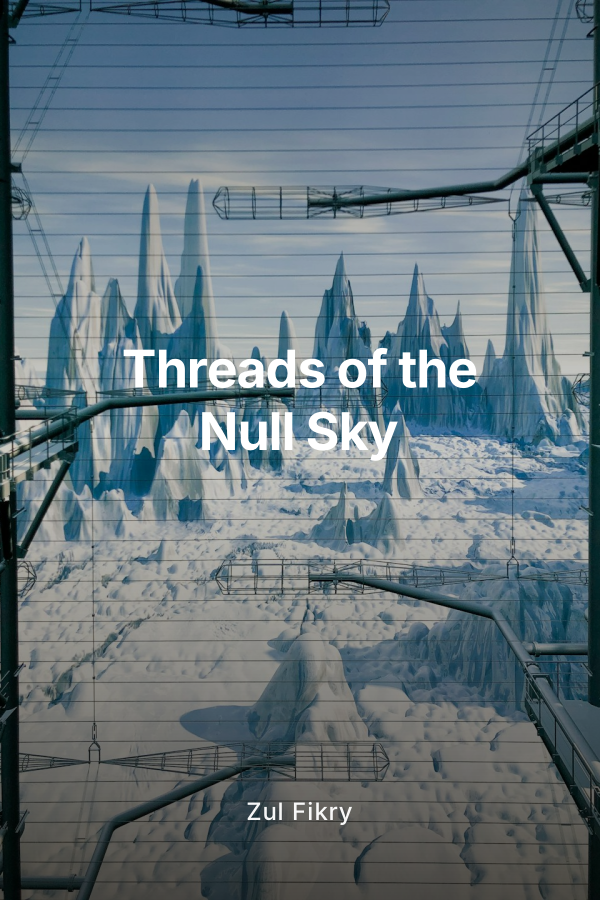
In a universe where everything that lives is bound to a luminous thread, there is a single boy who should not exist.
His name is Nox.
He awakens beneath a sky woven with strands of living light. Every star is a knot. Every destiny a bright filament stretching from birth to a vanishing point beyond sight. The night does not hold constellations but vast, shifting designs that resemble indecipherable runes, as if the cosmos itself were a loom forever weaving and unweaving reality.
Nox has no thread.
The world calls such beings Null Types, spoken of only in old, fearful whisper. Legends insist that Null Types are calamities in human shape, voids that unravel the tapestry of existence. Yet Nox remembers nothing of his origin. No past, no family, no purpose. Only a faint ache in his chest where a thread should be, and the cold, unnerving awareness that the sky does not recognize him.
Far above all worlds drifts Loom, an unseen, ineffable intelligence that tends the strands of fate. Loom does not speak to the living. It adjusts, balances, amputates. When a thread tangles, Loom cuts. When a life disrupts the pattern, Loom erases.
Until Nox appears, and the pattern shudders.
The first time Loom notices him, it is not with words but with omission. Threads twist around Nox and yet never touch him. Futures collapse nearby, destinies seize and convulse, entire villages fall into silence for a heartbeat each time he draws breath. Loom responds with what it understands best: correction.
Correction takes the shape of Hunters.
They are not quite human. Their bodies are inhabited by darkened strands, skin veined with liquid starlight, eyes reflecting the sky’s shifting script. They follow orders whispered from beyond the atmosphere, receiving visions of silhouettes that must be removed from the weave. This time, their target is something their threads cannot anchor, cannot classify, cannot even fully see.
They are sent to cut nothing.
Nox’s first encounter with the Hunters becomes the quiet spark of rebellion. Cornered in a dead forest where every tree bears the faint echo of severed lives, Nox meets Kiris, a girl whose thread is bound to his absence.
Kiris is the only soul whose fate-line behaves differently near Nox. Instead of recoiling, her silver thread wavers, then coils around his shadow, glimmering with strange, forbidden patterns. When Loom’s attention sharpens on the anomaly, the Hunters descend. They carry shears of glassy star-metal that sing when they cut threads, blades meant to prune fate itself.
Kiris should die that day.
Her thread is marked to end. The shears arc toward her life-line, guided by visions sent from the upper firmament. Yet within the instant of her destined death, Nox reaches out. Not with a blade, not with sorcery, but with the simple, impossible fact of his nonexistence. Her thread passes through his hand and frays into countless strands, refusing to sever. The pattern jolts. Loom’s sight fractures for a heartbeat.
Kiris lives.
In that stolen heartbeat, something fundamental alters. The Loomed sky quivers, patterns breaking into static, runes disassembling and reconstituting into new, violently unsanctioned shapes. Hunters twitch as their guiding strings tangle and misalign. Far above, Loom has to recalculate the tapestry.
Nox has performed the one act no one should be able to perform. He has denied Loom an outcome.
From that moment, survival becomes treason.
The early chapters of the saga follow Nox and Kiris as they flee through war-scarred borderlands, plague-empty towns, and ruined sanctuaries where threads hang like cobwebs that no body remains to claim. The world is more graveyard than kingdom, every abandoned village a testament to the precision with which Loom prunes its design. Children speak nursery rhymes about the “Sky Hand” that plucks unwanted lives away in the night.
The deeper they travel, the more Nox learns what it means to be Null.
In cities where priests read destinies from the sky, he feels like a stain on a sacred tapestry. Oracles convulse in his presence, their prophecies shredding into senseless murmurs. Fate-maps show blank soil where he stands, as if someone had burned a hole through the page. To those who serve Loom, Nox is not human. He is a wound.
Yet around him, something new begins to grow.
Threads near Nox jitter, stutter, and sometimes slip their ordained paths. A condemned mother survives her appointed execution. A child fated to drown suddenly clings to a shattered plank the sea was supposed to claim. Each tiny deviation ripples out, faint but stubborn. Nox’s absence from the pattern does not simply erase. It corrupts, complicates, invites possibility where none should exist.
The rebellion does not begin with banners or armies. It begins with tiny, unapproved choices.
Nox never wanted to lead anything. His only desire is to exist, to breathe in a universe that insists he is an error. Kiris, bound to the luminous coil of her own thread, sees further. In the quiet hours when their campfire light stains the undersides of low clouds, she speaks of her visions. Her thread sometimes splits at the edges, generating phantom futures around Nox that Loom cannot stabilize.
In those fever-dream possibilities, she sees a world where no sky-weaver dictates who must perish. She sees humans walking beneath a dark, unthreaded sky of simple stars.
She calls it the Null Dawn.
Nox calls it impossible. But the idea takes root in him, as stubborn as he is.
Each arc of the long saga carries them to a different realm shaped by Loom’s distant governance. In the rain-sunk lowlands, they encounter miners whose threads are short and brutally taut, knotted in ways that ensure they die young for the stability of distant cities. In the frost kingdoms, they meet a royal line whose bloodline is kept artificially long, their threads reinforced by sacrificial cuts to the lives of their subjects.
In the hushed monasteries of the Inner Reach, blind monks trace the sky’s weavings with calloused fingers, mapping the secret history of Loom’s corrections. Here Nox glimpses the scale of the universe’s cruelty. Whole civilizations have been cropped out of existence, forgotten because Loom decided their trajectories threatened the harmony of the grand design.
Nox and Kiris rarely win open battles. The Hunters adapt, arriving in greater numbers, guided now by blackened, reinforced strands. Each time Nox survives, Loom learns. Each failed attempt to cut him is absorbed into the pattern as data, translated into more refined methods of erasure. Survival only sharpens the enemy.
Yet with every escape, Nox and Kiris meet more of the broken and the outraged, those whose lives bear the scars of Loom’s decisions. A father whose child simply vanished from his arms mid-breath. A warrior forced to live long past his natural span, his thread anchored to a war no longer remembered. A seer whose voice was taken the day she foresaw a future Loom did not approve.
They do not see themselves as soldiers. They are the leftovers of a merciless arithmetic. Still, they gather around the Null boy and the girl whose thread will not cut. Whispers spread along caravan routes and through the undercellars of markets. There is a rumor that the sky has made a mistake and that mistake is still walking.
As the rebellion swells, mystery clings stubbornly to its heart.
What is Loom?
Some say it is the last remnant of a god who refused to die, clinging to order as its only remaining instinct. Others claim Loom is a machine built by a forgotten age of humans who feared randomness more than tyranny. There are older, more forbidden legends of a time before threads, when the sky was not a loom but an open, silent void. None of these stories are confirmed. The narrative allows theories to surface then recede like half-remembered dreams. Answers shimmer at the edge of revelation, only to be obscured again by a new horror, a new survival.
Nox’s nature as a Null Type deepens in complexity without fully shedding its enigma. He discovers that he can do more than disrupt threads. In moments of desperation, he can reach into the air and feel the cold texture of unspun possibility, a formless, resisting substance that is not yet destiny. When he exerts his will, tiny segments of the tapestry warp. A dead branch that should have fallen days ago clings longer to a tree. A storm tide arrives an hour late, saving those who would have been drowned.
Yet these small acts have a cost.
Each time Nox alters a thread, even by a heartbeat, Loom reacts. Skies darken to bruised purple as if the universe is holding its breath. Patterns shift violently, and new knots appear, denser, more vicious. Lives that were once simple now entangle with wars, plagues, and disasters that Loom steers into place to reassert control.
For every life Nox saves, another strand somewhere tightens into tragedy.
This is the fulcrum of his struggle. Survival is not heroic. It is messy, ambiguous, bloodied by unintended consequence. Nox’s rebellion is not the shining banner-wave of a chosen one who brings simple freedom. It is a grim, stubborn rejection of a system that claims perfection yet leaves only corpses and silence in its wake.
The more Nox sees of the tapestry, the more he suspects that Loom itself is afraid.
Null Types are not entirely unknown. Scattered records in decaying libraries and forbidden archives speak of earlier anomalies that appeared at the edges of the pattern. They never lasted. Loom adjusted, suppressed, reset. Whole epochs were rewoven, reality folded over itself so that even memory aligned with the corrected design. The sky forgot its own errors.
Nox is different. Loom cannot erase him by cutting a thread he does not have. It must find another method.
The final act of the book’s arc draws Nox and his fractured rebellion to the epicenter of the universe’s weave, a place known only in myth as the Crown Aperture. It is said that here the sky descends in curtains of blinding radiance, threads packed so densely that the air sings with the grinding of destiny. No mortal is meant to come that close to Loom’s handiwork. To step inside the Crown is to be edited out of existence.
Yet in the wake of a cataclysmic assault by Hunters grown monstrous with too many threads woven through their bodies, Nox no longer sees any other path. His survival has pushed Loom to unleash horrors that twist the corpses of cities into living, obedient knots. Whole regions fall beneath skies stitched shut, where no new births occur and every remaining life is stretched thin for the sake of stability.
To keep existing passively is to watch the universe shrink into a static, strangled tableau.
Nox and Kiris lead a final, fractured pilgrimage toward the Crown Aperture. Around them gather those who can still choose in defiance of the sky’s orders: seers who have burned out their own threads to slip Loom’s control for a few brief days, warriors who have already died once and been crudely woven back, children whose destinies were never fully inked.
The approach to the Crown is a gauntlet of raw metaphysics. Gravity snarls, memories unravel and rewind, and time dilates unevenly between one step and the next. Each traveler glimpses alternate lives they might have led, each vision a cruel temptation to fall back into the pattern’s comfort. Many do. They kneel, surrendering themselves to Loom’s sweetest illusion: safety without freedom.
Nox presses on.
At the heart of the Crown Aperture, he finally perceives Loom not as a being but as an endless, convulsing process. An intelligence encoded entirely in the movement of threads, alien in its priorities, frantically balancing equations of life and death in pursuit of an equilibrium no mortal mind could love. Loom does not hate Nox. It does not even recognize hate. It recognizes imbalance. And Nox is the purest imbalance it has ever encountered.
The climax does not provide neat answers. Nox touches the core of the weave and glimpses half-formed histories. A time when there were no threads at all and existence teetered on the brink of chaotic dissolution. A desperate choice made by something that might once have been human, or divine, or both, to bind the universe into a fabric that could be predicted, and therefore preserved.
Order as salvation. Order as prison.
Faced with the power to rip the tapestry apart or cement it forever, Nox chooses a third path that is never fully explained. He does not become Loom’s replacement, nor does he accept annihilation. Instead, he allows his Null nature to bleed into the weave, not shredding it but perforating it. Tiny gaps appear in the pattern, holes through which unbound possibility seeps.
Loom convulses. The sky spasms.
Some threads break without repair. Others knot themselves of their own accord, no longer waiting for distant guidance. Scattered lives wake to the dizzying realization that they can move in ways the sky never predicted. Wars end abruptly because commanders lose the comfort of believing that victory or defeat is already written.
Nox disappears in the explosion of untextured light.
The book concludes not with his triumphant return or explicit death but with the echo of his absence. In villages and cities and monasteries from the frost kingdoms to the rain-sunk lowlands, people look up at a sky no longer perfectly composed. Gaps in the weave reveal raw, starless darkness. In that darkness glints something new, a thin, hesitant shimmer like the first breath before speech.
Kiris stands alone on a ruined wall, her once-silver thread now frayed into countless filaments that twist and dance of their own accord. She cannot feel Loom’s pull anymore. The sky is quieter inside her mind.
She does not know where Nox has gone. She only knows that children born beneath this broken tapestry have threads that behave strangely. Some knot themselves in shapes never seen before. Some fork, diverging into soft halos of unreadable possibility. One or two, though, are different still.
They have no thread at all.
The saga’s first book ends on this image, its mysteries not solved but transformed. Loom endures in some diminished, altered capacity, still weaving yet forced to contend with holes it cannot close. The universe is no longer a flawless, suffocating design, nor is it pure chaos. It has become something fragile and volatile, a contested space between fate and its absence.
Nox’s rebellion was never about erasing destiny entirely. It was about creating room to breathe in a cosmos that feared the unknown so much it was willing to slaughter to avoid it.
Across the darkened heavens, the unthreaded patches grow slowly, like bruises or like dawn. Whether they herald salvation or catastrophe is uncertain. The book leaves readers in that uncertainty, suspended in the tension between terror and hope, where every step forward feels like an act of defiance against a sky that, for the first time in ages, is no longer sure how the story must end.