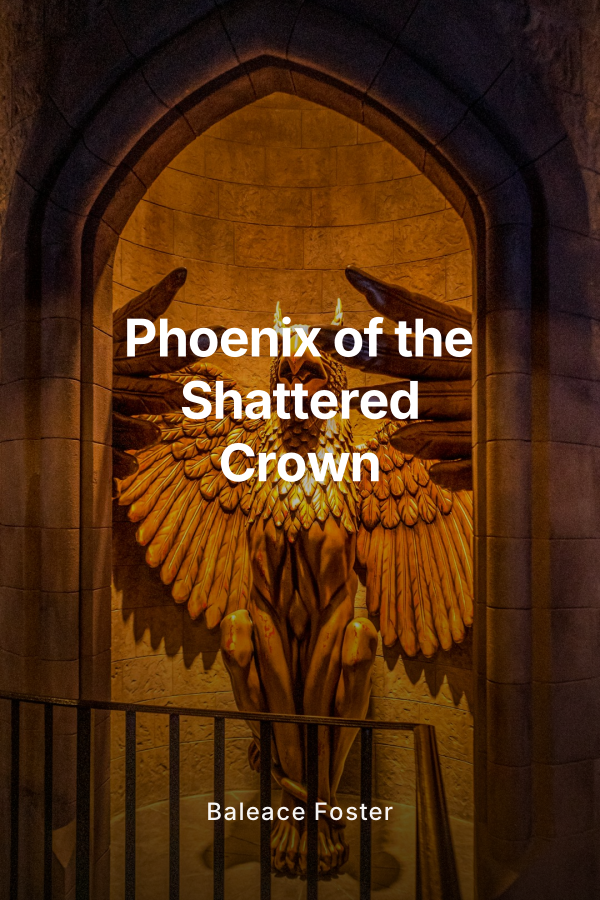
This novel follows Lyric, a fallen princess marked by a phoenix legacy, as she stands at the crossroads between two men and, more importantly, two futures that cannot coexist. On one side lies Marcus, the shelter she once craved, a man who embodies safety, loyalty, and the illusion that she can return to a life where she is protected rather than exposed. On the other stands Theron, a formidable figure who sees not the frightened princess but the blazing force she could become, and who dares to ask her to step into a shared future where she must never hide again.
At its heart, the book is not a love triangle in the conventional sense. Instead, it is the story of a woman who must decide whether she belongs to the role the world wrote for her or to the self she is still becoming. Each man represents a path. Marcus offers a harbor, a life bounded by familiar walls and gentle compromises. Theron offers open sky, terrifying altitude, and a bond that demands radical truth. Lyric is a phoenix figure whose destiny requires her to burn away the last of her innocence, her right to disappear, and the comforting lie that she can be both completely safe and fully reborn.
Chapter 1 introduces Lyric as a princess who has lost almost everything, navigating political danger and the lingering expectations of a crown that no longer fits. Marcus enters here as her steadfast defender, the one who stands beside her when the palace turns cold, the one who turns chaos into something like home. Through him, the reader understands what Lyric has always wanted: to be cherished, protected, and allowed to remain small enough to fit inside someone else’s arms. The early narrative frames Marcus as everything a cornered royal could ask for, while quietly sowing the seeds of a deeper unrest in Lyric. Even as she leans into his care, her phoenix nature stirs. The more he shelters her, the more she feels the walls of that shelter press in.
Chapter 2 complicates the illusion of safety. Marcus is framed for a crime that coils out of the shadows surrounding Lyric’s inheritance, forcing him into exile and tearing away her last semblance of stability. What could have become a straightforward enemies plot instead becomes a more haunting test of loyalty. Marcus returns at great personal risk, not to reclaim her love but to defend her when the threat against her life peaks. This is the moment that defines him. He stands in the fire once more, knowing she has already begun to slip beyond his reach. The choice he makes is not to fight for what they were but to protect who she is, then walk away. His farewell is not a dramatic declaration but an internal pivot, a private resolve to let her go romantically and to release his claim on the future they once imagined. The reader sees it in the softened way he says her name, in the slight distance he allows between them, in the unspoken blessing he leaves behind. Lyric does not fully understand it in the moment, but the audience does. He becomes a tragic almost-love whose final gift is not possession but permission: permission for her to become someone he can no longer safely hold.
Chapter 3 centers on Theron, the man who refuses to treat Lyric as fragile porcelain. Where Marcus tried to buffer her from the harshness of her fate, Theron demands she look straight into it. He is powerful, dangerous, and weary of masks. He has seen the darkest corners of their world and carries shadows of his own. Yet with Lyric, he chooses vulnerability instead of control. In the pivotal chapter 46 scene, he offers her not just his heart but the unvarnished truth of who he is and what their future will demand. He asks her to see him fully and accept him, knowing that her refusal would shatter the life he has quietly built in his imagination. The risk is not abstract. By inviting her into his real self, he endangers his emotional defenses, his carefully guarded secrets, and the vision of a shared life that has become the one thing he cannot easily replace.
In that exchange, the tone is romantic not because it is soft, but because it is raw. Theron does not promise safety. He paints a future where Lyric stands beside him as his equal, transformed and radiant, no longer hiding behind titles or fears. His love becomes an invitation to power. He shows her the contours of a life in which she owns her phoenix nature: a life where she steps into open fire and refuses to dim herself to fit anyone’s comfort. The scene is laced with tension because the reward he seeks is immense. If she accepts him as he truly is, he gains not merely her affection but a partner willing to share his vision of what they could be together. If she turns away, he loses not only her but the belief that anyone can genuinely choose the man behind his reputation. The tenderness of this moment lies in how much he is willing to place at her feet, and how much he stands to lose if she cannot bear what she sees.
Chapter 4 brings Lyric to her defining choice. By now, Marcus has stepped into the role of a completed chapter in her life. His internal resolve to let her go means that the path of safe harbor is no longer truly open, even if she tried to step backward into it. His love, once a possible future, has become a memory that taught her what it is to be held. Theron remains, not as the inevitable endgame, but as the embodiment of the path she is most afraid to walk. To choose him is not merely to choose a man. It is to choose a life where she can never again vanish into the background, where the world will know precisely how powerful she is.
Lyric’s phoenix nature comes fully to the forefront here. The climax is shaped around her acceptance that rebirth cannot coexist with perfect safety. She recognizes that to rise, she must burn the last of her hiding places. The cost is clear. By embracing her transformation, she forfeits the right to be small, to be innocuous, to be invisible. She gives up the quiet domestic dream that Marcus once represented, the pure comfort of a life lived in the lee of someone else’s strength. In exchange, she claims her own. The moment is not framed as a bitter loss but as a solemn trade: she lays down the version of herself that existed only within safe walls and steps into the self who walks through open doors without asking permission.
The book closes on Lyric’s conscious acceptance of this paradox. She cannot be both completely safe and completely reborn. Her love for Theron intertwines with that realization. She chooses him because he is aligned with her future, not because she was forced into his arms by circumstance. In the final pages, their connection is less about romantic fantasy and more about mutual recognition. He sees her as the phoenix she is, and she sees him as the man who was willing to risk everything so that she could be fully seen. Marcus remains a scar and a soft place in her memory, the measure of a gentler life she might have had. Theron becomes the partner of her ascent, the witness to the woman she ultimately chooses to be.
Throughout the novel, the tone balances emotional intensity with introspective nuance. The intended audience is readers drawn to character-driven fantasy romance where relationships are inextricable from questions of identity and destiny. The magic here is not only in Lyric’s phoenix heritage, but in the unbearable intimacy of being truly known. By the end, the love story resolves not into a neat happily ever after, but into something sharper and more honest: a woman stepping into her own power, fully aware of what it cost, and a man standing beside her who would rather lose her than ask her to be less.
This is a tale of shattered crowns and chosen flames, of a princess who discovers that the real question was never which man she would choose, but which version of herself she was willing to live with. In answering that question, Lyric does not simply survive her story. She authors it.