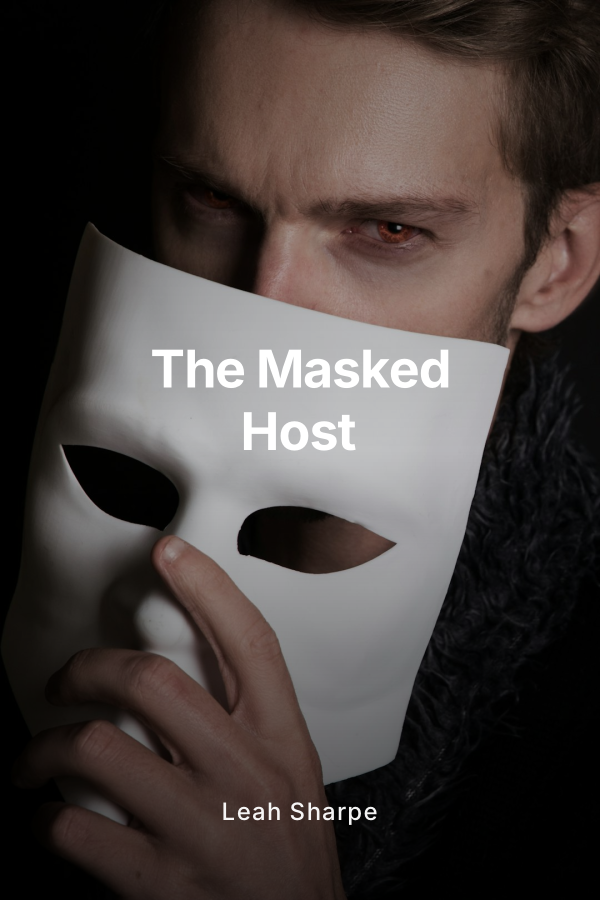
The Masked Host is a tightly wound mystery about image, obsession, and the dangerous difference between the girl the world thinks it knows and the young woman forced to outrun a killer who has seen through her disguise.
Ruby Blaze is nineteen, rich in followers but poor in real friends, the reigning “it girl” of every exclusive guest list in the city. On social media she is all glitter and champagne, the glamorous party girl who never goes home early. In private she counts exits before she counts drinks, watches faces more than fireworks, and deletes more photos than she posts. The wild, carefree Ruby is a character she performs, perfected in the mirror and amplified online.
When she is invited to an ultra private mansion party hosted by a mysterious collector known only as “The Host,” Ruby treats it as another power move for her brand. No phones allowed inside, whispered guest list, a sprawling house on the edge of the city that no one can quite pin on a map afterward. It is the kind of story her fans crave. It is also the night everything unravels.
Inside the mansion Ruby catches a glimpse of something she was never meant to see. A locked room, a girl’s shoe where no guest should be, a flicker of surveillance footage that does not match the party in progress. She stumbles on a clue that connects to Sofia, a missing girl the city has already begun to forget. One moment Ruby is weaving through velvet ropes in a borrowed gown. The next she is barefoot in a corridor, holding a detail about Sofia that could never be coincidence.
Her discovery does not go unnoticed. The house owner, always seen in a distinctive mask that turns him into his own logo, suddenly stops playing host. Music still thumps through the walls, but the party has shifted into something predatory. Ruby feels the mansion tilt against her, hallways stretching longer than they should, doors that clearly locked themselves now standing invitingly open.
When Ruby bolts, the Host breaks his carefully curated persona and chases her through the labyrinth of his own home, then out into the night and down a string of streets that blur under her running feet. The chase is fast, panicked, and ugly, the glamorous party girl stripped down to pure survival. She manages to lose him only through quick thinking and a risky detour that uses her own public image against him. By the time dawn arrives, she is the only one who knows how close the city came to its next missing girl.
The chase marks a pivot Ruby cannot undo. Fear presses in, but it does not send her back into hiding. Instead, it sharpens her. She becomes careful yet relentless. She understands that the Host will not call the police, because involving them would expose whatever he is hiding about Sofia and the other faint traces Ruby cannot stop replaying. The very fact that he chased her instead of confronting her in front of witnesses tells her everything she needs to know about his guilt.
From this moment the story follows Ruby as she quietly turns from curated chaos to controlled investigation. She begins to treat her own life as a crime board. Her clever tricks, once used to slip out of afterparties or shake off invasive fans, are repurposed into tools of deduction. She creates fake profiles to infiltrate exclusive circles that orbit the Host’s world. She starts keeping a timeline on a hidden notes app, recording every remembered face from the mansion, every suspicious interaction since, every rumor about Sofia that never quite lined up.
Ruby learns to plant conversational traps. When a fellow influencer casually mentions the mansion “theme nights,” Ruby repeats a harmless detail slightly wrong on purpose, then watches closely for any flinch of correction. When a promoter insists he has “never heard of that place,” she later sees him accidentally tag the same estate’s garden in an old, hastily deleted post. Small lies become her favorite clues. The party circuit that once fed her persona turns into her map of suspects.
But Ruby refuses to fully step into the open. She knows her image can work for her but also make her easy to discredit. If she screams about a masked man and a missing girl, it will be written off as the meltdown of a spoiled party girl seeking attention. So she moves in the space between visible and invisible, using her fame for access while masking her suspicions behind the practiced smile that made her famous.
The summary of The Masked Host tracks five rising arcs that will unfold across the full book.
Chapter 1 introduces Ruby’s dual identity. The first pages show her basking in the glow of online adoration and VIP invitations, yet privately making small, smart moves that hint she is far more observant than anyone assumes. The rare cracks appear when she sees a news snippet about Sofia, an almost forgotten local girl whose unresolved disappearance pricks at Ruby’s conscience. When the coveted invitation to the Host’s mansion arrives, we see how her team and fans push her to accept. This is billed as the next big step for her image. It is also the first real choice Ruby has to make entirely for herself. She goes, not just for clout, but because something about the event timing, the location, and Sofia’s last known movements refuses to leave her alone.
Chapter 2 focuses on the party at the mansion. The house is a character in its own right, luxurious and theatrical but full of odd restrictions. No cameras. No live posts. Guests steered subtly away from certain wings. The Host himself appears always masked, his voice smooth and rehearsed. Ruby, initially playing the part expected of her, starts noticing things that do not belong. A staff member wearing Sofia’s bracelet. A locked door with a woman’s laughter cut short behind it. A corridor where the music is muted and a faint dripping sound echoes instead. Following her instincts, she takes a wrong turn that leads her to a room that confirms her worst suspicion. Ruby realizes she holds a piece of Sofia’s story that could blow apart the entire carefully staged night.
Chapter 3 captures the immediate fallout. When the Host realizes what Ruby has seen, his composed persona cracks. The chase through the mansion is not a sleek thriller sequence but a messy, breathless scramble, lined with micro details that later become important clues: which doors are secured, which staff react, where cameras are pointed and where they are strangely absent. Ruby uses spur of the moment tricks to survive, from blending into a masked crowd to weaponizing the assumption that she is drunker and more distracted than she actually is. The pursuit spills into back alleys and unfamiliar streets until she finally slips away, cutting across routes she had memorized on ride home maps while pretending to scroll mindlessly. She escapes, but the night brands her.
Chapter 4 surveys the aftermath through a quieter, more psychological lens. Ruby is frightened, sleeping with lights on, jumping at every unfamiliar car near her building, yet she refuses to let terror erase the details in her mind. She writes everything down in a secret file. Her cleverness, once used to manage optics, now turns inward. Ruby maps the timing of shots at the bar to when certain guests vanished from sight, connects a DJ’s oddly constrained playlist to the precise moments the Host needed everyone distracted, replays the path of her own escape to guess which sections of the mansion are “public” and which belong to darker business. Outwardly she leans even harder into the party girl role, using the world’s low expectations as camouflage. Inwardly, she begins a disciplined campaign of quiet investigation across clubs, offices, and online spaces that encircle the Host’s world.
She also faces a moral problem. Every step closer she treads to Sofia’s truth increases the danger. The Host saw her face as clearly as she saw his mask. If she pulls in law enforcement without substantial proof, she risks not only being dismissed but provoking him into finishing what he started that night. The summary highlights how Ruby navigates the balance between bravery and self-preservation, transforming her instinct for self publicity into a new instinct for self protection without losing her resolve to help Sofia.
Chapter 5 brings all thematic strands together into a sharp promise without revealing the final twists. By now Ruby has identified patterns that implicate the Host in more than just one disappearance. There are other girls whose stories nearly vanished, their final sightings hovering around the same network of private events and silent estates. Through calculation and risk, Ruby edges closer to his true identity, attempting to unmask the man behind the mask not just literally but socially and financially. The more she uncovers, the more she understands how deeply appearances protect him, just as they once protected her from scrutiny.
The heart of The Masked Host lies in the evolution of Ruby herself. The world’s “glamorous party girl” becomes a strategic observer, learning to turn every careless underestimation into an advantage. Her clever tricks move from survival games at hangovers to deliberate acts of detection. She begins planting red herrings in the Host’s digital orbit, feeding him false trails through anonymous tips and staged online chatter to watch how his network reacts. Each trap yields fresh information about his methods, his fears, and the leverage he wields over those who serve him.
These choices do not come without cost. Ruby’s closest online confidants notice inconsistencies in her content, managers question her reluctance to share mansion footage they think she must have secretly taken, and potential allies prove untrustworthy. The summary hints at one semi trustable adult figure hovering at the edges, someone Ruby hesitates to involve fully but may be forced to rely on before the end. The tension lies in whether she can expose a predator who lives behind a mask without destroying the carefully managed persona that has both imprisoned and protected her.
Through misdirection, subtle clues, and a deliberate trail of logical deductions, The Masked Host offers readers a layered mystery that starts with the glitter of the party scene and peels back its darker underside. Every red carpet appearance, every DM, every throwaway joke at a bar has the potential to be signal or noise. The book invites readers to sift through the same confusion Ruby faces, deciding for themselves which seemingly glamorous details hide danger and which apparent threats are crafted illusions.
At its core, this is a story about the cost of seeing too much and the power of refusing to look away. Ruby’s sprint through the mansion and the streets beyond is only the beginning. Once she loses the man in the mask, she discovers the harder task is finding the courage and cunning to go back, figuratively if not physically, and finish what that terrified glimpse into his world began.
The Masked Host concludes its summary with one final promise. The full book will not simply reveal who the Host is. It will ask, all along the way, who Ruby chooses to become in order to unmask him, and what she is willing to sacrifice of the girl the world thinks it knows in order to save the ones the world is already forgetting.