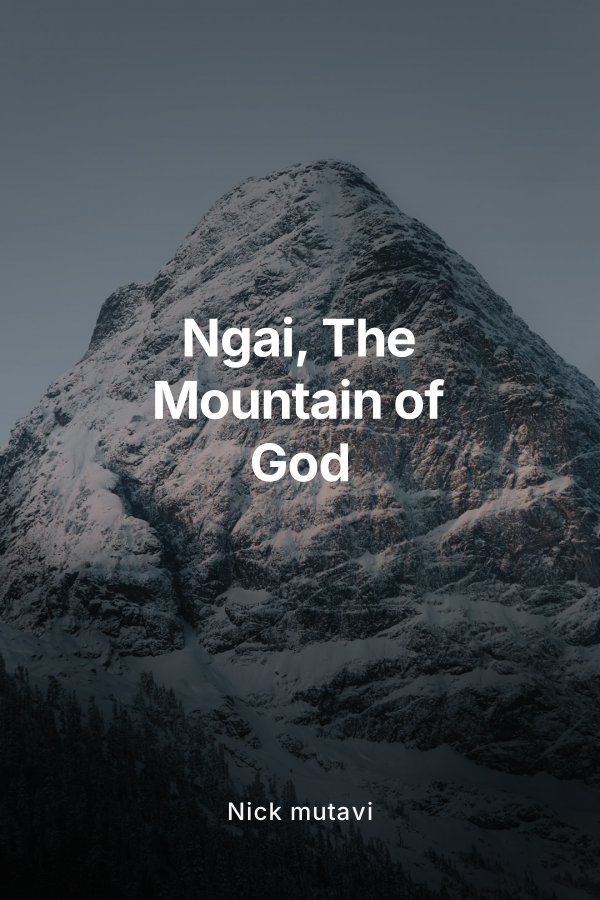
This book is an awakening in print. It invites everyday Christians, seekers of biblical truth, and lovers of Africa’s ancient landscapes to walk step by step through a bold claim: the real Mount Sinai is not on the cramped, rocky peninsula of tradition, but in the vast, volcanic heart of East Africa, at a mountain the Maasai have long called Ol Doinyo Lengai, “The Mountain of God.”
Drawing on Scripture as the ultimate “ruler” and on the land itself as a living witness, the book presents a forensic tour rather than a sentimental pilgrimage. It argues that God has already given a checklist for Sinai in the Bible water, pasture, space for a nation, a fiery quaking mountain, altars of covenant and idolatry, battlefields and sites of judgment and that any true candidate for Sinai must meet every one of these criteria on the ground. Tradition, when measured against this biblical checklist, simply cannot stand.
Instead of accepting a mountain because it feels holy or has a long-standing reputation, the reader is challenged to ask harder questions. Can a narrow, barren corner of the Sinai Peninsula sustain two to three million people and their herds for nearly a year, as the Exodus narrative requires? Where are the broad, supporting plains needed for a nation-sized encampment? Where is the active volcanic fire, the smoke like a furnace, the quaking that shook the mountain itself? And where, at its base, is there evidence for two distinct altar zones one for the covenant with the living God, and another for the Golden Calf rebellion within sight of each other?
The book answers by turning south and west, across the Red Sea, into Africa’s Serengeti ecosystem and the Great Rift Valley. Here, the story unfolds in biblical order, following the journey of Israel and using each stage as a test against the land. The argument is firm yet respectful: a true Mount Sinai must agree with God’s own requirements written in Scripture and mirrored in the stone, soil, rivers, and plains. Where tradition fails these tests, it must be laid aside, however cherished it may be.
From Wilderness of Sin to Raphidim: A Land That Matches the Story
The summary begins in the Wilderness of Sin, a landscape of thorns that mirrors the curse of Genesis and the heart of human rebellion. In this picture the book traces a band of newly freed slaves moving through a region dominated by acacia trees, a land that physically echoes the thorns and hardship bound up with sin. Through this wilderness, Israel is reborn as a nation, receiving commands in a terrain that visually reminds them of Eden’s lost obedience.
From there, the journey leads to Raphidim, “resting places” or “places of support,” where God intends to bring His people from curse into rest. The book argues that the wide, open, thorn-free plains of the Serengeti correspond precisely to this description. In the Maa language, the word Serengeti speaks of endless, spreading plains, a concept that parallels the Hebrew root behind Raphidim, with both ideas pointing to a place where the land opens up and supports life. The plains of this ecosystem already host the Great Migration of more than two million large mammals every year proof that this land can carry a vast population and their animals.
Through vivid description, the book paints the reader into the scene. You stand on a horizon that runs unbroken, in a land where herds sweep across grasslands that can feed multitudes. Israel’s need for pasture and water is not a theoretical problem applied to an inhospitable desert but a lived reality in a place that already sustains migrations of wildebeest, zebra, and other animals in staggering numbers. Suddenly, the requirement that Sinai’s region must support a nation-sized encampment feels not impossible but obvious in such a setting.
The Rock at Horeb: Water in a Thirsty Land
At Raphidim, the Bible describes Israel nearly turning on Moses for lack of water. God responds by commanding him to strike the rock at Horeb, releasing water in the sight of the elders. The book locates this miracle in a real-world setting where hydrology and Scripture align. The proposed rock stands within a landscape tied to a significant underground water system, connected to a perennial river, and shaped by erosion marks that whisper of long ages of flowing water.
Instead of picturing water bursting out of nowhere in a waterless void, the book helps the reader see a miracle that unlocks what God had already placed within the land an immense aquifer waiting beneath the surface. The power of the scene lies not only in the supernatural act but also in its rootedness in a specific geological context. The story of Israel’s testing at Massah and Meribah becomes a story you can almost touch, as you imagine standing on that very rock, watching water surge forth and a desperate people saved from death.
Timing and Rain: God’s Calendar in the Sky
Crucial to the book’s argument is timing. Exodus does not only give spiritual lessons, it gives dates. The people of Israel left Egypt on the fifteenth day of the first month, tied to the spring barley harvest and anchored to the lunar calendar. The book correlates this departure with late March or early April. From there, a journey of roughly 45 to 50 days brings Israel to the wilderness regions around late May.
In the East African setting proposed, this period aligns with the end of the rainy season and the beginning of the green months. Showers have left the Serengeti flush with fresh grass. New life has already surged through the herds during the calving season. The land is at its most generous. By the time Israel would arrive, they would meet not desolation but pastures already prepared. The book stresses that such ecological precision is more than coincidence; it reads like the signature of a God who not only directs history but arranges climate and cycles of life to meet His people at exactly the right moment.
The Fiery Mountain: A Volcano That Matches Exodus
The heart of the book is the confrontation between the biblical picture of Sinai and a living volcano that stands over the plains of northern Tanzania. Scripture speaks clearly: the mountain burned with fire up to the heart of heaven, it smoked like a furnace, and it quaked greatly. These are not metaphors for a quiet, rocky hill but the language of a mountain alive with volcanic power.
Ol Doinyo Lengai fits this description with startling accuracy. It is no dormant block of granite, but a unique, active volcano that erupts natrocarbonatite lava, a dark, fluid flow that cools to pale ash. Its eruptions send fiery fountains skyward, fill the air with dense plumes of ash and steam, and shake the ground with frequent tremors. The book describes what it would be like to stand on the plains as this mountain roars, the sky thick with smoke, the earth shuddering beneath your feet. It feels not like a distant story, but like a firsthand report of the scenes in Exodus and Deuteronomy.
Here, the argument sharpens. If God Himself described Sinai as a mountain wrapped in fire that shook violently, can any quiet hill truly qualify, however beloved by tradition? And if there is, in fact, a mountain on earth that matches this portrait feature by feature, should we not take that evidence with utmost seriousness? The reader is consistently invited to compare: which site obeys the checklist of God’s own words?
Altars at the Foot of the Mountain: Covenant and Idolatry in Stone
Once the people reach Sinai, the Bible places two altars at the base of the mountain. One is the altar of the covenant, where Moses sprinkles blood and seals Israel’s relationship with God. The other is the altar of rebellion, where the Golden Calf is raised in defiance while Moses is still on the mountain. Both, the text suggests, stand within sight of each other, embodying the stark choice between loyalty and idolatry.
The book identifies a prominent, flat rise named Oldupai as a strong candidate for Moses’ covenant altar. The site is rich in large, uncut volcanic rocks the very material specified for a holy altar and commands a sweeping view of the surrounding plains, with the fiery mountain looming behind it. It is a natural stage for a nation to gather in covenant ceremony.
Nearby, a smaller rise called Oldupai Ndogo “The small Oldupai” is proposed as the location of the Golden Calf altar. Here, the book explores the bitter irony of having the true altar of God and the pedestal of a man-made idol so close together. It delves into the skills Israel carried out of Egypt, including the metallurgy needed to fashion a golden calf around a wooden core probably a species of hardy acacia. This detail explains Moses’ later actions he burns the idol to destroy the wood, then crushes the gold and scatters it on water, forcing Israel to drink the symbol of their own sin.
Archaeological work around nearby Lake Ndutu has uncovered stone tools, charcoal deposits, and evidence of ancient craftsmanship, hinting that this has long been a place where people forged and shaped materials. While not direct evidence of the Exodus event, these discoveries help illustrate that the region carried the knowledge and resources needed for the kind of skilled idolatry described in Scripture. The book uses these details carefully, not as proof but as context, building a picture of a land that could have hosted such a momentous act of rebellion.
Judgment and the Scavengers of the Plains
The book then turns to the aftermath of the Golden Calf incident. Scripture records that about three thousand men were slain by the sword and that a further plague struck the people. But where are the bodies? In many imagined settings of Sinai, this question lingers uncomfortably.
In the Serengeti environment, the answer is soberingly simple. The ecosystem hosts dense populations of vultures, hyenas, and jackals creatures perfectly adapted to remove carcasses quickly and thoroughly. The book argues that this natural cleanup crew provides a clear, realistic explanation for the absence of mass graves while also aligning eerily with covenant warnings that disobedient Israel would find their corpses given over to the birds of the air and the beasts of the field with no one to drive them away.
The edge of the Olduvai Gorge becomes, in this telling, a kind of natural crematorium, where heat, wind, and hungry scavengers erase physical traces of judgment. The land’s ecological design deepens the theological point: rebellion carries consequences that are both spiritual and tangible, and God’s warnings are not poetic exaggerations.
The Battle of Rephidim and Jehovah Nissi
Before reaching Sinai fully, the Israelites fight the Amalekites at Rephidim. Here, the book places this battle on a broad plain near the proposed water source, a landscape capable of holding armies rather than a cramped valley. From a nearby rise, Moses, Aaron, and Hur oversee the conflict. When Moses raises the rod of God, Israel prevails; when his arms fall, the enemy advances. After victory, Moses builds an altar and names it Jehovah Nissi, “The Lord is my Banner.”
In the suggested East African location, outcrops called the Moru Kopjes offer a striking match. Their summits are known for “ringing rocks” stones that give off a metallic, bell-like tone when struck. The book imagines these sounds being used in celebration and remembrance, a physical echo of the banner-like memory of God’s deliverance. The battlefield is no longer an abstract line of text but a real plain you can stand on, with stones that sing when you strike them, just as the name Jehovah Nissi celebrates the Lord as the one raised up over His people.
Korah’s Rebellion: Judgment Written in the Ground
Later, near the same mountain, the rebellion of Korah, Dathan, and Abiram shatters the camp. The earth opens and swallows the rebels and their households, while fire from the Lord consumes the 250 men offering incense at the Tabernacle. The book uses this episode to show how precise the narrative is: two kinds of judgment, in two distinct locations, affecting different groups.
The proposed Sinai region offers geological formations that could accommodate such an event, including fissured ground and dramatic terrain changes that fit the idea of the land itself becoming the instrument of judgment. The book lays out a simple cartography of the revolt and its aftermath: the differing camps of Korah, Dathan, and Abiram, the centrality of the Tabernacle, and the paths that would have separated those whom the earth swallowed from those whom fire consumed. It argues that a truly credible Sinai must have a landscape where such a division of scenes is geographically plausible, not merely theologically interesting.
Throughout this section, the tone remains pastoral as well as investigative. The reader is invited to reflect: if God once judged rebellion by reshaping the very ground beneath people’s feet, what does that say about the seriousness of undermining His order and authority today?
The Cumulative Case: Scripture and Stone in Agreement
In its closing argument, the book pulls each strand together. The vast plains that can host a nation and sustain its animals. The sheltered pasturelands that match the timing of the Exodus and the rhythms of the rainy season. The hydrological systems that explain water from the rock. The burning, smoking, quaking volcano that reads like a living commentary on Exodus 19. The dual altars at the mountain’s foot, with setting, materials, and surrounding archaeology that all echo the biblical account. The battlefields, ringing rocks, scavenger-filled ecosystems, and judgment-scarred landscapes that give Korah’s rebellion and the Golden Calf story a concrete home.
The conclusion is not shouted but presented as a weighty, reasoned demand for attention. No other proposed site, the book insists, satisfies more than a small fraction of God’s own criteria for Sinai. At Ol Doinyo Lengai and its surrounding plains, the entire checklist aligns. Even the traditional Maasai and regional names hints of “Mountain of God” and meanings linked to rest, support, and even shameful blows echo themes central to the Exodus and its rebellions.
Questions for an Awakening Reader
Far from being a dry academic treatise, the book speaks directly to believers who are ready to awaken from unexamined tradition. It asks simple, penetrating questions in clear language. If the Bible gives us a detailed description of Sinai’s landscape, climate, and behavior, why would we settle for a site that matches almost none of it? If God’s timing of the Exodus aligns with the rains and pastures of East Africa, why cling to a location where such provision would be impossible without constant miracles that Scripture never mentions?
The reader is encouraged, gently but firmly, to re-examine what has been accepted for generations. Is it faithfulness to keep defending a traditional site that contradicts God’s own checklist, or is true faith the willingness to follow Scripture wherever it leads, even if it redraws our maps?
At the same time, the book invites a broader transformation of perspective. It calls the Church to see Africa not as a footnote in biblical geography, but as a central stage where God’s redemptive story unfolded in literal earth and sky. It encourages believers to trust God’s precision in timing and provision, seeing in the Great Migration, the rain cycles, and the volcanic fire a giant, natural classroom where God has written lessons of obedience, rest, and judgment into the living world.
Tone, Genre, and Audience
Ngai, The Mountain of God is written as a persuasive, investigative work of biblical geography and theology with a strong devotional undercurrent. It speaks to general Christians who want their faith anchored in reality, to those hungry for deeper insight into the Exodus, and to readers fascinated by Africa’s landscapes and cultures.
The tone is firm but respectful, passionate yet careful, blending clear teaching with vivid narrative scenes. The book uses creative expression to bring the reader to the mountain’s foot, into the plains of Raphidim, and under the shadow of the volcanic fire, while never altering the core checklist, locations, or conclusions. Every chapter aims to awaken, to persuade, and to call the reader into a more critical, Scripture-first faith that is not afraid to question human traditions when they fail God’s own test.
Across its two chapters and roughly four thousand words, the book will move from establishing the checklist and dismantling the traditional Sinai claim, to building the positive, cumulative case for Ngai, the Mountain of God, as the true Mount Sinai. At each step, it will weave in gentle moments of reflection and application, linking God’s faithfulness in the wilderness to the reader’s own journey through doubt, tradition, and renewed trust in His Word.