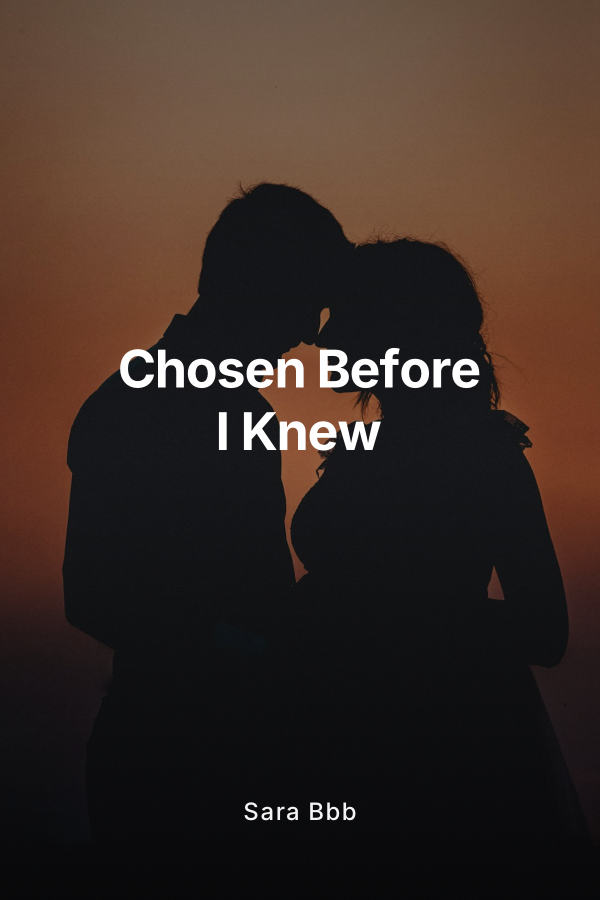
This book is a romantic, character driven fantasy set among rival High Courts, where power, politics, and desire collide. At its center is Liora, a woman whose hypersexual bravado masks a lifetime of never being any man’s first choice, and Azriel, the lethal shadowsinger who has loved her in silence, protecting her from the dark and from himself. Around them revolve two powerful foils: Helion, the radiant High Lord who glorifies her desire without asking for her heart, and Eris, the cunning Autumn heir who offers her the one thing she has never had, a public and irrevocable choice.
Across five chapters, the book traces how a private obsession becomes an irrevocable declaration, and how a woman who has always survived by being wanted must learn what it feels like to be chosen.
Chapter 1 sets the emotional ground: years of Azriel quietly altering patrol routes, changing missions, and watching from the edges of gatherings so Liora is never in true danger, even as he insists it is all “strategy.” His jealousy stays hidden behind unreadable eyes when Helion’s hands linger on her or Eris makes her laugh. Liora leans into her hypersexual persona, using it as armor in courts where women are treated as trophies or weapons, and where wanting is safer than hoping to be wanted back. Helion becomes her joyful validation, a lover who treats her desire as something holy and fun, offering light, praise, and the freedom to take control in bed, while never asking for more than the moment. Eris, in contrast, sees past the glittering surface, interrogating what lies beneath the bravado and making it clear that he is willing to stake power, titles, and a formal seat at his side on her.
Chapter 2 deepens the central triangle: Helion as sunlight and worship, Eris as steel and strategy. With Helion she explores pleasure without consequence, hearing murmured praise instead of judgment and experiencing, for the first time, a man who refuses to shame her appetite. With Eris she finds something more dangerous. He offers an official role in Autumn that would make her politically untouchable, forcing her to consider security, legacy, and the cost of finally accepting a place where she is publicly defended. Azriel watches this unfold from the shadows, his self-imposed distance becoming more and more agonizing as Liora begins to believe that being chosen first might actually be possible, just not by him. His silence hardens into its own cruelty, even as his every move is an act of covert devotion.
Chapter 3 builds to the point of no return with Eris. Under pressure from warring factions and old traumas, Liora decides that a binding future with Autumn may be the only path that does not end in her obliteration. Possibilities range from a magically sealed betrothal contract between Night and Autumn, to a formal announcement at a High Lords’ gathering proclaiming her as Eris’s consort, to a planned private pre bonding night where she intends to seal her emotional, sexual, and political future with him. In every version, she steps into Autumn colors as a visible claim, her choice painted on her skin for all courts to see. Eris proves himself by offering her not just passion but stability and a fearless public allegiance. When he warns Azriel that he will step aside for only one conversation, it underscores the real stakes: Liora’s heart, her safety, and the fragile possibility that this time, she will not be an afterthought.
Chapter 4 is Azriel’s reckoning. Forced to confront the fact that his restraint has not protected Liora but simply left her to build a life without him, he finally steps out of the shadows. His confession is not abstract longing, but a list of raw, painful receipts. He admits that he learned her routines under the guise of “security” when it was obsession, that he changed patrols and missions to keep her safe, then lied and called it tactical. He names the night he almost kissed her and fled, the moment he asked Rhys to place her in posts that would keep her sleeping within reach of his shadows. The line “I chose you before I knew” becomes a hinge for his entire arc, acknowledging that his heart had committed itself long before he allowed himself to recognize or honor it. For Liora, hearing this is both intoxicating and enraging. Choosing him now means breaking not only Eris’s heart, but her own vow to never again gamble on a man who made her his second choice.
Chapter 5 resolves the tangle of promises and self preservation. Liora must decide whether Azriel’s late truth can outweigh years of silence, whether Helion’s joyful worship and Eris’s steady offer of power are enough, or whether she can demand something fiercer: to be loved in the light as fiercely as she was guarded in the dark. The fallout of her choice ripples through Night and Autumn, reshaping alliances and exposing what each man truly values when desire collides with duty. At its heart, the ending is not about which lover she chooses, but about Liora refusing to be an echo of any man’s regret ever again. Whatever future she walks into, it is one where her hypersexuality is no longer armor but expression, and where “being chosen first” means more than a contract or a crown. It means a partner who will stand beside her publicly and privately, fully awake to the cost of that love.
Overall, the book is a slow burn, high tension fantasy romance for readers who love morally complex characters, political stakes intertwined with intimacy, and heroines who are unapologetically sexual yet aching for deeper recognition. It explores the difference between being desired and being honored, between worship that costs nothing and choice that costs everything, and asks a single piercing question: if the person who has always guarded you finally steps into the light, do you trust them enough to step toward them, even if it means setting fire to the life you built to survive without them?