In a town where monsters move through the trees and secrets sleep behind every closed door, Juliett has learned to survive by disappearing. She keeps her sleeves long, her voice quiet, and her eyes away from anything that looks like concern. The bruises at home are easy to explain. The deeper wounds inside her are not. When she transfers to Beacon Hills High, she hopes only to finish the year without attracting attention.
Stiles Stilinski has never been good at not paying attention. His brain never slows and his heart is never quiet, especially when danger circles his best friend Scott and the pack. Hyperverbal, restless, and burdened by more fear than he ever admits, Stiles lives in a constant hum of anxiety. He thinks he hides it well enough. Then Juliett walks into his life and notices every tremor he tries to bury.
The story unfolds across four sweeping chapters that trace how a frightened girl who expects betrayal and a frantic boy who expects to be too much learn to build something tender and unshakeable in the middle of chaos.
Chapter One follows the subtle beginnings of their connection. Juliett watches Stiles from the fringes of crowded hallways and late night strategy sessions, fascinated by the way he covers his worry with jokes. He sees flashes of fear in her eyes that have nothing to do with the supernatural threats closing in. A quiet friendship forms in the margins of group meetings and midnight research. When the pack faces their first new enemy with Juliett in the woods, the night tilts into terror. She ends up crouched beside a tree, hands shaking so hard she can barely breathe. Stiles, flooded with his own panic, spirals into a familiar storm of worst case scenarios.
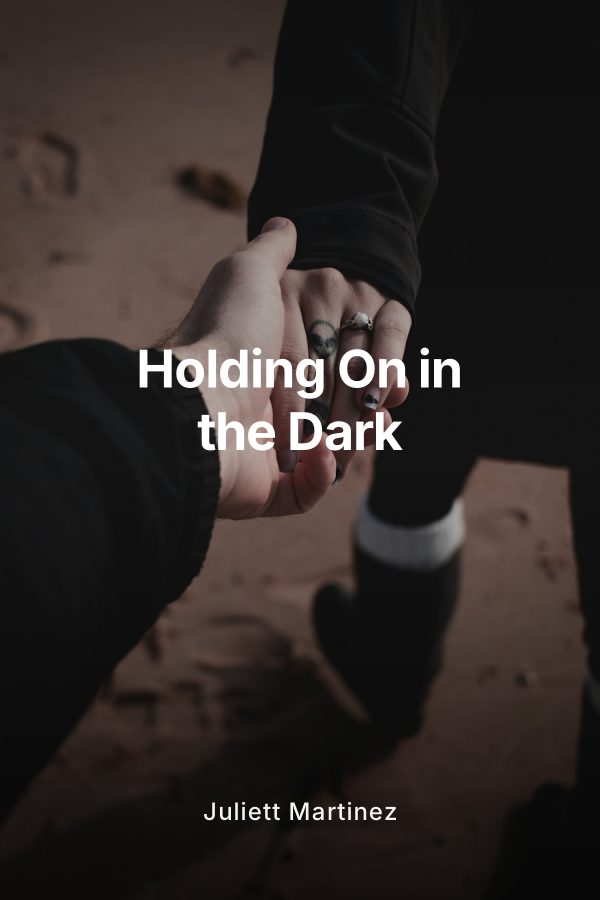
It is there, in the dark, that Juliett simply reaches for his hand.
She does not say a word. She just threads her fingers through his and holds on, steady and sure until his breathing syncs with hers. In that stolen moment, Stiles realizes she can see him clearly, every fissure and fracture he hides. He is shaken by how seen he feels and even more shaken by the gentle certainty that she might actually care. After the immediate danger passes, she keeps shaking but starts cracking jokes, deflecting the pack’s concern with a crooked smile. The others are half relieved and half astonished when she calmly walks them back through the attack, identifying patterns, missteps, and opportunities they missed. Scott and the pack call her a genius for the way she pieced the chaos together. For the first time in a long time, Juliett hears something about herself that is not “weak” or “problem.”
Chapter Two deepens both the danger and the intimacy. Stiles cannot shake the memory of her hand in his. He overanalyzes every look with Scott, dissecting every shared laugh and lingering touch, terrified that he is imagining her interest and terrified that he is not. As Juliett joins more missions, the pack begins to lean on her insight. She becomes their quiet strategist, mapping routes, anticipating enemy behavior, and designing backup plans that save them again and again. Each time they trust her judgment, a little more of the shame she carries from home begins to crack.
Yet the more she cares, the more it hurts to keep her history locked away. The bruises on her body fade faster than the memories of what caused them. After one particularly close call in the forest, Stiles sees the way her mask slips when she thinks no one is watching. He notices the flinch that has nothing to do with claws or fangs. His protectiveness surges, but he refuses to cross into control. He does not check her phone. He does not demand explanations. He simply makes sure she never walks to her car alone, stays on the phone with her on long drives, and gently reminds her that she can say no to any mission and he will back her completely.
Juliett feels the difference. She has known control disguised as concern. This is something else entirely. To prove to herself that this safety is real, she makes one quiet, terrifying decision. In Chapter Three she asks Stiles for time alone and tells him everything.
Her full disclosure shatters the fragile distance between them. Sitting in his room with the door slightly open and the lamp dimmed, Juliett talks until the words scrape her throat. She speaks of years of manipulation, of blows that landed where clothes could cover, of the way her father turned home into a battlefield. As she talks, Stiles shakes so hard he has to sit on his hands. He jokes once, weakly, just to let her know the world is not ending, then falls silent and listens. Tears burn behind his eyes but he refuses to look away from her, refuses to make her pain about his reaction.
When she finally runs out of words, Stiles asks her the single question no one has ever asked her before. What do you need from me now?
That question becomes the turning point of the book. Juliett admits that she wants to be believed, to be protected without being caged, to see her father face consequences so she can stop looking over her shoulder. Stiles promises she will never face any of it alone. He does not swear vengeance in a blaze of anger. Instead he channels his fury into action. He goes to his father, the sheriff, and gives full disclosure of his own. The scenes that follow ache with tension as law and love collide. The sheriff listens, horrified and painfully calm, then begins the painstaking work of building a legal case that could finally hold Juliett’s abuser accountable.
Throughout this chapter, intimacy grows not through grand romantic gestures but through small, sacred moments. Stiles holds Juliett’s hand in waiting rooms. He sits beside her in interviews, saying nothing unless she looks at him, ready with a steadying word or a ridiculous comment to draw out a laugh. She falls asleep on his shoulder during late night planning sessions and wakes to find a blanket tucked over her and a sticky note that reads, “You are not alone in this.” The pack rallies around her, not as a fragile victim but as the mind that has saved their lives more than once. They give her a teasing nickname that speaks to her strategic brilliance, and for the first time she starts to believe she might be more than what was done to her.
Chapter Four brings all threads together as external threats mirror the internal battles both characters must face. The supernatural danger escalates and forces Juliett into a leadership role she never imagined. When an enemy targets her specifically, hoping to break the pack by shattering its quiet strategist, Juliett has to decide whether she will retreat into old patterns of silence or step into the strength she has slowly claimed. With Stiles at her side, she chooses to fight.
Her growing confidence transforms the dynamics of every relationship she touches. She begins insisting on learning to protect herself, demanding combat training so she can stand beside the pack, not behind them. Her insistence draws a new boundary in her relationship with Stiles. She loves that he is protective, but she refuses to be wrapped in cotton and set aside. He listens, pulls back the impulses that edge toward overprotection, and learns to trust her judgment the way she has learned to trust his heart. They move from almost-accidental touches to deliberate affection, each kiss and embrace rooted in the hard-earned knowledge of what they have survived together.
When the legal case against her father reaches its climax, the fear that has shadowed Juliett’s entire life rises one final time. Courtrooms and depositions feel more daunting than any creature in the woods. Yet she walks into each one with the quiet ferocity of someone who knows she is no longer alone. The sheriff stands at her back. The pack fills the gallery seats. Stiles is the steady presence she can always find with a glance. The outcome of the case matters, but the true victory is the way she claims her story as her own. She is no longer a secret to be hidden. She is a survivor whose voice carries weight.
By the end of the book, Juliett has transformed from a girl who flinches at every raised voice to a young woman who leads strategy meetings, speaks first when danger appears, and trusts herself enough to love openly. Stiles has grown from a boy who tries to fix everything with frantic action into a partner who understands that real protection sometimes means holding space, asking the right question, and respecting the boundaries of the person you love. Together they craft a relationship built on consent, communication, and the quiet bravery of staying.
Holding On in the Dark is a romance woven through trauma, found family, and the strange comfort of fighting monsters with people who refuse to let you slip back into the shadows. It is about the first person who notices when your hands start to shake and does not look away. It is about the courage it takes to speak the ugliest truths and the tenderness of being believed. Above all, it is a story of two hearts that learn to hold each other in the worst nights the forest can offer and still find a way to joke through the shaking, to plan for a future that once felt impossible, and to believe that love can be both soft and strong enough to stand in any dark.