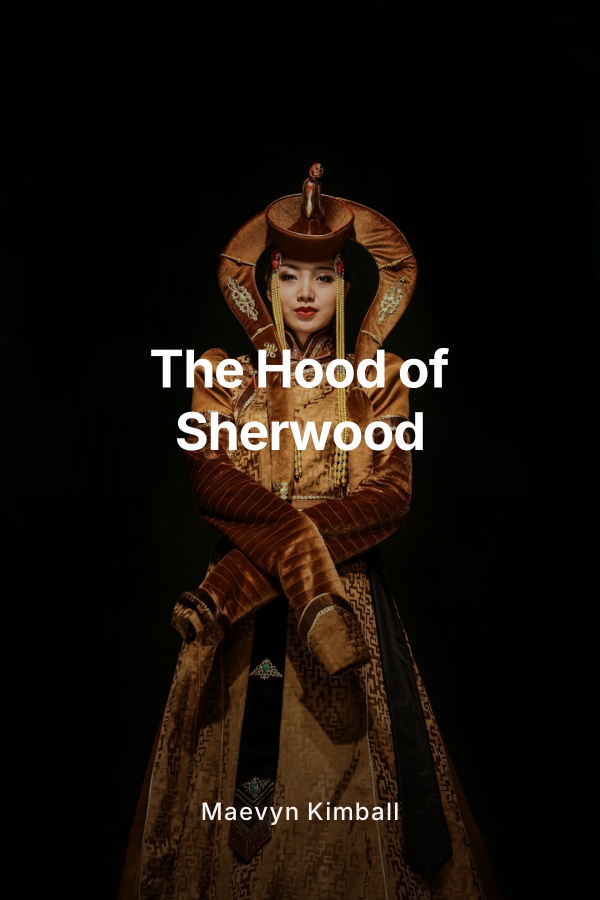
This book is a young adult novel tending toward adult themes, set in a grounded version of medieval Nottingham and Sherwood Forest with no magic. It reimagines the Robin Hood legend as the story of Lady Robin, a baron’s daughter who embraces a double life and transforms from a spiteful rebel into a selfless champion of the poor. It features a slow burn sapphic romance between Robin and her maid Mariam, who begins the story as a spy for the Sheriff of Nottingham before defecting to Robin’s side.
At roughly ten thousand words across five chapters, the book traces how Robin’s scandalous act of rebellion against her corrupt parents grows, through rumor and resistance, into the familiar legend of Robin Hood that even the nobles misunderstand and fear. Along the way, Robin must maintain her mask as a dutiful lady, oversee her family’s estate, and orchestrate daring raids against unjust taxes and cruel officials. Her carefully balanced life threatens to collapse as the Sheriff tightens his grip on Nottingham, as impostors and admirers adopt her name, and as her feelings for Mariam deepen under the shadow of deception.
Chapter 1 introduces Robin as a restless young noblewoman chafing under courtly expectations and an arranged marriage meant to secure her family’s power. Preferring trees and targets to silk and etiquette, she stumbles upon her parents’ ledgers and discovers the extent of their graft. Pushed to the brink when her marriage is set, she seizes their hidden wealth and secretly rides to the nearby villages, intending at first to embarrass her parents. Meeting the desperate poor for the first time, she witnesses starvation, fear of the Sheriff’s collectors, and families broken by debt. When one stunned villager asks her name after she distributes food and coin, she answers, “Robin,” without disguise, and that truth begins a rumor that soon mutates into the impossible idea of a folk outlaw named Robin Hood.
Chapter 2 shifts focus to Robin’s double life. In Nottingham’s halls she presents herself as the new head of the barony after engineering her parents’ downfall, all grace and harmless chatter, using the nobles’ tendency to underestimate her as a weapon. Among her household, only a young blacksmith’s son in the nearby town knows part of her secret, crafting the bows, arrows, and hooded gear she needs for her nocturnal raids. Into this fragile arrangement arrives Mariam, a quiet, competent maid who appears to be the perfect attendant. Unbeknownst to Robin, Mariam has been planted by the Sheriff, who suspects that Robin’s estate hides the mysterious Hood responsible for recent disruptions. Mariam begins her mission with dutiful resolve, gathering scraps of information for the Sheriff while learning Robin’s habits and the rhythms of the household. The chapter lays the groundwork for mutual trust, carefully seeded attraction, and the fault line of betrayal waiting beneath them.
Chapter 3 charts Robin’s evolution from clever rebel to emerging leader, and Mariam’s shift from spy to conflicted ally. As Robin targets tax caravans, rescues prisoners, and undermines corrupt bailiffs, the common people begin embellishing each exploit, turning her into a larger than life figure whose gender grows more obscured with each retelling. Ballads in taverns praise a faceless archer, wanted notices describe an outlaw no one has actually seen, and opportunists begin robbing in Robin Hood’s name for selfish gain. The Sheriff uses this confusion to justify harsher crackdowns. During these operations, Mariam is ordered to feed the Sheriff precise intelligence from within Robin’s estate. Instead, as she witnesses the misery in Sherwood’s fringe villages and sees Robin’s genuine horror at the suffering her own class caused, Mariam starts to hold back, then to twist her reports, misdirecting patrols and quietly shielding Robin. Their bond deepens through small acts of care in private: bandaging wounds, sharing stolen laughs after tense escapes, and arguments over risk that barely conceal growing affection.
Chapter 4 brings the story to its emotional and moral turning point. Robin plans her most audacious redistribution yet, using her family’s remaining hoards to relieve entire districts crushed by the Sheriff’s greed. This time she goes among the poor not as a distant benefactor but as a constant presence, seeing their gratitude and their stunned recognition that someone from the ruling class finally cares whether they live. Their thanks stirs a new conviction in her: what began as revenge against her parents must become a lasting fight for justice. At the same time, the Sheriff grows suspicious of the consistent failures of his traps and presses Mariam harder, threatening her with punishment and possibly danger to any loved ones. Torn between fear and conscience, Mariam withholds key information and ultimately feeds the Sheriff a major falsehood that saves Robin but leads to a brutal raid elsewhere, a choice that weighs heavily on both of them. When Robin learns that Mariam has been hiding a connection to the Sheriff, it sparks a painful confrontation that forces both women to lay bare their loyalties, their guilt, and the depth of their feelings. Mariam must prove her change of heart not with words but with a risky sacrifice that severs her ties to the Sheriff forever.
Chapter 5 culminates in an escalating battle for Nottingham’s soul and for the meaning of the Robin Hood legend itself. The Sheriff orchestrates a lavish noble gathering in Nottingham and a supposed amnesty for any outlaw willing to surrender, in truth a trap designed to lure the real Hood into the open. Robin, now fully embracing her role as protector of the people, uses her status as Lady of the barony to infiltrate the scheme, while her network of peasants, townsfolk, and a growing band of self chosen “Merry” followers disrupt the Sheriff’s plans across the city and Sherwood. As the myths about Robin Hood reach a fevered pitch, Robin is forced into a public choice between preserving her safety as a noblewoman and claiming responsibility for the rebellion. The climax confronts her with a costly decision: risk her title, her fortune, and perhaps her life to protect the poorest under her care, or retreat into privilege and let the legend detach from the woman who started it. The resolution sees her unmasking herself on her own terms, asserting that Robin Hood is not one man but an idea of justice anyone can carry, even as the ballads and whispers continue to twist her story into something more familiar to history. Her romance with Mariam settles into a hard won partnership, grounded in shared danger and mutual respect, and the final scenes hint at a future where Sherwood’s trees shelter not an outlaw, but a new kind of leader who chose love and courage over vengeance.
Overall, The Hood of Sherwood blends political intrigue, found family, and queer romance into a coming of age arc that reframes Robin Hood as a young woman who begins by wanting to spite her parents, yet ends by reshaping an unjust world. The book invites readers to watch how a single honest name spoken in a poor village becomes a legend, how a spy becomes a soulmate, and how a girl with a bow learns the cost and the power of choosing to be a hero.