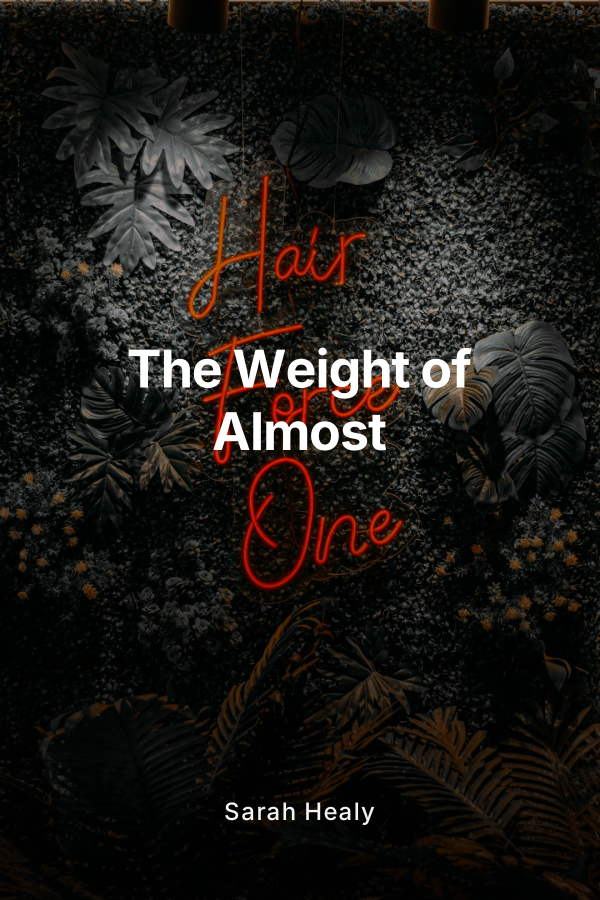
Only the first page of this book is left. We lost the rest in October 2026.
We lost access to the service that stored them, and no other copy exists. We're sorry.
This book follows a driven, perfectionistic British student from sixth form into and through university, charting how an identity built on being “the clever one” corrodes under pressure and gradually transforms into something more honest, messy, and human. Across five chapters that loosely span four academic years and an epilogue, the story explores academic burnout, high functioning anxiety, panic attacks, disordered coping, and the quiet, unglamorous work of recovery. It is written for readers who have lived inside their own heads too intensely, especially high achievers who secretly fear that any slip will reveal they were never enough in the first place.
The protagonist enters university carrying a lifetime of expectations: parents who introduce her as “our clever one,” teachers who once predicted brilliance, friends who assume she will glide to a First, and her own conviction that her worth is inseparable from grades and praise. Outwardly she appears calm, witty, and capable, quickly gaining a reputation as someone who is both clever and chilled. Inside, she is permanently braced for impact, terrified of being exposed as average. The book’s emotional core lies in that gap between perception and reality, and in the subtle ways it widens year by year.
A key relationship is with a blunt, observant rowing friend who notices what others miss: the way the heroine’s hands lock too tightly on the oar, how she goes silent after bad news, how she trains through exhaustion. This friend becomes an early mirror that something is not right, gently but insistently challenging the protagonist’s “I’m fine” script long before the eventual collapse. Parallel to this friendship is the slow burn with Will, a fellow student who initially reads her confidence at face value. His late but meaningful understanding of her inner world gives the romantic plotline its tension: their connection depends on her learning to let someone see the mess she works so hard to hide.
Each chapter deepens the portrait rather than repeating it. Early sections establish the high achiever mask and the systems that uphold it, from family pride to institutional prestige. The middle of the book tightens the screws as coursework intensifies, rowing demands escalate, and subtle symptoms of anxiety and panic shift from background noise to inescapable intrusion. The narrative shows panic both directly and obliquely, alternating between vivid episodes and quieter, anticipatory dread. By Year 3 the mask frays, culminating in a collapse that can no longer be contained or explained away. Later chapters explore the halting path through therapy, the awkwardness of accommodations, and the loss of identity when productivity can no longer be the main measure of self.
Rather than glamorising breakdown as a single cathartic moment, the book treats it as a long accumulation and an even longer unwinding. Recovery is shown not as a miraculous turnaround but a series of small negotiations: dropping a module and feeling like a failure, choosing rest over another training session, telling the truth in a tutorial for the first time, letting her rowing friend walk her home when she wants to insist she is okay. The romance with Will is written in the same quiet register, less about grand gestures and more about learning to let someone stay when she feels least impressive.
The tone is intimate and psychologically precise, grounded in sensory details of lectures, boathouses, libraries at midnight, and cramped student kitchens. Pacing moves with the academic calendar so the reader feels the repetitive yet escalating rhythm of terms, exams, summers that never quite restore her, and the slow dawning realisation that something has fundamentally shifted inside. The story speaks to anyone who has lived by grades, metrics, or other people’s expectations, and to those who love such people and do not know how to help.
Ultimately, The Weight of Almost is about what happens after the persona of “the smart one” breaks beyond repair. The epilogue lands on a quietly hopeful note: not triumphant reinvention, but a more sustainable, less performance driven way of being. The protagonist does not abandon ambition, but she renegotiates its terms, learning that courage can look like dropping out of a race, changing her mind, or sitting through a panic wave without pretending it is not there. In doing so, she discovers that her life can be driven by more than fear of falling, and that love, friendship, and self respect can exist even when she is not exceptional.